By one definition, Arabic lots are astrological factors derived through mathematical calculations involving three other factors in the horoscope, such as planets or angles. The distance between two factors is projected from a third, usually the Ascendant, to establish the position of a particular lot. This is one of astrology’s more important concepts, yet also one of its most mysterious. The lots are thought to have a closer affinity with the soul and the spiritual dimensions of human existence, and are therefore accorded deeper significance when interpreting the areas of life addressed in a natal chart. In Hellenistic astrology, they were used primarily to assign additional topics to signs and houses. For example, if the Lot of Marriage fell in Scorpio in the second house, it would give that house and its ruler certain significations relating to marriage, even though these places would not ordinarily be examined in connection with that topic. In practice, the lots could also provide a third line of enquiry when astrologers considered a particular natal topic, such as children, marriage or career. The first step would be to examine the relevant planet—for instance, Venus in matters of marriage. Next would come the appropriate house and its ruler, in this case the seventh house; finally, the third step would be to examine the relevant lot, here the Lot of Marriage. Implicit in this approach is the “rule of three”: if something concerning a particular area of life is indicated by one of these three factors, the outcome is possible; if two factors indicate the same thing, it is probable; and if all three confirm it, it is certain. By far the best-known lot is Fortune, which some call the Lot of Fate, but there are countless others, and Arabic lots may be said to have reached their fullest flowering in medieval astrological practice. The subject of this two-part study, however, is the seven Hermetic lots, with particular attention to the four that the Hellenistic astrologer Vettius Valens identifies as the most important: Fortune, already mentioned, Spirit, Eros (Love) and Necessity. These four are the subject of the second part.
Arabic lots have their origins in the Babylonian astrological account of the relationship between the Sun and Moon, expressed through the arc of longitudinal distance between them projected from the horizon. Although some argue for an Egyptian origin, it appears that, like everything in astrology, they were conceived and derived from this primordial arrangement of the two fundamental astrological factors. Despite their familiar name, the methodology of Arabic lots was developed largely within Hellenistic astrology. Arab astrologers preserved the Greek inheritance while adding many new lots to the technique. Arabic lots serve to deepen natal analysis and reveal the inner meaning of the horoscope. The seven principal Arabic lots are the lots of the soul, or pillars of the soul, derived by analogy from the seven planets of the temporal horoscope. These seven planets are associated with the Pythagorean heptad and, long before Pythagoras, with the dualistic Mithraism of ancient Persia: the Persian mysteries of sevenfold initiation leading to divinisation, and the seven stages of the soul’s fall. On its journey towards earthly embodiment, the soul passes through seven planetary spheres; after death, it ascends through them once more towards one of the four celestial gates: Aldebaran in the east, Regulus in the north, Antares in the west and Fomalhaut in the south. These are therefore known as the royal stars and guardians of the corresponding celestial quarters, or gates. Plato’s account of the soul’s fall, or descent, appears to have been inspired by the Persian mysteries. Plato speaks of an eighth sphere, the sphere of the stars or zodiac, regarded as the place where souls originate. From there, each soul on its journey towards Earth passes through the seven planetary spheres in Chaldean order, from Saturn to the Moon. During this descent, each sphere enriches the soul, endowing or blessing it with the pure essence of its particular planetary principle; these essences are corrupted to a greater or lesser degree through earthly incarnation. After death, the soul ascends in the reverse order, from the Moon to Saturn, to be purified of its earthly failings in each successive sphere, according to the nature of the failing—more on these later. As it rises through the spheres and undergoes cosmic purification, the soul becomes lighter and purer, until it enters the eighth sphere of blessedness in a state of perfection. Aristotle adopted this theory from his teacher. St Thomas Aquinas, an admirer of Aristotle, was familiar with this account of the relationship between the soul and the planets. It has been suggested that the theory is closely connected with the seven virtues and their opposites, the seven deadly sins of Christian theology. The first three—hope, faith and charity—are known as the theological virtues, while the remaining four—wisdom, fortitude, temperance and justice—are called the natural virtues. These virtues are thus associated with planetary virtues and failings, or vices, as follows:
| Planet | Virtue | Sin |
| Moon | Hope | Gluttony |
| Sun | Faith | Pride |
| Mercury | Wisdom | Envy |
| Venus | Charity | Lust |
| Mars | Courage | Wrath |
| Jupiter | Temperance | Greed |
| Saturn | Justice | Sloth |
The virtues and sins are likewise associated with the lots of the soul, especially when we consider that each planet has its “own” lot. In Chapter 23 of his Introduction to Astrology, Paulus Alexandrinus presents a method for calculating seven lots associated with the traditional planets. He names as his source a work known as “Panaretus”, attributed to Hermes Trismegistus, which is why these are called the “Hermetic lots”. The diagram below shows how they are calculated; all distances are projected from the Ascendant:
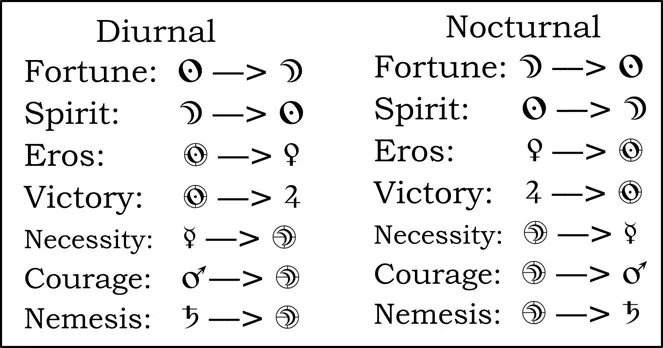
The first thing to notice is that only the Lots of Fortune and Spirit are calculated from the distance between celestial bodies—the Sun and Moon. In the other cases, the distance is measured from the relevant planet to either Fortune or Spirit, or in the reverse direction. In light of the preceding discussion, certain important Hermetic principles can be discerned in these calculations. First, their rationale appears to take account of the ruling luminary, or sect light. Thus, Fortune is always calculated from the ruling luminary to the other: in diurnal births, where the Sun is the ruling luminary, the distance is measured from the Sun to the Moon. The Sun is therefore the starting point, whereas in nocturnal births the starting point is the Moon, as the ruling luminary. This measurement seems to imply a movement from light towards darkness, since the calculation literally begins with the dominant or illuminating luminary at the relevant time of day or night and proceeds towards the luminary that is, in some sense, obscured or darkened at that time. This can be related to the deeper Hermetic conception of darkness as associated with matter and physical incarnation. By contrast, the calculation for Spirit runs in the opposite direction: it always begins with the luminary contrary to the prevailing sect and proceeds towards the dominant luminary—from the Moon to the Sun in diurnal births, for example. This, too, implies the Hermetic association of light with spirit and intellect.
Further patterns can be discerned among the remaining lots. As the diagram above shows, those with positive significations, such as Eros (Venus) and Victory (Jupiter), are both linked to Spirit. The others, with their negative implications, are linked to Fortune. Clearly, then, the lots of the benefic planets are associated with spirit and light, and hence with the Lot of Spirit, while those of the malefics are associated with darkness and matter, and therefore with the Lot of Fortune. In keeping with this, the association may also derive from the principle of light itself, since Jupiter and Venus are the two brightest planets, whereas Mars and Saturn are darker.
It is also interesting that some calculations proceed from the lot—Spirit or Fortune—to the planet, while others proceed from the planet to the lot, in both diurnal and nocturnal births. Once again, the rationale may have to do with the dominant luminary. Spirit is also known as the Lot of the Sun, and Fortune as the Lot of the Moon. As we can see, by day the lots of Venus and Jupiter are calculated from Spirit to Venus and Jupiter respectively, while by night the direction is reversed. The underlying principle is that the Sun emits light by day, so its lot assumes the same function; by night, it behaves more like the Moon, receiving light instead. In other words, the calculation depends on which of the two luminaries is dominant in the calculation of Spirit. In diurnal births, therefore, the calculation proceeds from Spirit to the relevant planet, imitating the Sun’s emission of light. In nocturnal births, it proceeds from the planet to the lot, which now acts as the “receiver”, since the Moon is the dominant luminary. This applies only to these two lots, as they alone involve Spirit. Yet the same principle appears to hold for the lots involving Fortune. By day, the Moon is the dominant luminary in the calculation of Fortune; moreover, as the Lot of the Moon, Fortune stands opposed to the dominant luminary, the Sun. It therefore receives light, and the calculation proceeds from the planet to Fortune. By night, when the Moon is the ruling luminary and the Sun is the dominant planet in the calculation of Fortune, Fortune “emits” light, and the distance is measured from it to the relevant planet. We shall return to these observations when discussing the Lots of Eros and Necessity mentioned by Valens, which are calculated differently from those described here.
Since the methods of calculation are given in the diagram above, the remainder of this article will focus on Paulus Alexandrinus’s descriptions of the seven Hermetic lots:
The Lot of Fortune is associated by Paulus with the Moon. He states that it signifies the body, the things the native does to acquire wealth, possessions, reputation and privileges.
As noted, the Lot of Spirit is associated with the Sun. It therefore signifies the soul, intelligence and the exercise of every kind of power (dunasteia), and is sometimes relevant in determining the native’s profession or occupation (praxis).
The Lot of Eros is associated with Venus and signifies the faculties of desire and appetite, as well as friendships and favours.
The Lot of Necessity is associated with Mercury and signifies restrictions, oppression, struggles, wars, enmities, hatred, condemnations and other limiting circumstances.
The Lot of Courage is associated with Mars and signifies boldness, betrayals, strength—or brute force—and all evil deeds.
The Lot of Victory is associated with Jupiter and signifies faith, good hope, contests, and every kind of beneficence, enterprise and success.
The Lot of Enemies is associated with Saturn and concerns spirits of the underworld, hidden things, weakness, exile, sorrow and the nature of death.
Sources used in this article:
- Chris Brennan – Hellenistic Astrology: The Study of Fate and Fortune
- Chris Brennan – The Theoretical Rationale Underlying the Seven Hermetic Lots
- Robert Zoller – Arabic Parts in Medieval Astrology (lesson from the DMA course)
- Nataša Karalić Koprivica – traditional astrology blog link