
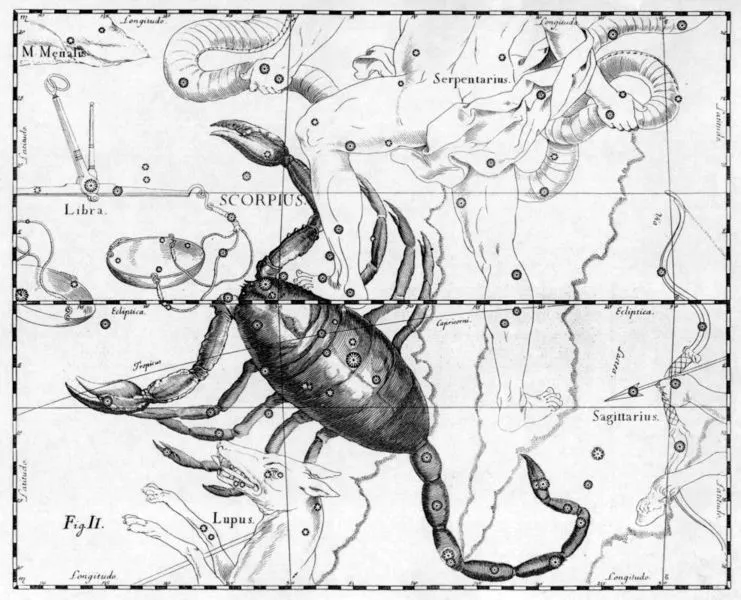
“Antares, Alpha (α) Scorpii, is a red binary star, fiery red and emerald green, near the centre of the constellation Scorpius, and is sometimes called the ‘Heart of the Scorpion’. Its zodiacal position is 10 degrees Sagittarius. Antares, the almost universal name for this beautiful star, derives from the second-century Greek astronomer Ptolemy, who understood it as a compound of anti Ares—‘like’ or ‘rival to’ Mars. In reference to its colour, the Latin Tetrabiblos has ‘Marti comparatur’; or, in the Homeric sense of the word, ‘the equivalent of Mars’, both because of its similar colour and because astrologers regard Scorpio as the house of that planet, and the god as its guardian. It therefore naturally shares, or perhaps inherits, the character of its constellation, and has always been associated with dignity and activity in human affairs.
The Dutch scholar Grotius (1583–1645), however, maintained that the word Antares signified a bat, as the Greek poet Vespertilius probably called it; while the seventeenth-century German astronomer Bayer misquoted Hesychius as giving Antartes, meaning a rebel or tyrant. Accordingly, a seventeenth-century Dutch astronomer aptly styled the constellation Insidiata, or the Hidden One.
Others call it Antar’s star, overlooking Ptolemy and celebrating Antar or Antarah, the mixed-race warrior hero of one of the Golden Mu‘allaqat, shortly before the time of Muhammad. (The Mu‘allaqat are seven celebrated poems of Arabia, said to have been inscribed in letters of gold on silk or Egyptian linen and hung in the Kaaba at Mecca.)
The Arabic Kalb al Akrab, the Scorpion’s Heart, which probably preceded the Greek Kardia Skorpion and Roman Cor Scorpii, became known in early English and continental European languages as Kelbalacrab, Calbalacrab, Calbolacrabi, Calbalatrab, and Cabalatrab. Antares alone constituted the sixteenth manzil (Arabic lunar mansion), Al Kaib, the Heart, one of the fortunate stations. The Chinese, however, included sigma (σ) and tau (τ), on either side of Antares, in their sieu (Chinese lunar mansion), the synonymous Sin, formerly Sam, with sigma as its determinant star. Brown nevertheless says that this Heart refers to that of Tsing Lung, the Azure Dragon, one of the four great divisions of their zodiac. They also recorded a comet in 531 BC ‘to the left of Ta Shin’, which Williams identifies as Antares; while, as the Fire Star, Wo Sing, it appears to have been invoked for protection against fire for centuries before our era. With some reservations, it is thought to have been one of the Ming t’ang, or Emperor’s Council Halls; his sons and courtiers, represented by other stars, stand on either side, while Antares, as Ta Who, proclaims to them the principles of his rule.
The Hindus used alpha (α Antares), sigma (σ), and tau (τ) for their nakshatra (Hindu lunar mansion) Jyeshtha, the Eldest, also known as Rohini, the Ruddy, from the colour of Antares. Indra, goddess of the sky, ruled this constellation, which was represented as a pendant pearl earring.
It was one of the four Royal Stars of Persia in 3000 BC, and probably the Watcher of the Heavens whom Dupuis identifies as Satevis; as their lunar constellation, however, it was Gel, the Red. The Sogdians altered this to Maghan sadwis, the Great Saffron-coloured One. The Chorasmians of eastern Persia called it Dharind, the Seizer; and the Copts, the present-day Christians of Egypt, Kharthian, the Heart.
For the Babylonians it marked their twenty-fourth ecliptic constellation, Hurru, a name of uncertain meaning, while the star itself was Urbat, according to the astrolabe discovered in Sennacherib’s palace and interpreted by George Smith. Brown, on the other hand, assigns this name to stars in Lupus, which borders Scorpius. Other Euphratean names were Bilu-zha-zri, Lord of the Seed; Kak-shisa, Creator of Prosperity; and, in the lunar zodiac, Dar Lugal, the King, identified with the lightning god Lugal Tudda, the Lustful King. Naturally, the records establish a connection with the planet Mars, their Ul Suru, as well as with Masu Sar, the Hero and King, and Kakkab Bir, the Rose-coloured Star. Brown also identifies it with the antediluvian king Euedorachos, in Greek, or Udda-an-χu, the Daytime Bird of Heaven.
In Egypt, Antares represented the goddess Selkit, Selk-t, or Serk-t, heralding the dawn through her temples at the autumnal equinox around 3700–3500 BC, and was a symbol of Isis in pyramid ceremonies. Renouf includes it with Arcturus in the immense figure of Menat, a name used for the Egyptian goddess Hathor.”
Astrological Influence
A Royal Star to which Ptolemy assigns the nature of Mars and Jupiter, Antares offers extremes of success, good fortune, danger and adversity. It clearly indicates the potential for great power, but where strength of will is not accompanied by integrity and wisdom, it carries the danger of destruction. William Lilly warns that it can describe an impetuous, headstrong person liable to bring about their own ruin through stubbornness. Primary directions of the luminaries to this star usually bring great honours and advancement, yet there is always a risk that the native will fall victim to its ruthless energies. Of the Sun directed to Antares, Lilly writes:
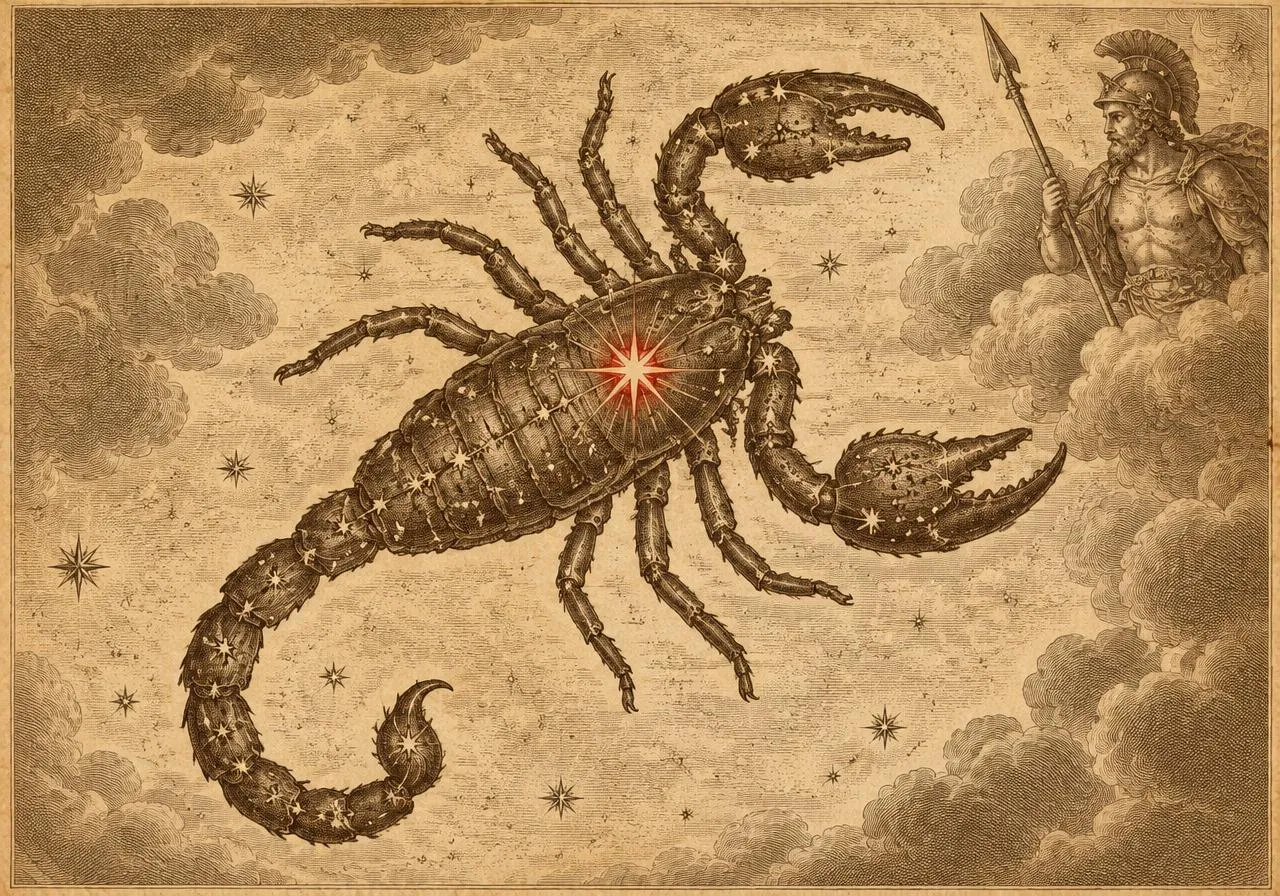
It presages many honours, provided the native be wary and suffer not himself to be deceived by soldiers. It oftentimes causes inflammatory fevers, or some act of violence, and injures the right eye.
Of the Moon’s direction to it, he writes:
It confers upon the native some manner of office attended by fear and enmity. It endangers his life through the deceit of his enemies, or a fall from a horse, etc. It signifies the death of his mother or wife, or a very grievous sickness.
And finally, of the direction of the MC:
The native shall greatly delight in the company of soldiers or religious men, or both. His acquaintance with them may procure him reputation, but little profit, for he shall expend much money upon exercises of arms, to which he shall be greatly inclined. Thereafter he may receive a military command from a Jovial or religious person, or hold an office or command at sea amongst mariners, for which he shall be much envied. These preferments, arising solely from the influence of the fixed stars, usually continue without sudden changes.
Its martial nature also frequently associates Antares with fearlessness and a readiness to act. It can bring considerable success, particularly in the West or through matters connected with the West. In any adverse configuration—including a poorly placed Mars—the native must be prepared for sudden events, unforeseen developments and possible accidents. Traditionally, Antares has a violent character and is held responsible for violent deaths, whether in battle or through judicial proceedings. It also poses a danger to the eyes. According to Dupor, Antares with the Sun brings wealth or military success after humiliation; with the Moon, popularity through daring undertakings, but also illness and assassination; with Mercury, lively thought and a gift for strategy, though a square to Mars may lead to criminality; with Mars or Saturn, there is always some connection with weapons or war; on the MC with the Moon, vanity leading to sudden death. On the Ascendant, it signifies a rise beyond one’s abilities through inheritance or ancestry, especially through war and revolution, danger or the deaths of others.
On the Ascendant of the chart: wealth and honours, violence, illness, and prosperity that seldom lasts. At the Zenith of the chart, Antares brings honours, offices and good fortune. With the Sun: feigned piety, insincerity, honours and wealth ending in disgrace and ruin, military rank, danger of betrayal, violence committed or suffered, fevers and illnesses, injury to the right eye, violent death. If rising or at the Zenith, it indicates great honours attained through violence, with difficulties and adversity. If Saturn and Mars are also present, infectious diseases are threatened. With the Moon: popularity, broad-mindedness, an interest in philosophy, science and metaphysics, a tendency to change religious beliefs, influential friends, favourable conditions for business and domestic affairs, involvement in local activities, exceptional power, fame and wealth, though these do not endure; danger of violence, illness, drowning or murder. In the first or tenth house, it brings honours and offices, but also many dangers and misfortunes. Susceptibility to blindness or eye injuries, especially if Mars and Saturn are simultaneously with Regulus. If Saturn is with Aldebaran, there is a danger of death, probably by hanging; if Mars is with Aldebaran, death by stabbing, blows or a fall is threatened, especially if angular. If a malefic is with Aldebaran in the fourth, seventh, eleventh or twelfth house, there is a danger of death from a sudden sword stroke, a stabbing or a fall. With Mercury: suspicion, false accusations against friends, unpopularity, the use of ecclesiastical influence in business, money earned slowly and with great difficulty, danger of illness to the native and their family, and the death of a relative at home or while travelling. With Venus: insincerity, dishonesty, energy and ability, but selfishness; unfavourable for financial gain and health. With Mars: harmful habits that profoundly affect the life, quarrels with friends and relatives, fairly favourable for financial gain. If the Moon is simultaneously with Aldebaran, there is a danger of death by the sword or hanging. With Jupiter: exceptional religious zeal, whether sincere or feigned, ecclesiastical office, a tendency towards duplicity, benefits through relatives. With Saturn: a materialistic outlook, dishonesty arising from one’s circumstances and surroundings, religious hypocrisy, numerous disappointments, losses through quarrels and legal affairs, trouble from enemies, many failures, obstruction by relatives, adverse conditions in family affairs, much illness and distress concerning children. If the Moon is simultaneously with Aldebaran, there is a danger of death by a sword stroke or hanging. With Uranus: abnormal and extreme ideas, duplicity, lies and exaggeration, an extreme socialist outlook, incitement to rebellion, lawlessness and anarchy, with a consequent danger of arrest; temporary poverty, discord with relatives, more than one marriage, adverse indications for children, violent death. With Neptune: cunning, intelligence, instability and mental ill health, secrecy combined with a degree of openness, dishonesty, a tendency to steal, thrift, insincerity, strange religious ideas, harmful surroundings, gain through hard work. Sudden and unexpected death through betrayal or at the hands of enemies seeking thereby to avoid retribution. With the Lot of Fortune or its ruler in the chart: poverty.