
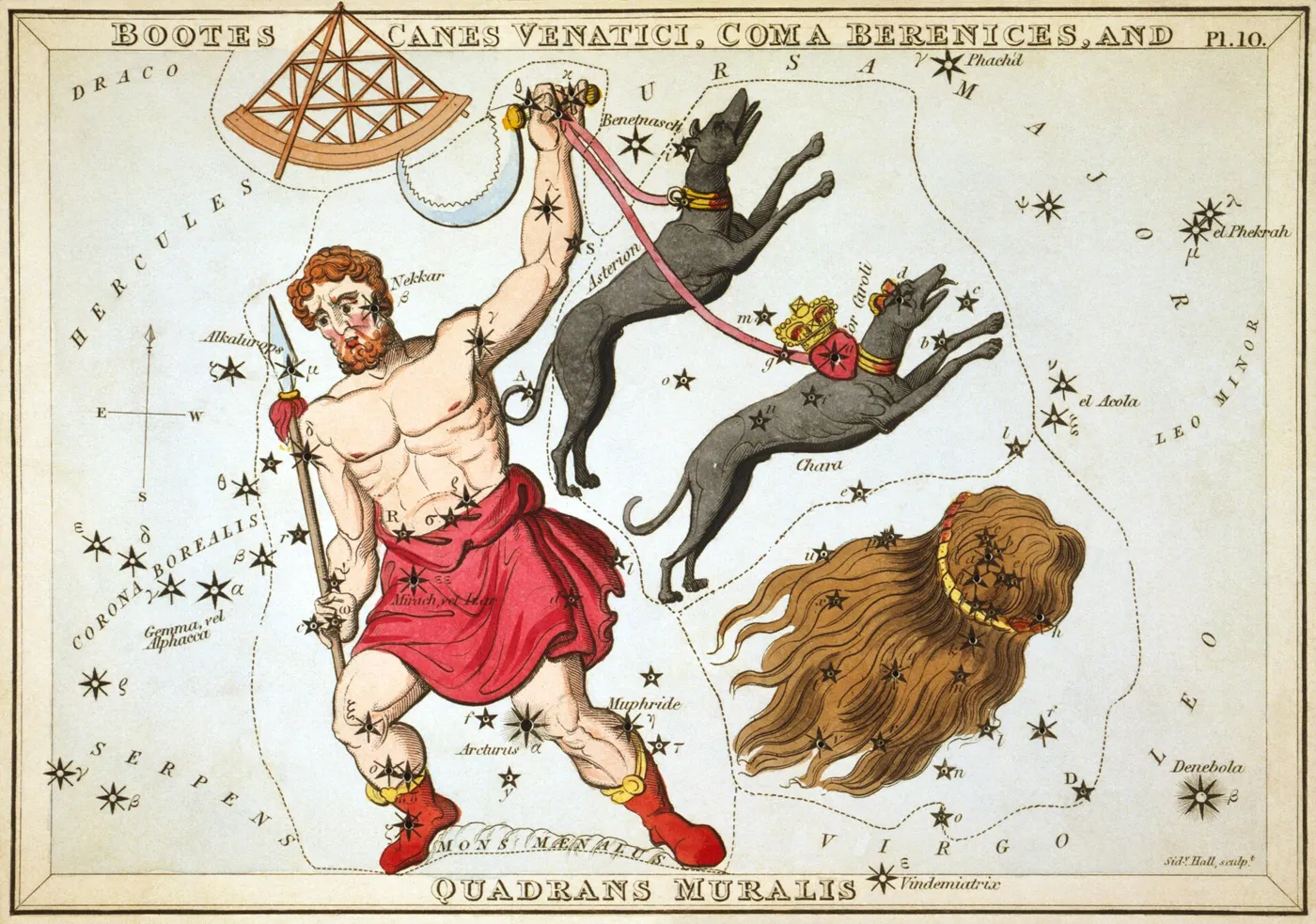
Arcturus is the most prominent star in the constellation Boötes, the Herdsman. In his description of this constellation, Manilius emphasises guardianship and the responsibility of safeguarding resources, symbolised by the herd.
“To those born at this hour, Fortune boldly entrusts her treasures, so that the wealth of monarchs and the revenues of temples shall be under their protection: they shall be kings under kings and ministers of state, charged with the care of the people; or, as stewards of great households, they shall devote their labours to the care of another’s home.”
Firmicus Maternus follows Manilius, adding that when the malefics are in aspect, the native is reduced to the station of a porter, receiving and greeting guests.
Ptolemy assigns the nature of Mercury and Saturn to the constellation as a whole, but notes that its principal star, Arcturus (from the Greek Arktouros, “Guardian of the Bear”: arktos – bear + ouros – guardian, owing to its position behind Ursa Major), has a nature like that of Jupiter and Mars. A first-magnitude star with a golden-red lustre, it lies on the figure’s left knee. It is the fourth-brightest star in the sky and one of the few stars named by Ptolemy and Manilius. It is also called Arctophylax, meaning “the watcher of the bear”, as well as Alchameth, Azimech and other variants derived from As-Simak, meaning “the one who rises into the heavens”. According to Bullinger, Arcturus means “He shall come”, while the Egyptians called it Smat, or “the Ruler”, and Bau, “the Coming One”. Al-Biruni tells us that it is sometimes called the “Guardian of the Northern Heavens”, again alluding to its role as a protector.
Arcturus was well known among ancient sailors and farmers as a bringer of storms at its heliacal rising, and Pliny described it as horridum sidus: a star almost invariably attended by a great storm. As such a bright and prominent star, its astrological influence naturally includes the potential for wealth and honour, while its martial element—implicit in its tawny colour—associates it with misfortune and conflict, a connection undoubtedly reinforced by the adverse agricultural conditions it signifies. William Lilly illustrates this well when he says that Arcturus on the Ascendant “… gives good fortune to the native, which he shall enjoy in this world with comfort and joy; yet notwithstanding he shall be involved in many troubles, discontents and fears, occasioned more by his own rashness than by any other cause.”
Given that Arcturus is the principal star of the “Driver”, modern authors discern in it the symbolism of organisation: the planner working “behind the scenes”, whose powerful energies can drive matters forward. According to Robson, it brings riches, honours, high renown, self-determination and advancement through seafaring and travel. Ebertin and Hoffmann maintain that this star makes the native “belligerent and quarrelsome”, with an “enterprising spirit”, while Noonan writes of Arcturus: “… Its influence has always been feared in mundane astrology, since it is adverse to farmers. Yet when rising on the Ascendant in a natal chart, it describes someone who will be loyal to friends, keeping their secrets in faithful silence. Such a person may enjoy the confidence of heads of state and be entrusted with public funds; but if it is setting, or in adverse aspect to Saturn and Mercury, the native may betray that trust and come to a shameful end.”
Lilly further asserts that Arcturus may signify death by suffocation when prominent in the chart and conjunct Mars, with the Moon on Ras Algethi. He considered both Arcturus and Seginus, the star on the left shoulder, capable of bringing “abundance of good fortune and great honour” when conjunct the Sun, Moon or Jupiter in the tenth house. Of the Moon with this star, Lilly warns that the native may be questioned over “foolish acts and committed to prison therefor, and may also obtain some inheritance, though one of his wives must suffer death.”
It grants abundance, high standing and a propensity for travel, whether by sea or overseas. Certain mediums attribute to this star an exceptional spiritual influence and the development of consciousness. The native often feels that they do not belong in the environment in which they live—and, in one way or another, this is invariably true.
On the Ascendant: Arcturus brings good fortune, accompanied by many cares and fears arising from one’s own folly. At the Midheaven: high government office, exceptional earnings and prestige. If also with the Sun, Moon or Jupiter, it brings immense wealth and great honours. With the Sun: Arcturus gives success through slow, patient and painstaking work; friends among the clergy; favourable for gain and dealings with the public and lawyers. With the Moon: new friends, business success, sound judgement and domestic harmony. If with Mars, there is a danger of death by suffocation. With Mercury: sobriety, diligence, popularity and religious inclinations; somewhat extravagant, yet wealthy; help from friends; a position of trust in a large company or corporation, or promotion by appointment; favourable for health and family matters. With Venus: popularity, gifts and favours from friends, and a few false friends of the same sex. With Mars: popularity, many friends and considerable gains, which will not be retained owing to extravagance. If in the first, seventh, ninth, tenth or eleventh house, with the Moon simultaneously on Pollux, there is a danger of death by suffocation. With Jupiter: gains through legal or ecclesiastical affairs, an influential position, a danger of hypocrisy, and profit through foreign affairs or the merchant navy. With Saturn: Arcturus brings despondency, selfishness, a tendency towards cruelty, business cunning and a materialistic outlook; favourable for gain and speculation, as well as family matters, but brings difficulties early in married life. Favourable for children, though with discord involving one of them. With Uranus: favourable for work requiring rapid buying and selling, and for dealings with the public; involvement with antiques or ancient objects and an inclination to form collections; connections with art, science and literature; an official position in a club or association; favourable for gain; favours from friends; favourable for marriage and children, with benefits from both; natural death abroad. With Neptune: perceptiveness, business instincts and changeability, with losses arising from these qualities; mediumistic ability and considerable negativity; involvement with societies in an official capacity; loss and misfortune in middle age, hastening death; favourable for friendships, partnerships, marriage and success; considerable reliance on a spouse’s advice.