
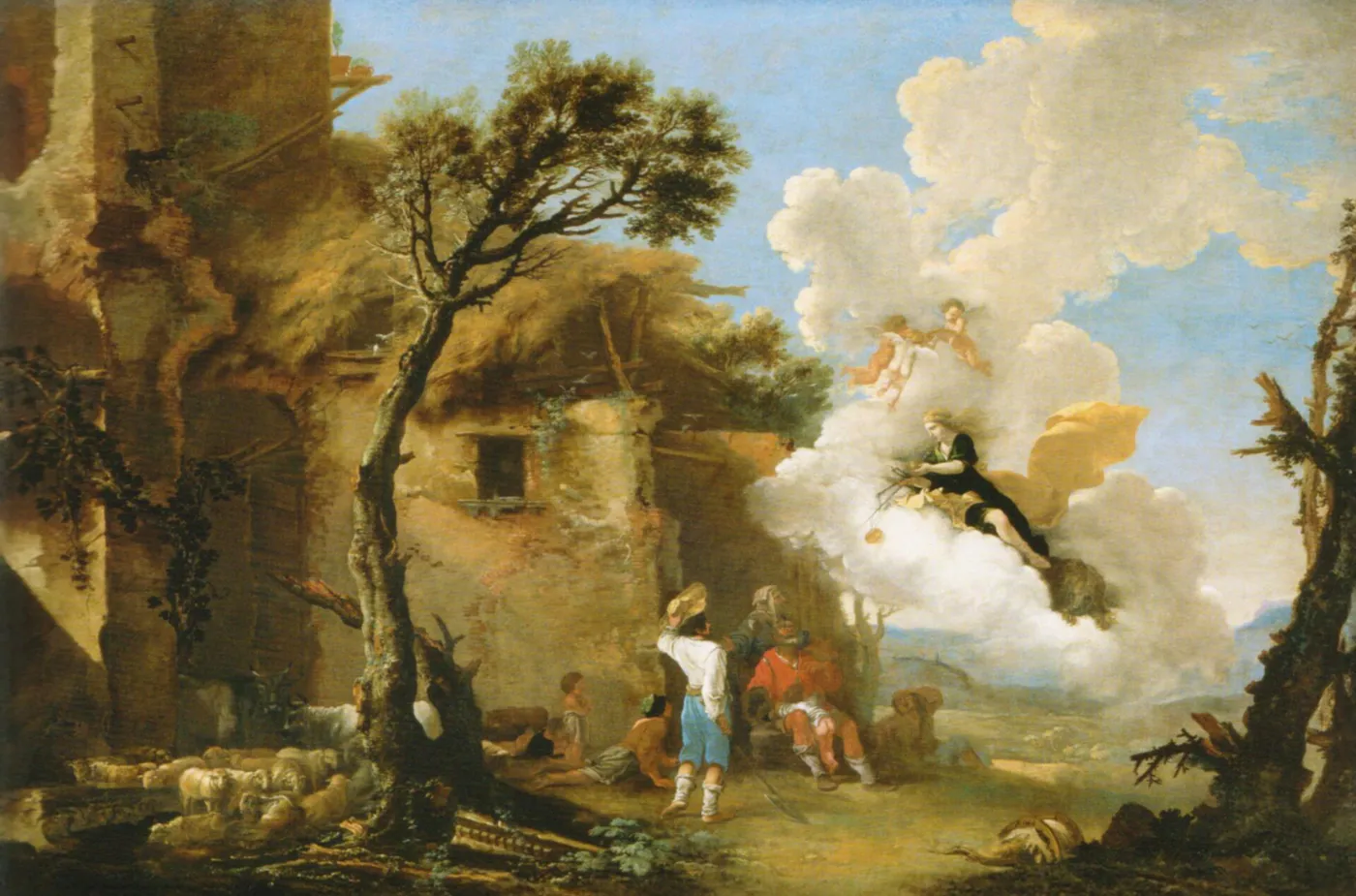
Spica has always been universally regarded as one of the most important benefic stars in the heavens. It lies in the constellation Virgo, specifically in the Virgin’s left hand. A brilliant, bright white double star, its associated symbol is an ear of wheat. This is the star used to establish the sidereal zodiac: Spica marks 0° Libra, placing the point exactly opposite it at 0° Aries, from which the entire zodiac is constructed. In the late period of ancient Egypt, the constellation Virgo was sometimes seen as the goddess Isis, with Spica representing the divine child Horus seated in her lap. Even the temples in the ruined ancient city of Akhetaten appear to have been aligned with this star’s rising and setting. Its Egyptian Coptic name was Khoritos, “the Solitary One”, acknowledging Spica’s dominant brilliance in an otherwise dimly lit region of the sky. This apparent isolation contributed to its reputation for barrenness or misfortune in marriage, but in other respects Spica is considered an exceptionally fortunate star, especially for those engaged in law, the arts, science or religion. Later, the Virgin came to be identified with the Mother of God, and Spica, accordingly, with Christ. Most often, however, it is seen as the sheaf of wheat held by Persephone, the maiden goddess. Hellenistic astrologers understood Spica’s nature as a blend of Mercury and Venus. Hence those born under its influence are often said to be learned, philosophical, eloquent, creative, intelligent, artistic, pleasure-loving, practical and successful, though sometimes changeable or promiscuous. The Anonymous of 379 wrote that Spica, particularly among stars of the nature of Mercury and Venus, gives people who serve as “hierophants”, or high priests, as well as philosophers, and produces women who may become priestesses of Isis, Demeter or Persephone.

In medieval astrology, Spica was counted among the so-called Behenian stars: stars with particular magical applications. It is associated with emerald and sage. In his books on Occult Philosophy, Agrippa attributes this star’s sigil to Hermes Trismegistus.
Spica is a gift, or “the Goddess’s gift to humanity”. Its gift takes the form of a splendid opportunity in life, which must be seized. It symbolises knowledge and profound insight.
According to Ptolemy, it has the nature of Venus and Mars, while Alvidas assigns it the nature of Venus, Jupiter and Mercury. It brings success, fame, wealth, a pleasant disposition, a love of the arts and sciences, immorality, barrenness and injustice towards the innocent. It is therefore exceptionally favourable, bestowing benefits on both the material and spiritual levels, but it is particularly important to emphasise its strongly protective character. In his The Horary Textbook, John Frawley describes its influence as follows: “The Virgin’s Ear of Wheat. The brightest star in Virgo. Associated with Our Lady, it is strongly protective. Spica on the Ascendant does not necessarily show that things will work out as we hope, but even if they do not, you will be all right in the end; you will be looked after. Spica can be highly fortunate, bringing rewards, but it does not carry the sense of material success that Regulus does. It is, however, more fortunate.”
William Lilly observes that Spica “predisposeth the native to attain the highest degrees of ecclesiastical preferment, or rich benefices, with applause and great esteem, together with suitable gains, all by reason of his admirable ingenuity; all matters concerning Venusian or Mercurial persons prove successful.”
Describing the star’s general nature, Lilly says that it signifies a person “… of a comely presence, diligent in the study of Sciences and Arts, or a most ingenious inventor when Mercury is with it; if Saturn be concerned, it giveth a suspicious person, sharp and haughty, violent in contention; but if Mars be with Spica, it giveth a rigid person, even a fool, or little better.”
Of the direction of the Midheaven to Spica, Lilly writes: “Unexpected honours or preferment may be conferred upon the native, beyond his hopes or capacity, and many times it giveth power of life and death over others. Many astrologers hold that the Midheaven directed to the Virgin’s Ear of Wheat signifieth ecclesiastical preferment, yet it must operate according to the native’s birth and capacity. It will have some effect even among persons of low estate; that is, in that year a common man may gain much by receiving the parson’s tithes.”
The direction of the Moon to this star, meanwhile, “conduceth to the increase of the native’s wealth and bringeth much fame, by reason of his excellent abilities and gifts of mind, which he shall receive through Mercurial, Venusian and Jovial persons.”
Lilly also treats a planet’s conjunction with this star as an accidental dignity, awarding it five points in his assessment of planetary strength. This principle is adopted by most traditional astrologers. Traditionally, Spica is regarded as an oasis of good fortune in an otherwise malefic region of the zodiac, the so-called Via Combusta, or Burnt Way, extending from 15° Libra to 15° Scorpio.
On the Ascendant or at the Midheaven: Spica brings boundless good fortune, wealth, contentment, advancement in the ecclesiastical hierarchy, unexpected honours and success beyond one’s own expectations or abilities. With the Sun: great and lasting advancement, a distinguished and elevated position, immense wealth, exceptional good fortune for parents and children, help from friends among the clergy, and favourable outcomes in public and legal affairs; at the Midheaven, advancement in the ecclesiastical or state hierarchy. If Venus and Mars are also present, the person will be a powerful king with many subjects, but numerous personal weaknesses. With the Moon: Spica gives gains through inventions, success, wealth and fame through the help of people ruled by Mercury, Venus or Jupiter. With Mercury: neatness, refinement, shrewdness and perceptiveness, favour from the clergy and people in authority, gains through investments, a position of responsibility. With Venus: benefits through friends, social success, false friends of the same sex. With Mars: Spica makes the native popular and socially successful, granting sound judgement and swift decision-making, or fierceness in argument, rigidity, and stupidity to a lesser or greater degree. With Jupiter: popularity, social success, prosperity, ecclesiastical honours and offices. With Saturn: a tendency towards suspicion, sarcasm and harshness, yet many good deeds; an interest in the occult, eloquence, popularity, many friends, gains through legacies but also extravagance, good health, and favourable outcomes in family matters. With Uranus: mediumistic abilities, popularity, work connected with jewellery, gains through marriage, a lucky touch, a sudden and natural death. With Neptune: good parentage, comfortable surroundings, always sufficient means, connections with companies, gains through legacies, favourable outcomes in family matters, some impulsiveness and extravagance; the native does not reach a great age. With the Lot of Fortune: great wealth, lustful inclinations.
According to Dupor, Spica brings the following when connected with these factors in the horoscope:
With Mars and Venus = often prosperity in both public and private life. Orb 1°30′. With the Moon = solitary study and gains through work, inventions or society. With Mercury = extensive knowledge, an orator, poet, actor or writer, and great intuition, especially if trine Uranus. With Venus = success in music or another art, especially with favourable aspects from the luminaries and Jupiter. If the Sun, Jupiter, Venus, Moon and Ascendant are partly in conjunction with Spica and partly in the 10th house, fame is assured from the outset; if there is affliction from Saturn or Mars, a fall will follow. On the Ascendant = philosophy, religion, art. With Saturn = poverty, at least for a time. With Uranus = a gift for discoveries and inventions, especially if trine the Ascendant. The Lot of Fortune = an increase in wealth and honours, according to the natal chart. In a favourable horoscope, it is best to have conjunctions with Spica in the 1st or 10th house, while in an unfavourable one, its conjunction with Saturn gives poverty and sterility, or, in the better case, chastity.