From time to time, astrologers posed a serious threat to Roman authority: during periods of political upheaval and instability, their predictions could influence public opinion and turn the masses against their rulers. At such times, astrologers and other potential “troublemakers”—sorcerers, unofficial prophets, Jews and philosophers—would be expelled from Rome for a specified period. In the second century BC, for example, the Epicureans were expelled first, followed some ten years later by philosophers in general. With the collapse of the Republic and the establishment of the Empire, the Senate, locked in conflict with emperors who gradually stripped it of its powers, was predominantly Stoic in outlook. This made the Stoics a particular target for the emperors. Such mutual hostility between emperors and Senate persisted until the age of the “good emperors”, from Trajan to Marcus Aurelius, who embodied the Stoic ideal of “rule by the best”.
The first occasion on which astrologers were deemed a political threat to Roman authority and consequently expelled from Italy was in 139 BC, in the time of Tiberius Gracchus. They were banished by a praetorian edict, and since the praetor’s term of office was limited, the prohibition itself would lapse when a new praetor took office.
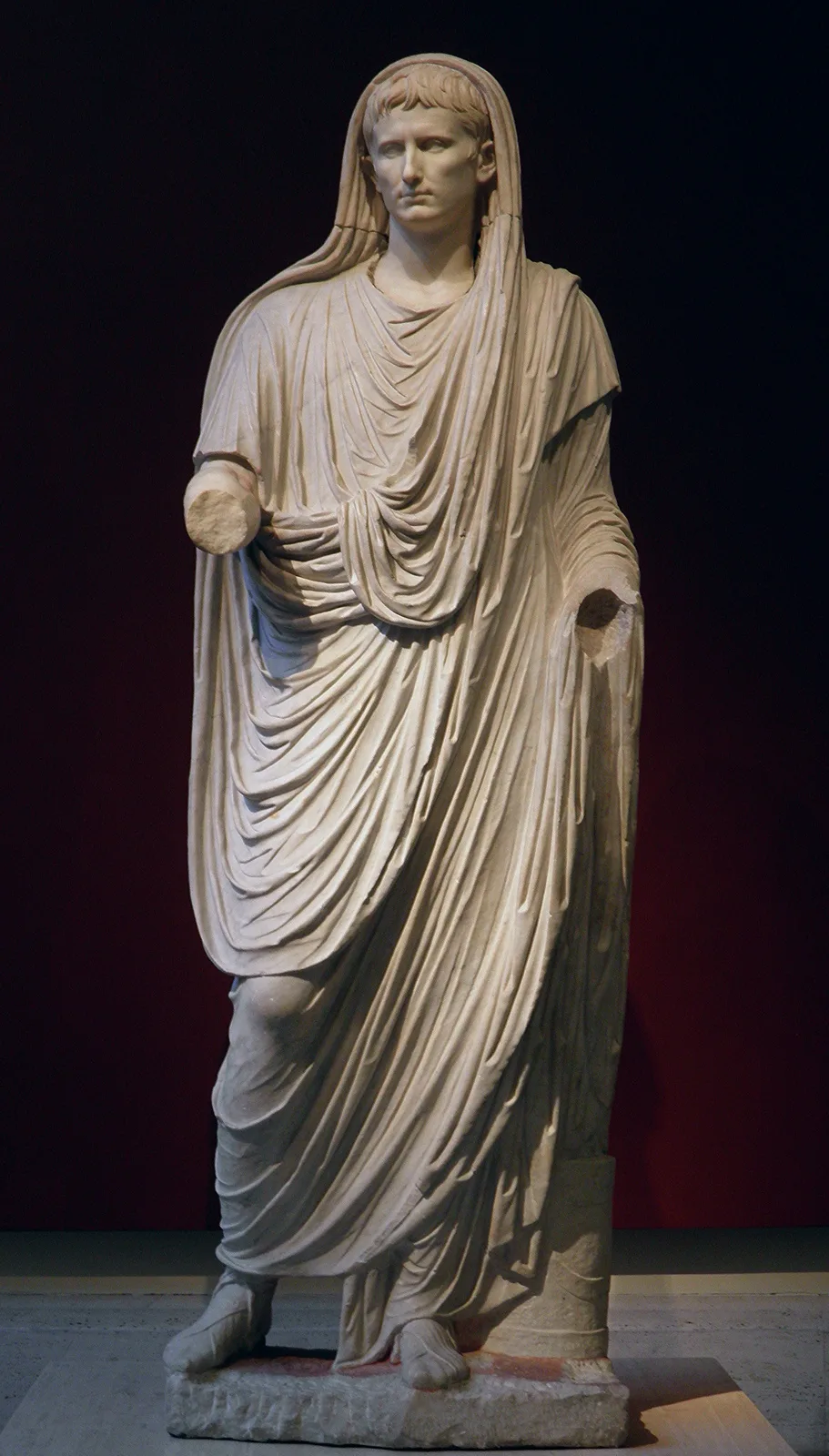
In 33 BC, as tensions mounted between Octavian, ruler of the West and the future Augustus, and his fellow triumvir Mark Antony, who ruled the East from Egypt, the people of Rome were strongly influenced by astrologers, sorcerers and prophets, most of whom came from the East. Since most astrologers in Rome were not Roman citizens, they might reasonably be expected to favour Mark Antony over Octavian; with such sympathies, they could easily persuade the Roman people that Antony was “dearer to the gods”. In that pivotal year, Octavian therefore decided to appoint his loyal friend Marcus Agrippa as aedile, whereupon Agrippa immediately expelled both astrologers and sorcerers from Rome. Since an aedile’s authority extended only over the city of Rome, rather than the whole of Italy, this expulsion was limited not only in duration—to his term of office—but also geographically. The following year (32 BC), Octavian defeated Antony and Cleopatra, consolidating his power. The third triumvir, Marcus Lepidus, had little influence, and upon his death in 12 BC Augustus also secured the office of pontifex maximus, or chief priest. Augustus then introduced reforms to Roman religious life and destroyed all prophetic writings except the Sibylline Books.
It was Agrippa who, in his youth, had accompanied the future emperor on a visit to an astrologer who foretold his great fame, although Augustus’s horoscope had already been cast by Nigidius Figulus, a respected senator and astrological authority of the preceding generation. During Augustus’s reign, astrology gradually acquired an elevated position at court and among the upper classes. It was against this background that, in AD 2, the future emperor Tiberius, restored to the favour of his stepfather Augustus, returned to Rome, bringing with him his friend and personal astrologer Thrasyllus. Astrology acquired a new status in the early Empire: Manilius wrote his Astronomica, the poets of the Augustan age competed in exalting the emperor through astrological symbolism, and Germanicus, Tiberius’s nephew and adopted son, translated and commented on Aratus’s astronomical work, the Phaenomena.
In AD 11. rumours began circulating in Rome that Augustus’s death was imminent, bringing the question of his successor—and with it the danger of a coup—back to the fore. Augustus responded with an edict which, unlike the temporary expulsions of astrologers imposed until then, would apply permanently to all diviners. Directed chiefly at astrologers, it made it illegal to seek answers through divination concerning the emperor’s health, that is, his death; to consult a diviner in private, lest the absence of witnesses encourage a client to ask a forbidden question; or to enquire about anyone’s death. These prohibitions were, of course, frequently broken, and in the years that followed many Roman noblemen and noblewomen found themselves on trial. Presumably, the courts also prosecuted wives, children and slaves who asked about the death of their paterfamilias, but unlike politically significant trials, such proceedings have left no record.
Although using divination to discover when someone would die had been forbidden since AD 11, astrological textbooks continued to transmit these techniques. Indeed, in that very same edict Augustus published his own horoscope, allowing those versed in astrology to calculate—by the forbidden method—and satisfy themselves that the emperor was not about to die. And indeed he did not, at least for another three years.
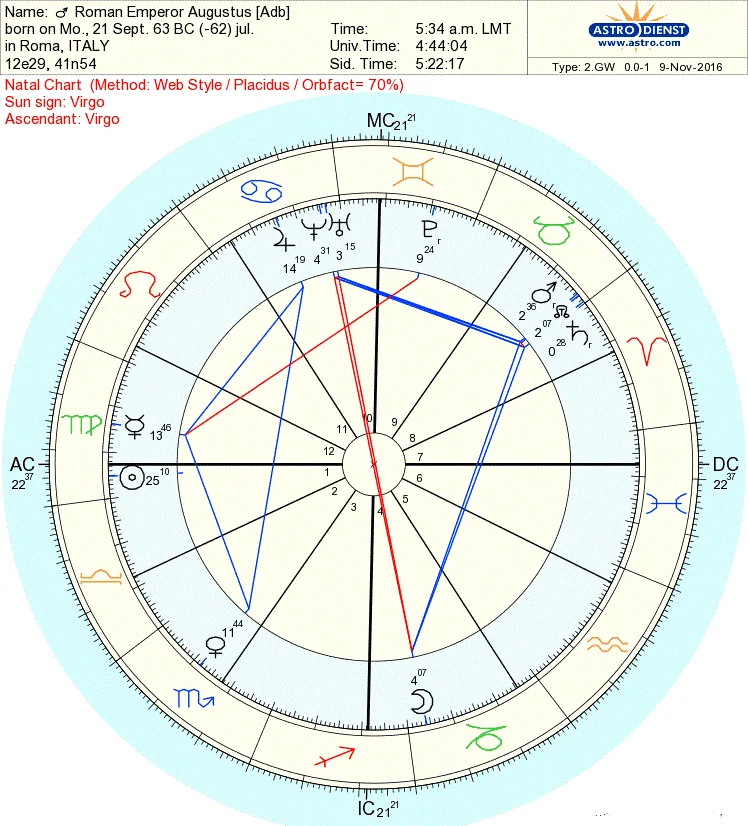
From a modern perspective, the chart looks problematic at first glance: Mars is retrograde and in detriment in Taurus, conjunct the retrograde malefic Saturn. Both oppose their ruler Venus, who is in detriment in Scorpio and on the South Node.
With Pluto in the ninth house, Augustus turned towards a thorough reform, a “transformation” of religion—in other words, a return to traditional values. His Moon in Capricorn in the fourth house of inheritance likewise favoured ancestral tradition. Yet he failed to bring about this transformation of values within his own household, as shown by Venus, ruler of values, in Scorpio in the second house. His daughter, represented by Saturn as ruler of the fifth house, fiercely resisted (opposition) the values he imposed (Venus in the second house), surrendering herself to a dissolute, orgiastic way of life (Taurus, Mars, the eighth house)—excess in the manner of the North Node. The Moon’s condition also shows that Augustus could not maintain control (Capricorn) over morality within his own home (fourth house). Public scandal and unrest, shown by Uranus and Neptune opposing the Moon from the tenth house, shook and disappointed him deeply, and he eventually disowned and banished his daughter (Moon in detriment).
Today, we might attribute his insistence on morality (the Nodes across the second/eighth-house axis) to repression, a defence mechanism, or hypocrisy, since away from the public gaze he himself was remarkably “morally free”, as well as to more narrowly political and propagandistic motives. But the astrologers of his day were not searching Augustus’s nativity for an integration of masculine and feminine principles, emotional maturity, or the “stage” of his soul’s evolution. To assess how “imperial” a nativity might be, they examined its potential for social standing, measuring outward, objective power and influence in terms of money or the army a person could muster. The Romans were pragmatic people, and so was their astrology. To glimpse Augustus’s chart through the eyes of astrologers such as those who foretold his imperial power, let us put all the planets beyond Saturn—and the asteroids and planetoids—out of our minds for a moment. We should also recall the house system most likely used at the time, whole-sign houses, and the old rule that planets are in aspect only when they occupy the appropriate signs, rather than merely being “within orb”.
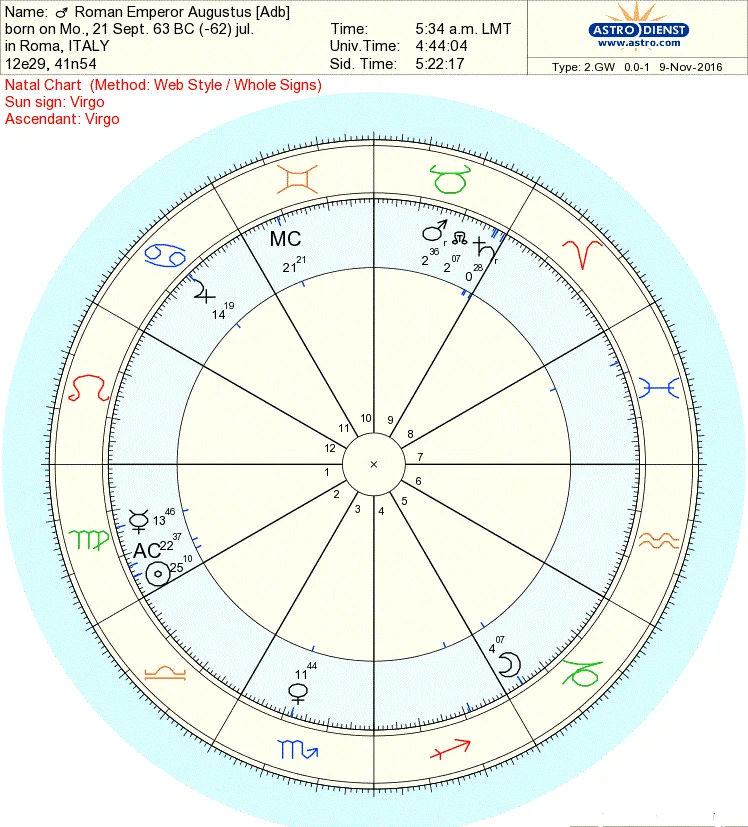
Ptolemy’s Tetrabiblos, though written in the second century, records rules already in use in Augustus’s day. From it we learn that one of the most important indications of political power is the placement of the luminaries—the Sun and Moon—in masculine signs and angular houses. Augustus’s luminaries are admittedly in feminine signs, but both are angular in Placidus. Another important concept in Hellenistic astrology is doryphory: the spear-bearers, or royal advisers. These are planets in the Moon’s sign which set after it, or in the sign following the Moon; and planets in the Sun’s sign which rise before it, or in the preceding sign. Benefics may also cast trines and sextiles to the luminaries and thereby join the retinue of the Sun and Moon, while malefics may cast squares and oppositions. The planets forming the doryphory should be in the best possible condition—in angular houses and aspecting an axis—so that they can advise the luminaries well, just as a king needs capable counsellors.
In Augustus’s natal chart, Mercury, in both domicile and exaltation in Virgo and placed in an angular house, precedes the Sun and is therefore the most prominent member of its doryphory. Exalted Jupiter in Cancer casts an aspect to the fifteenth degree of Virgo, ahead of the Sun, making it another exceptionally good member of the Sun’s retinue. The Moon casts a trine ahead of the Sun, Venus a sextile, and Mars and Saturn squares: every planet in the chart supports this angular Sun, and the king has many attendants. The Sun certainly benefits from the exceptional placement of its dispositor, Mercury, in exaltation and domicile and in an angular house, and from the fact that both rulers of the angles—Mercury, ruling the Ascendant and Medium Coeli, and Jupiter, ruling the Imum Coeli and Descendant—are exalted, or elevated. If we take this exalted Mercury, ruler of the Ascendant, to signify the name itself, and note its sextile to the planet of religion, Jupiter, in its own exaltation, we readily recall that Augustus means “the exalted one”, with all the sacred connotations the word carried before, thanks to Augustus, it came to denote imperial authority itself.
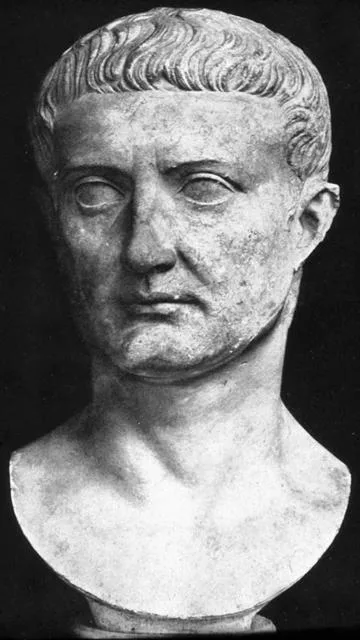
Augustus’s successor Tiberius and his future court astrologer Thrasyllus were most likely brought together by shared interests, such as philosophy and scholarly disciplines. The story of Tiberius throwing astrologers from a cliff is thus merely a legend about a far from popular emperor. What is certain is that Thrasyllus predicted a bright future for Tiberius, which began to unfold with his return from exile in AD 2. Through Tiberius, the Greek Thrasyllus (Tiberius Claudius Thrasyllus) obtained Roman citizenship, then a considerable privilege, and gradually established his own “astrological dynasty”: his son Balbillus served as court astrologer to no fewer than three emperors, his daughter married a Roman prefect, and his granddaughter married into the royal house of Commagene. It was Thrasyllus who established the standard arrangement of Plato’s works, organising the dialogues into the tetralogies familiar to us today. During Tiberius’s reign, Thrasyllus was something of a power behind the throne: he succeeded in having his daughter’s husband, Macro, appointed prefect of Rome after the fall of Sejanus, in which he probably played a part through his astrological advice to Tiberius. Tiberius also practised astrology and encouraged the search for “imperial horoscopes”. Prominent Romans whose nativities bore the marks of imperial power could come to grief, particularly if they became embroiled in a conspiracy. One story relates that Tiberius identified imperial indications in the nativity of Galba, the future emperor, but only for his later years. He therefore felt no concern, and Galba lived long enough to fulfil his natal promise. During one conspiracy and the unrest that accompanied it, Tiberius expelled astrologers and other diviners from Rome twice. Yet only the practice of astrology was forbidden, so he allowed any astrologer willing to renounce prediction to remain in Rome. Two diviners were executed at that time, but it seems that making predictions on forbidden subjects was not their only offence: their more active involvement in the conspiracy was probably the decisive factor.
Under Tiberius, asking the forbidden question about the emperor’s wellbeing became, in itself, evidence of high treason. Previously, the “forbidden question” had merely been the icing on the cake in prosecutions for the “juicier” substance of treason: plotting to overthrow the ruler, disloyalty or deception. Such prohibitions and expulsions naturally did not affect Thrasyllus or his son Balbillus. Thrasyllus died only a few years before his friend and patron, the emperor Tiberius, at which point Balbillus probably took over as imperial astrologer. After Tiberius’s death, Balbillus withdrew from Rome to Alexandria, but another member of this astrological dynasty played an important part in the political manoeuvring of Caligula’s reign: Ennia Thrasylla.
Upon Tiberius’s death, Thrasyllus’s daughter used her influence over her husband Macro, prefect of Rome, to install Caligula as sole ruler, although Tiberius’s will stipulated that he should share power. The ungrateful Caligula soon turned against the couple who had helped him, however, and both met an ignominious end. Thrasyllus had once told Tiberius that “Caligula would sooner ride across the Bay of Baiae on horseback than become emperor”. Caligula therefore had a bridge built across the bay to disprove Thrasyllus’s words by accomplishing the feat. The astrologer Sulla warned Caligula that he faced a violent death, and this duly came to pass. His successor was the only first-century emperor for whom imperial power had never been predicted, either by astrologers or by other diviners: Claudius, whose accession also brought Balbillus back to the imperial court.
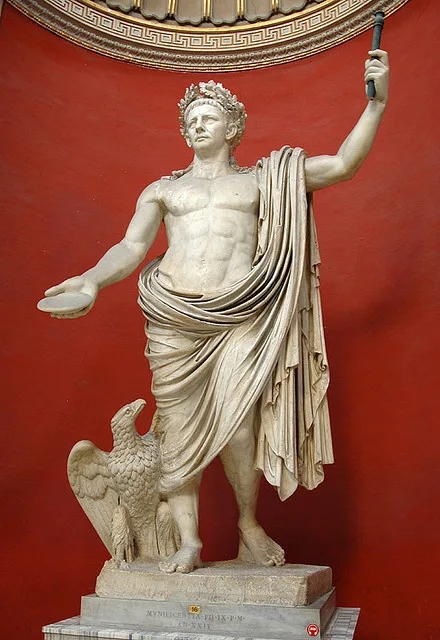
Balbillus accompanied Claudius on his campaign in Britain, a land then regarded as dangerous and unconquerable, not merely as an astrologer but as an official. On their return he also took part in Claudius’s triumph, the ritual procession in which Claudius honoured him with a crown. The emperor himself received the title “Britannicus”. Around this time, Balbillus was appointed high priest of the temple of Hermes in Alexandria and superintendent of imperial buildings and sacred groves in Alexandria and Egypt. He was also specifically appointed head of the university and the Library of Alexandria—an enormous distinction, since this was one of the most coveted offices among scholars of the day.
During a period of unrest, Claudius too was compelled to expel astrologers from Rome and Italy. His son Britannicus was only eleven, and his adopted son by his new wife—the future emperor Nero—was still a teenager. With the succession so uncertain, astrologers could readily discern success and imperial glory in the charts of ambitious clients. From Claudius’s reign onwards, asking questions about members of the imperial family also became evidence of high treason. This followed the trial of a Roman noblewoman who had enquired about the health of the emperor’s wife Agrippina, hoping to secure a marriage to the emperor herself.
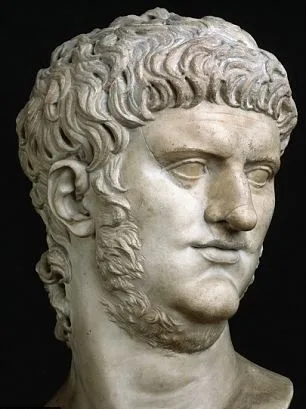
Agrippina was not a woman to be trifled with. She succeeded in marrying Claudius and then placing her son on the throne, despite Balbillus himself having predicted that Nero (pictured) would become emperor, but that she would pay for it with her life. Agrippina replied: “Let him, so long as he reigns.” We do not know whether Balbillus’s astrological advice helped Agrippina become empress after Claudius’s previous wife, but he was certainly on her side.
After Claudius died in suspicious circumstances, Agrippina and Seneca, the distinguished Stoic and Nero’s tutor, followed the astrologers’ instructions and waited for a suitable moment to proclaim Nero emperor. The real powers of the day, Seneca and Agrippina, then appointed Balbillus prefect of Egypt. Balbillus remained Nero’s astrologer, advising him in times of unrest. Nero was, for example, deeply troubled by the appearance of comets, which carried ominous meanings, particularly since this occurred in the midst of the Pisonian conspiracy. Balbillus advised him that, since comets generally claimed the lives of rulers, he could appease the Fates and divert the danger from himself by executing several prominent people. Nero decided to execute the conspirators, and Seneca himself was among those who perished. It is difficult to pass judgement today on Balbillus’s morality and actions—after all, he had to “survive” Nero—but the career of Ptolemy Seleucus likewise shows how closely astrologers were entangled in the political soap operas of their time.
Ptolemy Seleucus was the personal astrologer of Otho, one of the four men who succeeded one another as emperor and fought for power in the year after Nero’s death: Otho, Vitellius, Galba and Vespasian. Otho’s horoscope bore imperial indications, and his wife Poppaea Sabina was a highly ambitious but impatient woman. Unable to wait for the full promise of Otho’s nativity to unfold, she divorced him and succeeded in marrying the reigning emperor, Nero. She took Ptolemy, her former husband’s now former astrologer, to court with her. Ptolemy and Poppaea Sabina were on poor terms with Balbillus, who had to remain constantly on his guard against them. Yet Nero unintentionally killed Poppaea, then pregnant with a daughter, as we saw in the first article, after which Ptolemy returned to his old patron, Otho. With his enemies no longer at court to plot behind his back during his absence, Balbillus could at last breathe freely. He withdrew from Rome and took no part in the political upheavals following Nero’s death.
Besides Tiberius, who left Galba alone after discovering that imperial power awaited him only in old age, Augustus had also foretold his political glory, saying: “Thou too, my child, shalt one day taste imperial power.” That power proved brief and unstable, however. After Galba, astrologers predicted that Otho would overthrow Vitellius. When Otho fell, they “saved face” by finding a new deliverer from Vitellius in Vespasian, who had been proclaimed emperor. Predictably, Vitellius expelled the astrologers, ordering them to leave Rome by 1 October AD 69. Some remained, announcing that the emperor would be dead before the deadline. He was not: Vitellius lived for another three months. He persecuted them mercilessly; many were executed, and in such an atmosphere merely denouncing someone as an astrologer was enough to bring about their immediate downfall. Vitellius nevertheless lost, and Vespasian came to power. Even before reaching Rome, Vespasian ordered the expulsion of astrologers, as well as philosophers—Stoics and Cynics—in a separate edict. Meanwhile, Otho’s former adviser Ptolemy Seleucus had “attached himself” to Vespasian and predicted his success, and Vespasian formally accepted him into his service after taking power. Yet Vespasian also kept Balbillus in his camp, so the two astrologers’ paths crossed once again in the service of the same emperor.
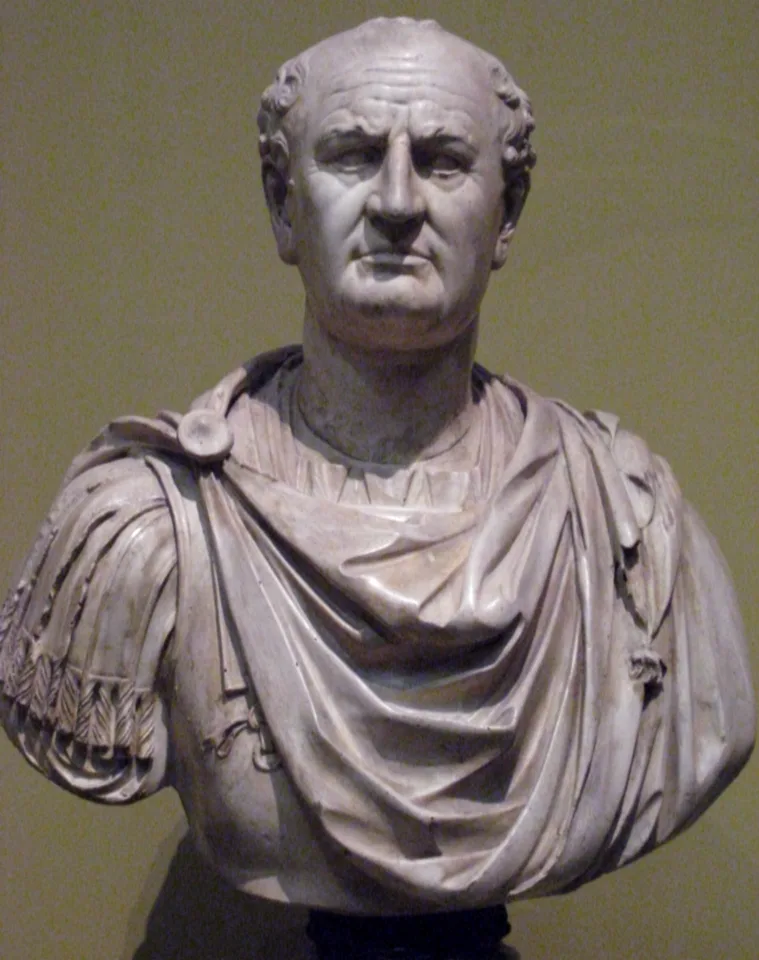
The difference in their standing was nevertheless clear. Vespasian granted permission for the Ephesians to celebrate sacred games in Balbillus’s honour, and these continued into the third century. It is also highly likely that Balbillus, with his family ties to the royal house of Commagene, persuaded Vespasian to pardon the Commagenians who had rebelled against him. Unlike many emperors, Vespasian (pictured) had such complete confidence in astrology that he neither persecuted those with imperial horoscopes nor put them on trial merely for asking the “forbidden question”. Astrology had revealed that his sons, Titus and Domitian, would succeed him, so he had no reason to worry. Titus appears to have continued his father’s tolerant policy, but Domitian was another matter. We may recall his paranoia about the time of his death from an earlier article. It was precisely this widespread belief in astrology that made questions about the emperors’ future forbidden, and perhaps that same confidence in astrology encouraged the conspirators to choose Domitian’s fateful “fifth hour” to ensure the success of their assassination.
In the next instalment, we shall see how emperors used astrology from the second century until the fall of the Empire.
This article was originally published on the Art of Astrology blog