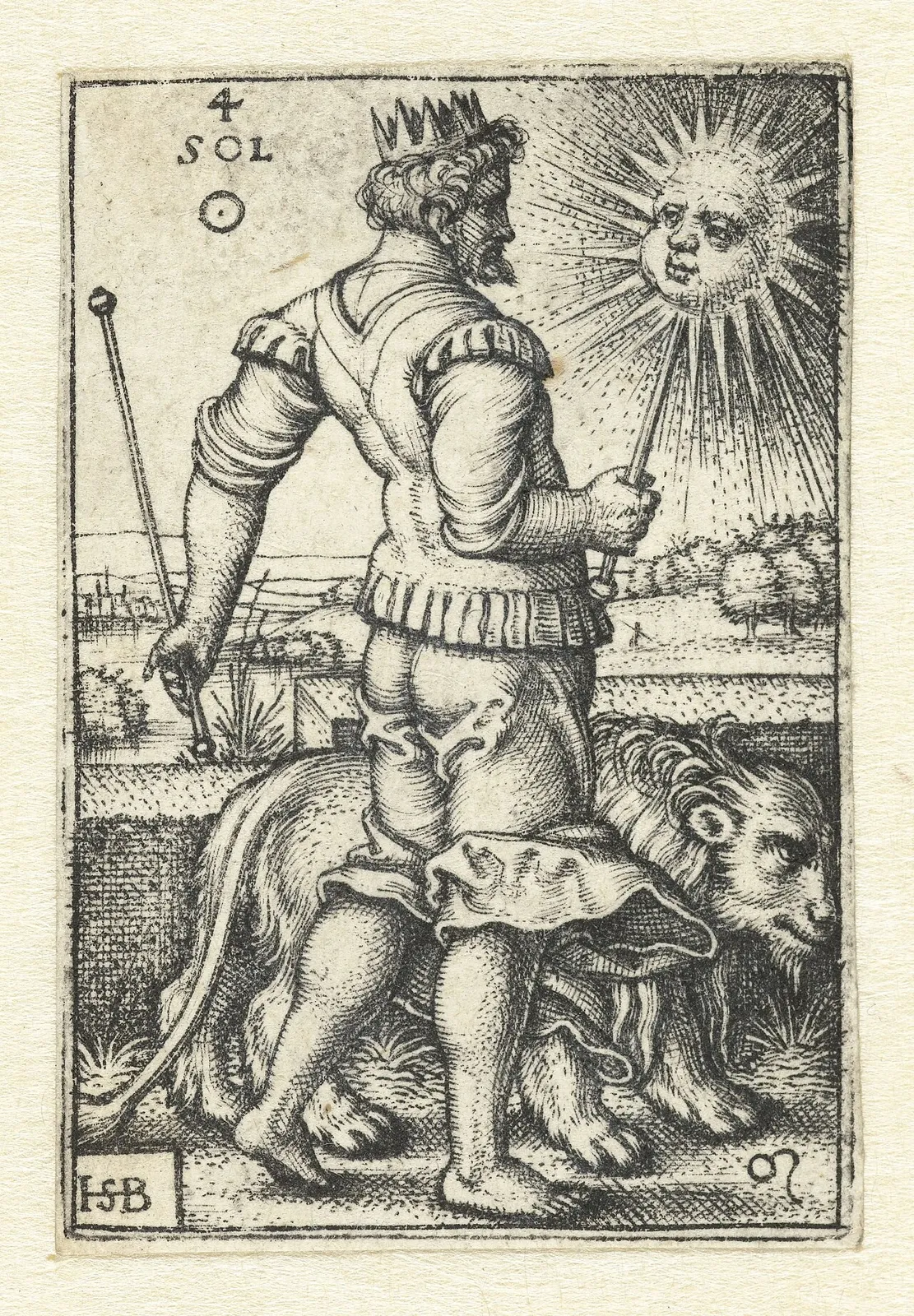
(Decl.: 11°N 58’; Magnitude: 1.3; Nature: Jupiter, Sun) Constellation: Leo (the Lion). This star lies in the body of the Lion and represents its heart (Cor Leonis). It is also known as Rex (king), and Regulus is itself a diminutive of Rex, meaning “Little King”. Another of its symbolic names is “the foot that crushes”. In late 2012 and early 2013, this star moves into Virgo after spending 2,160 years in Leo. It is the foremost of the four Royal Stars and represents the Watcher of the North.
So what is so special about Regulus? It has the X factor: it is a superstar, the Elvis of the fixed stars. It is ranked as exceptionally fortunate, the most benefic star in the universe. Medieval astrologers said that it would bring fame, wealth and glory to all those born under it, calling it the “Royall Starre”. Of course, this does not mean that everyone born with the Sun on Regulus is of royal descent, but they will certainly behave as though they are! Or, to paraphrase Frawley, this does not mean that you will become heir to the English throne if you were born a tailor’s son, but it may mean that you will take up your father’s trade and perhaps raise it to a higher level. Regulus is important because it is one of the brightest stars along the ecliptic. So, rather than the usual orb of 1°30′ allowed for fixed stars, I would give Regulus up to three degrees. William Lilly goes as far as five degrees. Regulus may therefore quite easily be shining on your Sun if you were born between 18 and 28 August, or if you have anything between 25 degrees of Leo and 5 degrees of Virgo.
In the history of astronomy and mythology, Leo was one of the earliest constellations to be recognised, with archaeological evidence showing that a similar constellation was known in Mesopotamia as early as 4000 BC. The Persians called Leo Ser or Shir; the Turks, Artan; the Syrians, Aryo; the Jews, Arye; and the Indians, Simha.
Some mythologists believe that in Sumer, Leo represented the monster Humbaba, who is slain in the Epic of Gilgamesh. In Babylonian astronomy, the constellation was called UR.GU.LA, “the Great Lion”, while Regulus was known as “the star at the Lion’s breast”.
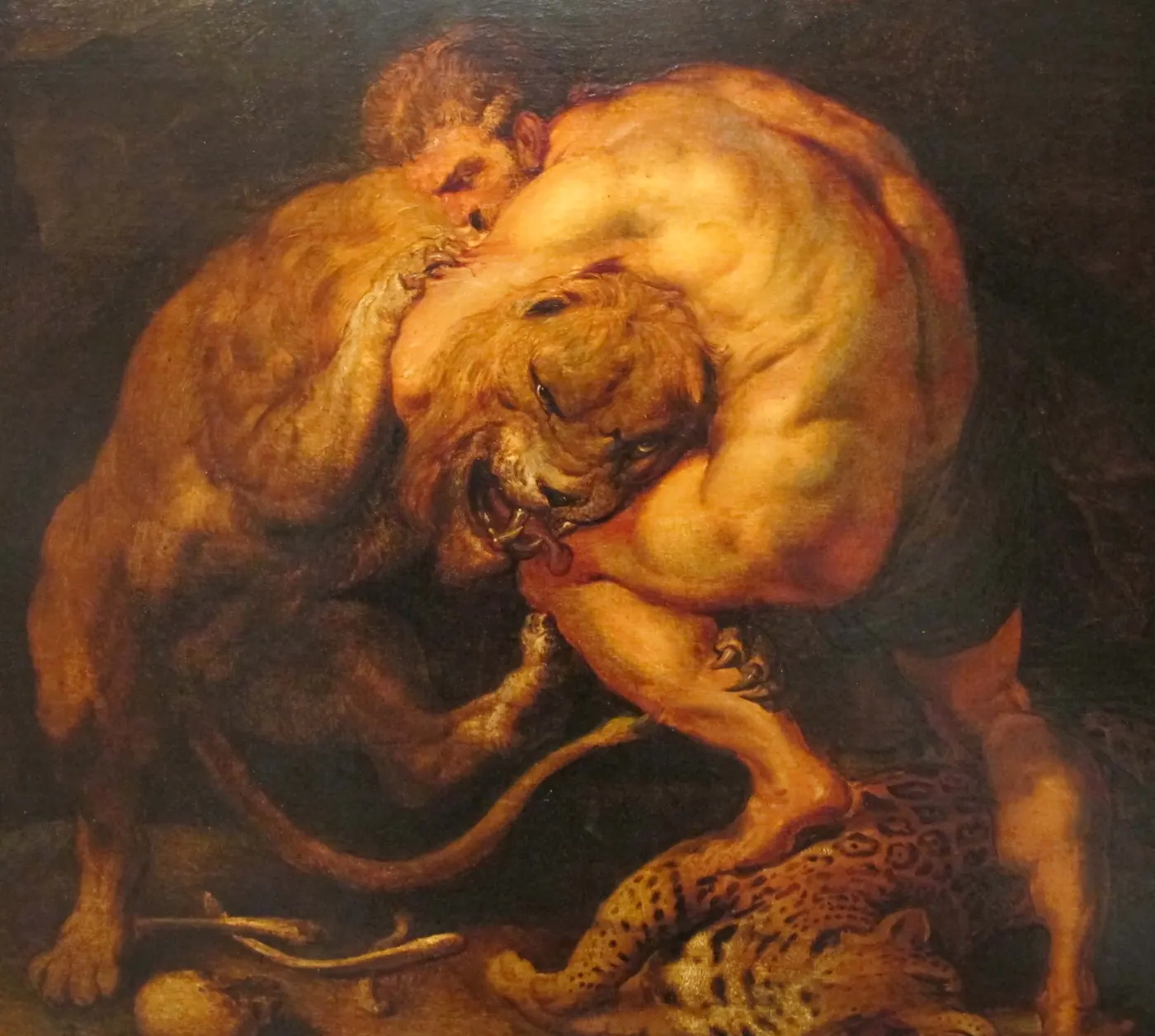
In Greek mythology, Leo was identified with the Nemean Lion, which Hercules slew as the first of his twelve labours. The Nemean Lion would take women hostage and carry them off to its lair in a cave, luring warriors from nearby towns to rescue these damsels in distress—and so to their doom. No weapon could kill the Lion, making clubs, swords and spears quite useless against it. Realising that he would have to overcome the Lion with his bare hands, Hercules crept into its cave and engaged it in combat. When the Lion leapt, Hercules caught it in mid-air, seizing its forelegs with one hand and its hind legs with the other, then bending them backwards, breaking its spine and freeing the captive women. Zeus commemorated this feat by placing the Lion in the heavens.
The effects of Regulus are directly akin to the combined influence of Jupiter and Mars, bringing victory and success; if these planets are favourably placed, the native achieves great success. Particular attention should be paid to the placement of Mars in the nativity, since it is the other planet that represents the nature of Regulus: to the extent that Mars is poorly placed, the native faces the danger of a fall after success. Regulus can raise a person above the circumstances into which they were born, especially when it is on the MC or conjunct the ruler of the Ascendant. If Jupiter is well placed, it bestows a certain nobility of character and openness towards others. With an unfavourable placement, physical dangers and a tendency towards violence are to be expected.
The Mars–Jupiter nature of this star can take you far, and many people born under it are indeed highly successful. Yet the rewards of this great ascent can be taken away quite swiftly if you fall prey to its negative expression. There is a risk of downfall when excessive pride, egomania, arrogance, an obsessive need to conquer and, above all, vengeance come into play. It is said that the higher these “Lions” climb, the greater their risk of falling from grace. Nevertheless, I believe that those most likely to fall are the ones who pursue success and fame for their own benefit, or simply to bolster their egos. But if someone born under Regulus has a genuine passion for their craft or business, allowing others to share in and enjoy their glory, I think our Lion King can sit safely on his comfortable throne.
John Frawley sums this up beautifully:
“The star Regulus is the brightest star in the constellation Leo. It is currently at 29 Leo. The Heart of the Lion. Any star that represents the heart of its constellation epitomises the idea that constellation embodies, so Regulus is the most leonine part of the Lion: a super-lion. It is exceptionally favourable for material achievement, and in horary astrology its influence can be confined to that alone. It is not necessarily a happy star, but it brings success. It has a Mars/Jupiter nature and is one of the Royal Stars, so it can raise you to royal dignity. Margaret Thatcher had the Moon on Regulus near the MC. Regulus is exceptionally good for worldly success. It will take you to the top in any sphere. Yet although we usually think of the nature of desire on an immediate, physical level, it goes beyond that. It is the fundamental ‘More, more, more!’ or ‘What next?’ or ‘Is that all?’ The idea that Regulus raises you to the throne and then brings about your fall is very much the idea that, however high the throne may be, it will never be high enough for you. This is the story of Alexander the Great. He weeps because there are no more worlds to conquer. That is Regulus. Alexander’s birth was delayed until the crucial planet was on Regulus. Regulus—that desire for achievement, together with the fact that achievement will always fall short of what the person aspires to—is the heart of the Lion. It lies at the very heart of the body that the soul assumes. And once you have boarded the bus, you cannot get off. Once you begin to be a solar hero, as Hercules does, you are trapped in that body until the end.”
Influence: According to Ptolemy, its nature is like that of Mars and Jupiter, although most recognised authors compare it to Mars alone, while Alvidas maintains that its effects resemble a favourable aspect between the Sun and Uranus. It brings violence, destructiveness, short-lived military honours followed by ultimate failure, imprisonment, violent death, success, lofty and magnificent ideals, and strength of spirit. It makes those born under its influence magnanimous, exceedingly liberal, noble and ambitious, instilling a love of power and a desire to command, and bestowing boldness and independence.
In his 145th Consideration, Guido Bonatti records:
“… When in a diurnal nativity thou findest Cor Leonis on the Ascendant, that is to say, on the eastern line, one degree below it or three degrees above it, or in the tenth house, without conjunction or any aspect of the benefics, it signifies that the native shall be a person of great consequence, powerful and highly exalted, attaining high office and honours notwithstanding his humble birth. If any benefic occupies that place, his glory shall be yet greater; but if the nativity be nocturnal, his fortune shall be diminished, though not greatly. If, however, the malefics cast their aspects there, it shall be much diminished—and if the benefics are also present, they shall increase the promised good by a fourth part and mitigate the evil in like measure. Yet, notwithstanding all this, he shall meet with an unhappy death, or at the least all his glory, eminence and power shall suffer an eclipse and be obscured by clouds.”
William Lilly writes of Regulus:
“Basilisk, or the Heart of the Lion, at 24° Leo—as I have said of the other fixed stars when either the significator of manners or the Lord of the Ascendant is in conjunction with them, or with any one of them, so likewise I say that, if either of these be corporally joined with the Heart of the Lion, it shows the native to be magnanimous, noble and courteous, desirous of dominion, or seeking to rule over others.”
He also adds that the primary direction of the MC, Ascendant, Sun or Moon to this star brings a period of increased wealth, good fortune and reputation, and indicates support from eminent people. When well placed, it promises the greatest good fortune, but owing to its choleric nature, Lilly observes that the native will “… suffer by some disgraceful words, and also by some acute or choleric disease, unless the same be carefully prevented by medicine.”

On the Ascendant: great honours and wealth, but with violence and trouble; sickness, fevers, acute illnesses, short-lived prosperity, favour from those in high places, victory over enemies, and scandals. Here Dupor sees it as an indication of great authority and advancement, with a love of honour and luxury. One example is Elton John, who has Regulus on the Ascendant and did indeed receive a royal commission when he played at Princess Diana’s funeral. Fittingly, he also wrote the theme music for “The Lion King”. He has sold more than 250 million records, ranking him among the most successful singers and songwriters of all time. He was knighted for his services to music and charity. As we can see, Elton has received more than his fair share of the glory of Regulus, although he has struggled with alcohol and cocaine addiction. Elton has also suffered from bulimia for some time. At the Midheaven: honours, advancement, good fortune, high government office and military success. When with the Sun, Moon or Jupiter, great honours and immense good fortune follow. With the Sun: power, authority, great influence over enemies, honours and wealth, but with violence, trouble, disgrace and eventual ruin; illness, fevers, and gains that seldom last. Perhaps the most familiar example to us of the Sun—and Mercury—on Regulus is Slobodan Milošević. With the Moon: an interest in the occult, powerful enemies, danger from enemies, gains through speculation, public prominence, great power, honours and wealth, short-lived benefits, violence, trouble and illness. It makes women proud and independent. An example is Margaret Thatcher, mentioned above, who in 1990 suffered a fall typical of Regulus. If, at the same time, the Moon is with the Dragon’s Head in Gemini, Jupiter is in the tenth house in trine to Mars, and the Sun is with the Dragon’s Head, great advancement follows, even from the lowest station to the highest rank. With Mercury: honesty, fairness, popularity, nobility of character exploited by opponents, fame, and gains through high position. With Venus: many disappointments, unexpected events, turbulent relationships, and trouble through love affairs. With Mars: honour, fame, strength of character, public prominence and high military rank. Henry Ford, founder of the Ford Motor Company, had Regulus with Mars and on the Ascendant. Ford became one of the wealthiest men in the world, partly through his system of “Fordism”, under which he paid his workers twice as much as his competitors did. This honourable act certainly encouraged further growth. He remained dominant for a long time, until he went against his own pacifist stance. By the Second World War, his company was being used to produce armaments. He subsequently suffered a series of strokes and became senile, thus losing all real power. With Jupiter: fame, attainment of high office, especially in the military, and high military rank. When also on the MC with Jupiter, it brings great recognition and eminence, wealth and authority. With Saturn: fairness, friends among the clergy, success in ecclesiastical or legal affairs, learning, prosperity, gains through speculation, companies or friends, high position, pride in home and family, good health, and heart trouble towards the end of life. If the star is angular, especially rising or culminating, it indicates honours and public trust. If Mars is in the Pleiades, violent death in some disturbance. According to Dupor, a fall in social standing and violent death. With Uranus: energy, ambition, success, possible injustice or dishonesty, self-aggrandisement, high official position, association with the nobility, involvement with religion for business purposes, gains through speculation and companies, favourable for marriage, grief at the death of a daughter and disappointment in a son, with friends turning into enemies towards the end of life. Possible withdrawal from the world into a solitary life, and violent death through accident or murder. With Neptune: a distinguished leader or lawgiver, diplomatic conduct, strength of character, the ability to establish control over others, influential friends, few enemies, domestic harmony, and a natural death at an advanced age. With the malefic planets and the Moon on Antares, Praesepe or the Pleiades, blindness or injuries to the eyes.