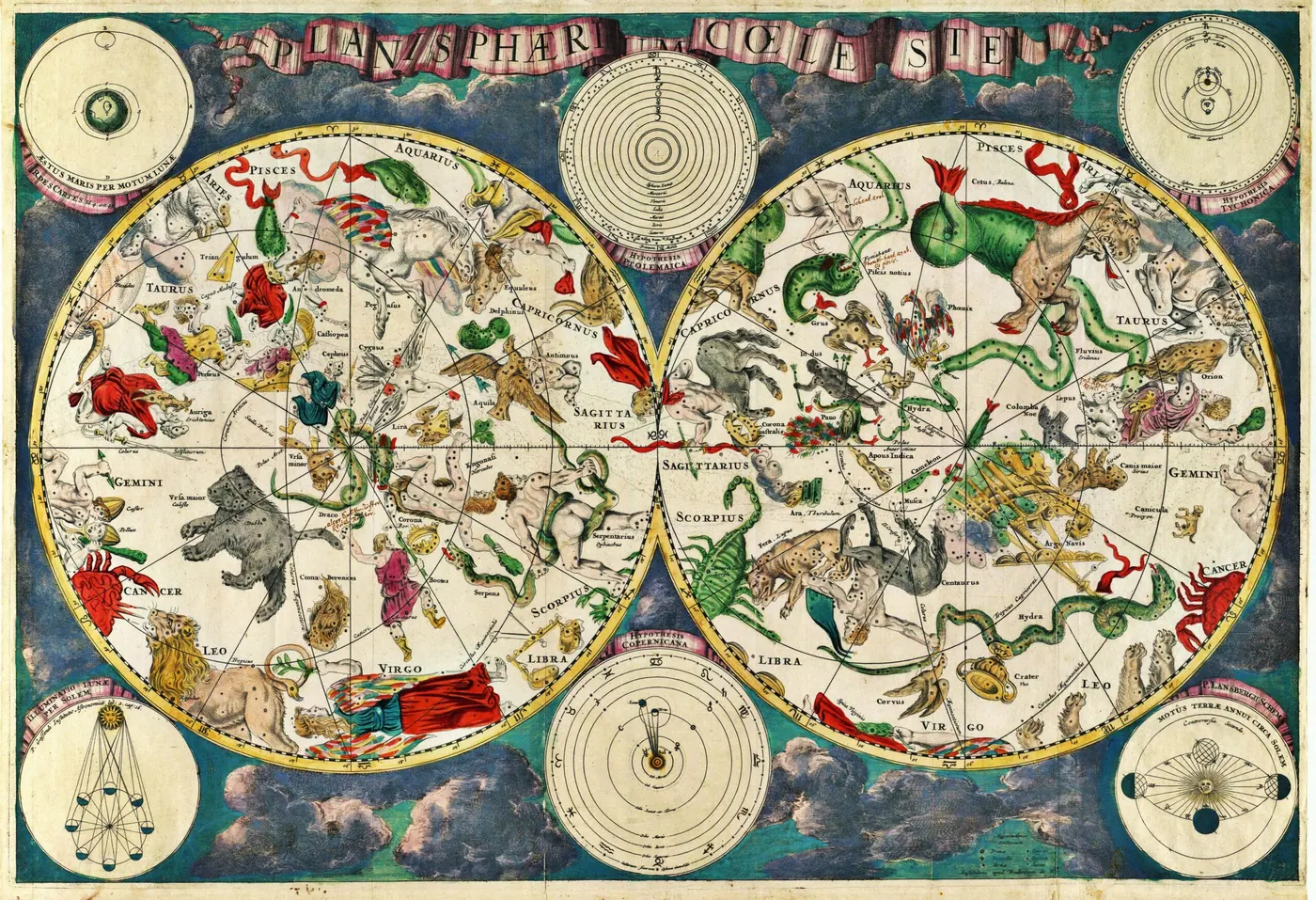
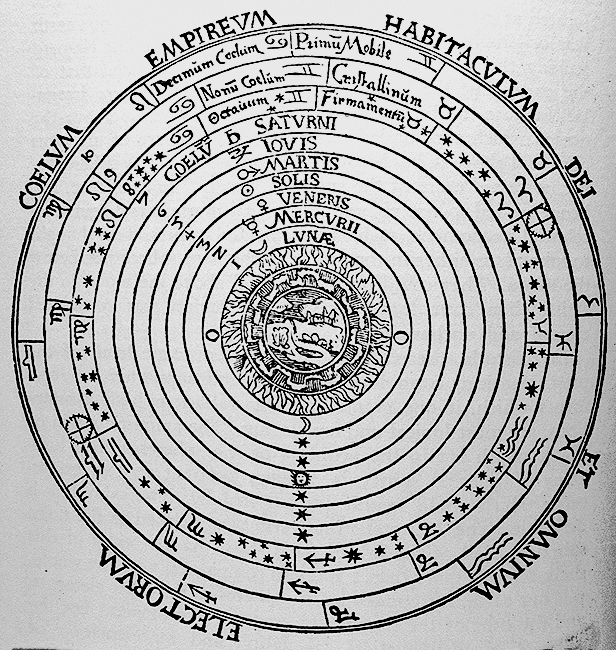
The fixed stars are what we ordinarily call ‘stars’, as distinct from the ‘wandering stars’, or planets. As a glance at the night sky will confirm, there are a great many fixed stars. About a hundred have considerable astrological significance, and their importance increases as we move up the astrological scale: they are very useful in natal astrology and indispensable in mundane astrology, while horary enquiries generally lie beyond the scope of their influence. Within the traditional cosmological model—the only one relevant to astrology—the fixed stars belong to the eighth sphere, above the seven planetary spheres. Above the sphere of the fixed stars lie three further spheres, immaterial and invisible, whose significance is metaphysical. These are the sphere of the zodiac, representing the totality of archetypal possibilities of creation, articulated and realised through the material, visible spheres of the fixed stars and planets, and two divine spheres at the very summit of this hierarchy. The sphere of the zodiacal signs is, in fact, the divine intellect, the first mover (primum mobile), through which all the lower spheres move, including that of the fixed stars. Beneath the sphere of the Moon lies the sublunary world, to which humanity belongs, composed of the four basic elements and their combinations. Titus Burckhardt aptly described the philosophical, and to some extent practical, significance of this arrangement:
The gradation of the celestial spheres reflects the ontological order of the world, in which each successive degree of existence is such that the higher ‘contains’ the lower, just as a cause ‘contains’ its effect. Thus, the wider the celestial sphere in which the stars move, the purer, less conditioned and closer to the divine source is the corresponding degree of existence or level of consciousness.
The influence of the fixed stars consequently differs from that of the planets, being essentially far more dramatic, sudden and violent. As a rule, planetary influences unfold gradually and relatively slowly—almost quietly, one might say—whereas the stars seem to exert most of their influence in sudden, forceful, sharp bursts, producing tremendous effects over short periods. Having raised the native to great heights, they may abruptly cast them down again through a succession of dramatic and unexpected catastrophes. In other words, the fixed stars can raise someone from poverty to immense wealth, or the reverse, whereas the planets do not act in this way. As a rule, the stars do not act alone, except perhaps when placed on the angles; their principal effects are transmitted through the planets. They seem to form a kind of foundation upon which the horoscope is built. When a planet falls upon a star, the star’s action is greatly amplified, giving it a prominence in the life quite unexpected from the planet’s position and aspects in the chart alone. Astrologers are familiar with cases in which a particular planet’s influence is emphasised for no apparent reason, with dramatic consequences throughout the life. In such cases, however, there is usually a fixed star operating in the background through the planet concerned.
The extent and significance of a star’s effects depend on several factors: (a) apparent magnitude, (b) celestial position, (c) the nature of the planet through which it exerts its influence, (d) the mythology of the constellation to which it belongs, and (e) the general character of the horoscope.
(A) Apparent magnitude: A star’s magnitude bears a definite relationship to the intensity of its action. A first-magnitude star exerts a powerful influence, a second-magnitude star is considerably weaker, and so on. Stars fainter than the fourth magnitude have very little effect, except in the case of clusters.
(B) Celestial position: The closer a star lies to the ecliptic, the greater its power. In the northern hemisphere, a star of northern declination is more powerful than one of southern declination, while the reverse applies in the southern hemisphere. It is often said that stars of high celestial latitude cannot affect us, but this assumption is highly questionable. Experience, particularly with comets, seems to suggest that bodies in every region of the celestial sphere can exert an influence upon the earth and its inhabitants.
(C) The nature of the planet through which they act: As already noted, the fixed stars lend strength and energy to the planets and modify their effects, but the nature of the planet itself also exercises considerable control over the outcome. The greatest effect occurs when the star and planet share the same nature: in such cases, the planet’s influence becomes exceptionally powerful, while the star’s malefic effect is diminished. Thus, if Mars falls upon a star of its own nature, its power increases. If it falls upon stars of the nature of Jupiter or Venus, its influence is reduced and modified, while a star of Saturn’s nature alters it considerably. In other words, a planet gains intensity when it falls upon stars of a similar nature; upon one of a contrary nature, its expression becomes subdued and distorted, and it may have a somewhat dulling effect upon the character.
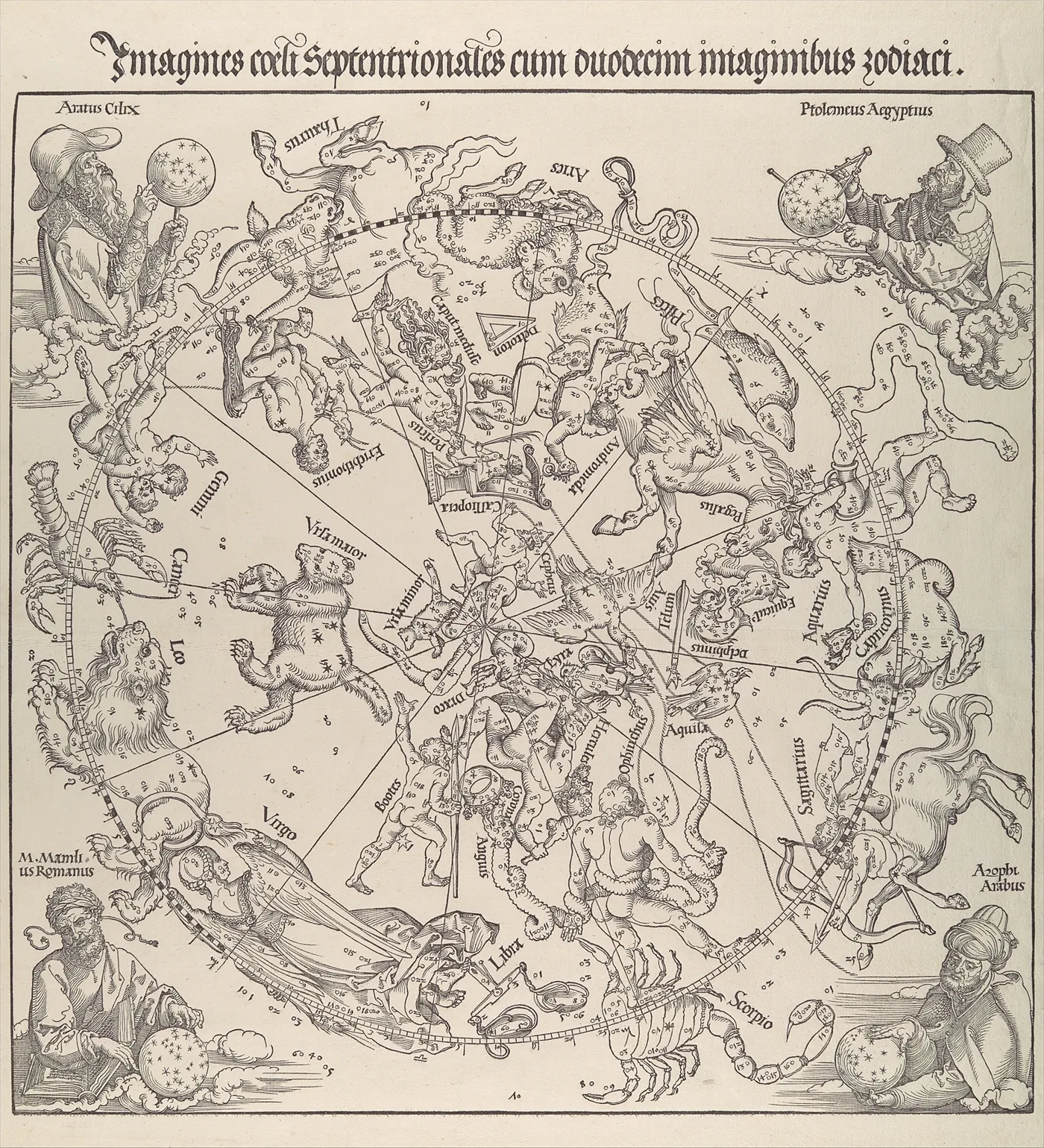
(D) The mythology of the constellation. Another important principle in working with the fixed stars is the mythological significance of the stars themselves, or rather of the constellations to which they belong. Many authors suggest that the figures of the constellations are somehow predetermined, that they really exist up there in the sky, but this is simply not true. These stellar images are not in the sky; they cannot exist there in that form. Even the grouping of the stars is not something that exists in the heavens themselves. The constellations are not neatly arranged figures, but a confusing jumble, overlapping one another. In some constellations, such as Aries, there are three rather unremarkable stars lying more or less close together. In others, such as Eridanus or Draco, a sequence of stars stretches across half the sky. No one ever happened to glance at those stars and thought they belonged together. Rather, there was a recognition that these stars belonged together in much the same way as members of a family. Their grouping into constellations expresses this recognition. Once grouped in this way, these families have a particular nature, discernible just as we recognise families whose members are all bad people, or the reverse. The same applies to the stars, and this is why they were associated with a particular image. A myth was also attached to them, embodying their nature and telling their story. Studying the story conveyed by a constellation’s myth is an exceptionally important key to understanding the influence of an individual star.
(E) The general character of the horoscope: This is an important consideration that must not be forgotten. The outcome of a star’s action through a planet depends largely upon that planet’s strength or weakness in the horoscope. In a natal chart indicating great ability and high standing, success attained through a star’s influence will therefore be more enduring than in a nativity without such indications. Moreover, the fixed stars never contradict the planetary indications. A person will not become a murderer, thief or forger solely through a star’s influence: the general character of the chart must also point in that direction. The stars’ principal function is to emphasise qualities, not to bestow new ones, so their precise nature and effects must be judged according to the usual rules of astrology.
The fixed stars act according to their position and are said to ‘cast no rays’. In other words, their aspects are considered ineffective, and their influence is exerted chiefly through conjunction or parallel. Like the planets, they are most powerful on the angles and weak in cadent houses. Their effects are highly significant when they rise on the Ascendant, culminate on the MC, or occupy the nadir, even when acting alone. In such cases, all first-magnitude stars confer honour and advancement. If the star is of the nature of Mars, these will either be lost or maintained amid trouble and danger; if it is of the nature of Saturn, it may bring eventual disgrace and ruin. The angle occupied modifies the influence: in the 10th house it affects the profession; in the 7th, partnerships; in the 4th, the home; and in the 1st, the native personally.
The stars exert their most powerful effects when in conjunction or parallel with a planet, as we shall discuss in greater detail in subsequent articles. Conjunctions are usually treated in precisely the same way as planetary conjunctions in a horoscope—that is, by degree of ecliptic longitude—and parallels by declination, though the orbs are generally much smaller. Nevertheless, opposition may prove almost as powerful as conjunction, while the square has an undeniable influence that it would be unwise to disregard, although many consider its effects less significant. Trines and sextiles have very little effect, if any.
The fixed stars are of the utmost importance in the major events of life. They become especially significant when we begin to progress the horoscope, since major life events will be shown very reliably by conjunctions of the chart’s progressed key points with fixed stars. As already noted, however, they are also important in the underlying map of the life, indicating its potentials.
It remains to consider the actual natures of the fixed stars and how these are described. The generally accepted method of expressing a star’s influence is to compare it with that of the planets of the Solar System. A particular star may, for example, be ‘of the nature of Mars’, meaning that it possesses characteristics similar to those normally displayed by that planet in a horoscope. Often, however, two or more planets are named in the description. In such cases, the first planet named should be understood as describing the star’s principal influence, while the second describes a modifying influence. A star of the nature of Mars and Jupiter, for instance, has an influence resembling that of Mars, but modified by Jupiter’s nature. Its purely martial qualities thus acquire Jupiter’s expansiveness, with more optimism and good fortune than would otherwise be present, and so forth.
This method of classifying and describing the precise nature of the stars allows us to gain a sound understanding of each one. By combining it with the sign and decan occupied by the star, together with the planet and house through which it acts in a particular nativity, we can refine our judgement of its specific effects considerably. We can also assess how another, little-known star may act, since its nature can be inferred from the general character of the constellation to which it belongs.
We do not know how these natures were first discovered or established, for Ptolemy, to whom we owe these interpretations, gives no rules for determining them. That he followed some set of rules seems clear; otherwise, it is difficult to understand how such fine distinctions of influence could have been discerned. According to Agrippa, the natures of these fixed stars are known through the resemblance of their colours to those of the planets.
There should be little difficulty in using the fixed stars in natal astrology, but for beginners it is worth setting out the following rules:
I. Mark on the chart, or draw up a list of, the fixed stars in conjunction, parallel or opposition with the planets, together with their magnitudes and natures.
The following orbs may be allowed for conjunction and opposition: up to 7 degrees 30 minutes for first-magnitude stars; 5 degrees 30 minutes for second-magnitude stars; 3 degrees 40 minutes for third-magnitude stars; and 1 degree 30 minutes for fourth-magnitude stars. These are general guidelines, but I must stress that I do not agree with these orbs. An orb of one degree seems acceptable to me for first-magnitude fixed stars. For Sirius, by far the brightest star, I would allow a maximum of 2 degrees. I would agree with Anne Wright, who allows about 1 degree 15 minutes for first-magnitude stars, gradually reducing this to 15 minutes for sixth-magnitude stars.
II. Identify the constellation containing the star and its nature, which we shall explore further, and combine the influences of the constellation, star and planet.
III. Modify these characteristics according to the sign, decan and house occupied by the star, together with the aspects to the planet and the house it rules, just as with ordinary planetary conjunctions.
IV. The star’s magnitude and its position in an angular, succedent or cadent house will give some indication of the strength of the influence it will exert.