Of all astrological terms, Mercury retrograde is certainly attracting ever more publicity. Its retrograde periods are all too familiar as times when communication problems and misunderstandings may arise, signing contracts is discouraged, poor judgements and decisions seem inevitable, travel and traffic can be troublesome, and important documents, including identity papers, may go missing. Drawing on recent experience, I must add one more warning to this list—and to Mercury retrograde’s already poor reputation: do not give interviews while Mercury is retrograde! 🙂
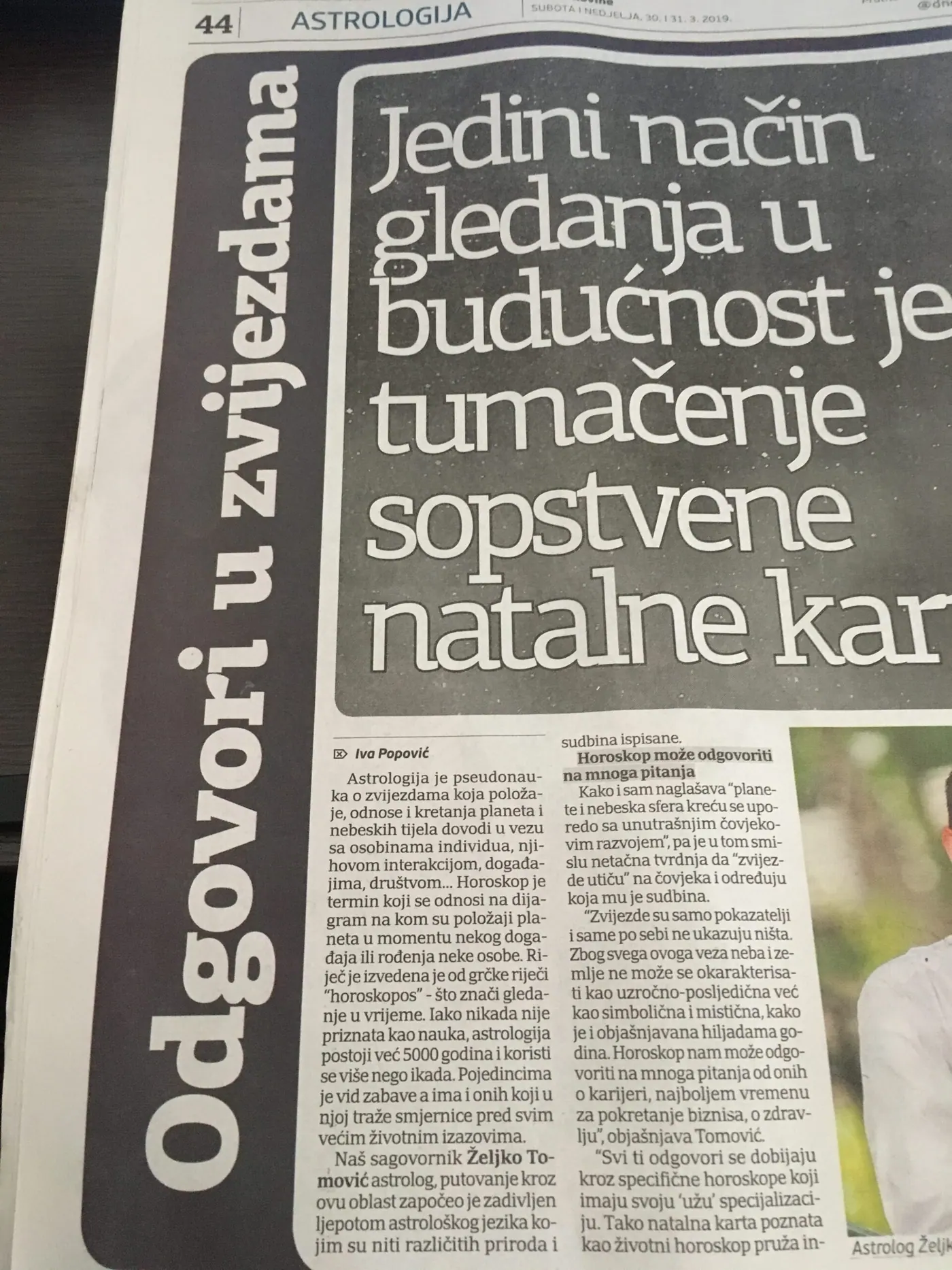
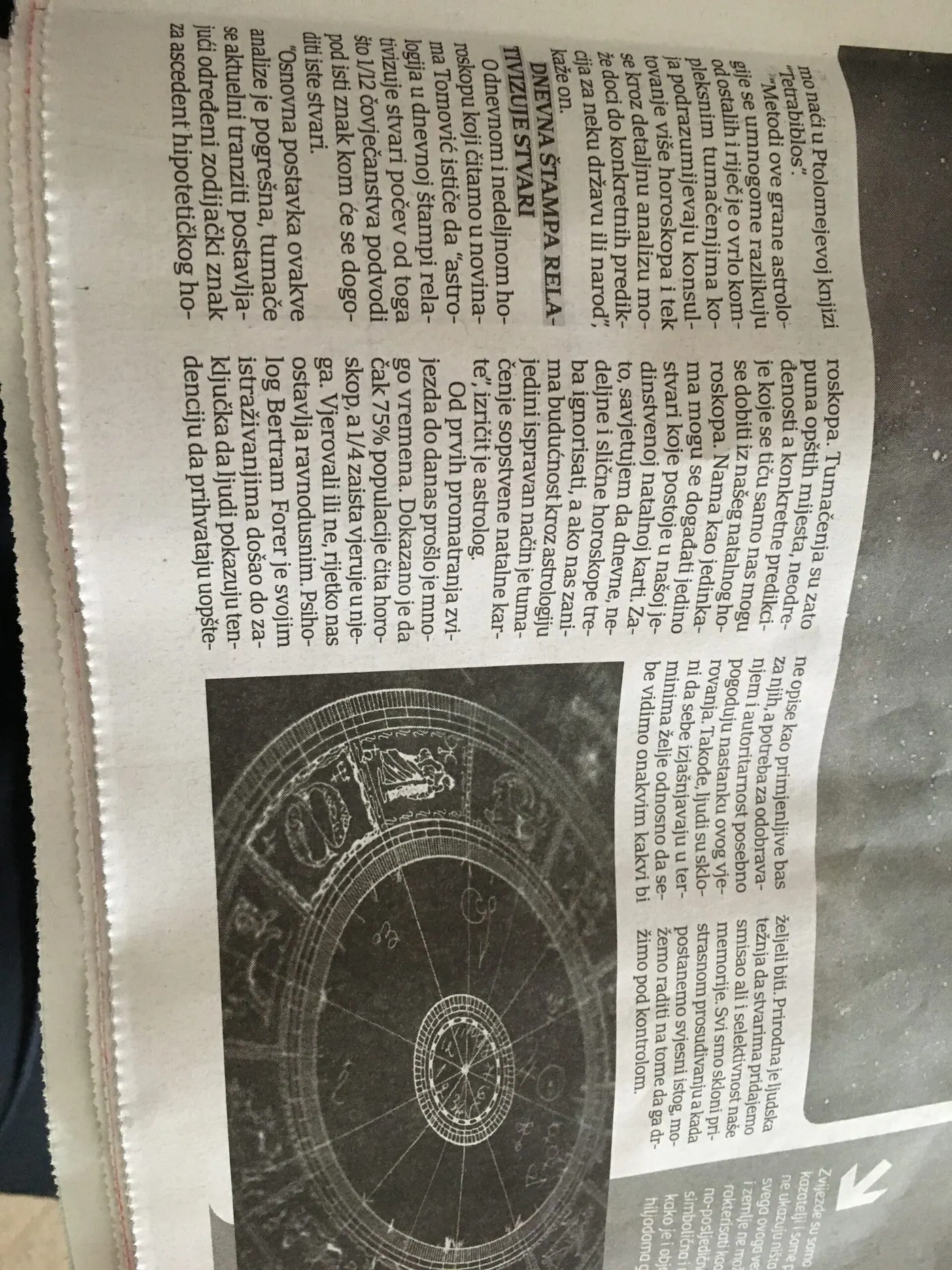
About ten days ago, I spoke to a journalist from the local newspaper Dnevne novine, answering questions intended to give a wider audience a better understanding of astrology. Yet when the article appeared, it contained numerous serious shortcomings that not only defeated its original purpose but could also leave readers even more confused, despite the journalist’s undoubtedly good intentions. For these reasons, and to safeguard my integrity and the approach to astrology I cultivate on this website, I have decided to publish the interview here in full.
- Why did you choose astrology in particular?
I can honestly say that I have always been fascinated by one of astrology’s fundamental premises: that each of us lives out a “piece of heaven” uniquely our own. This also inspired me to explore that premise as thoroughly as possible. As I found it confirmed in practice, I discovered the beauty of the astrological language in which the threads of different natures and destinies are inscribed. Thus this art took deep root in my spirit and being, already steeped in the study of Hermeticism. I was particularly intrigued by the synchronistic connection through which that piece of heaven manifests in everyday life. Its essence lies in the simultaneous unfolding of changes and cycles in the heavens, through planetary movements, and within the human being, without a cause-and-effect relationship between the two. The planets and the celestial sphere thus move in parallel with our inner development; in this sense, it is incorrect to claim that the “stars influence” us and determine our fate through that influence. The stars are merely indicators and, in themselves, cause nothing. For all these reasons, the astrological relationship between heaven and Earth cannot be described as causal, as it so often is today, but rather as symbolic and mystical, as it was understood for thousands of years. Taken together, these and many other insights have convinced me that astrology truly “works”, and on many levels beyond that initial premise.
- What do people most often ask you?
The questions are remarkably varied, and their breadth has convinced me that astrological symbolism can lead us to almost any answer. From questions about lost possessions, through the sorrows and joys of love, to matters we might call philosophical, the answer has always lain hidden in the mystical connection I mentioned in my previous answer, as represented in the relevant chart. Although I initially assumed that questions about love would make up the bulk of enquiries, this has not proved to be the case. Alongside these, questions about work and career, legal disputes, health and even death are very common.
- How do people’s interests now compare with those of the past?
There is little scope for a meaningful comparison, since the questions remain much the same. Nevertheless, it is worth mentioning that more and more people have recently been asking about choosing the most favourable moment to begin an undertaking, or even for the birth of a child. The scope for intervention in the latter case is very limited, but such requests have been made. This can certainly be seen as a sign of growing confidence in astrology and its capabilities: people are seeking to give their endeavours a “cosmic seal”, are they not?
- What kinds of answers can a horoscope offer?
As I have already suggested, a horoscope can provide answers to all manner of questions. “Which career suits me best?”, “When is the best time to start my own business?” and “Will I have children?” are practical questions to which astrology can give concrete answers. Yet it can also address deeper concerns, such as “How can I best fulfil my purpose?” These answers come through particular types of chart, each with its own “specialism”. A natal chart, also known as a “life horoscope”, provides information about many different areas of life: aptitude for education and professional development; choice of occupation and career; business and financial circumstances; talents; love and marriage; offspring and relationships with children; health conditions and risks… An annual horoscope covers the same areas over the course of a year, usually from one birthday to the next, and is based on the natal chart. A relationship chart examines a particular relationship, offering valuable information about the harmony and compatibility between two people, and the level on which that harmony actually exists. From this, conclusions can be drawn about the relationship’s longevity. The broadest range of questions is covered by horary charts, an exceptionally useful astrological tool for giving precise answers to clear, specific questions. Will I get a job at that company? Will I marry him? Does he love me? Should I take that journey? Will I pass this exam? Will they repay the debt? Whereas natal astrology is useful for a more general overview of the native’s life, horary astrology seeks to provide practical, “yes or no” answers to these and many other questions.
- Can a horoscope answer questions about society as a whole and the future of a country or the world?
Yes. These questions belong to a particular branch of astrology known as mundane astrology. It concerns collective matters: the destinies of countries, wars, revolutions, states, regions, climatic changes, economic progress, social events and similar developments affecting large numbers of people. Sometimes events are readily discernible because their indications are particularly striking; at other times, prediction is a subtler undertaking. We can find the beginnings of mundane astrology in Ptolemy’s “Tetrabiblos”, where he describes the differences between peoples and their associations with particular zodiac signs. He maintains that national characteristics and the customs of different countries derive from the geographical longitudes and latitudes at which their peoples live, and the relationship of these locations to the Sun’s position. The methods of this branch differ considerably from those used elsewhere in astrology. Its judgements are highly complex and require the consultation of several different charts: the Sun’s ingress into Aries for the territory concerned, as well as its passage through the other equinoctial points; charts for solar and lunar eclipses; and charts for the great conjunctions—that is, the conjunctions of the chronocrators Saturn and Jupiter, which occur every twenty years. These conjunctions also have their own cycles of changes in triplicity, with the shortest cycle lasting around 200 years and the longest nearly 800. Only through such detailed analysis can specific predictions be made for a country or a people.
- What is the most interesting chart you have worked on, or a detail that has stayed with you?
There have been all manner of curious cases and interesting situations, but I would single out a project that presented a particular challenge. I had a client who traded on the financial markets and was trying to predict periods of rising and falling currency and commodity prices on the Forex market. Although this was an entirely new field of astrological interpretation and prediction for me, we nevertheless managed to develop a system with a high success rate across frequently repeated forecasts. I deliberately say “we”, because this is one example of how a client’s experience can help an astrologer develop such specialised astrological systems. At one point, the degree of accuracy was such that the brokerage firm was giving the client recommendations contrary to our predictions, while expressing surprise at his investments and the profits that followed.
- Do horoscope readings tend towards vague generalisations, making statements seem true of us personally when they could actually apply to almost anyone?
We have the modern astrology of the daily press to “thank” for this tendency. It certainly reduces things to generalities, beginning with the assumption that one-twelfth of humanity falls under the same sign and will experience the same events. Such “predictions” have to be framed broadly, in statements that really could apply to anyone, because their underlying premise is wrong. What they do is interpret current transits by placing a particular zodiac sign on the Ascendant of a hypothetical chart. Only in very rare cases could these predictions prove true; generally, this is impossible, which is why we end up with interpretations full of so-called “commonplaces” and vagueness. Predictions that are specific and true for us alone can come only from our own natal chart and the relevant predictive techniques derived from it. As individuals, we can experience only those things indicated in our unique natal chart, and only when their time arrives—that is, when they are activated through predictive techniques. The wisest course, therefore, is to ignore these daily, weekly and similar so-called horoscopes. If we are interested in exploring the future through astrology, the only sound approach is to have our own natal chart interpreted.
- How did the zodiac signs originate, and how were their characteristics established?
The sign characteristics we most often encounter today are also a product of the so-called “reformation” of astrology. In reality, this is simply a trivialisation of the subject designed to make it more accessible to the masses. Nowadays, people meeting for the first time will quite often ask, “What’s your star sign?”—as though this might offer a better insight into someone’s character. I frequently hear people say, “I’m a Sagittarius”, or “That’s how we Aquarians are”, and so on. This not only reduces personality to an inaccurate correlation but reduces the whole person to a zodiac sign—and not even to the sign itself, but to our imperfect, and often mistaken, conception of it. These are mere speculations, with no astrological foundation.
In the tradition, zodiac signs never possessed a “personality” that could automatically be applied to everyone born on a particular date. The approach was different. Traditional authors do not give “descriptions” of the signs in the sense of assigning them personality traits. Generally, they list their qualities, followed by the things associated with them through symbolic correspondence: professions, animals, places, colours and so forth. Aquarius, for example, is fixed, airy (and therefore hot and moist), diurnal rather than nocturnal, masculine, human rather than animal like Aries or Leo, vocal rather than mute like the water signs, and Saturn’s principal sign, among other things. Logical conclusions can be drawn from these qualities, but they must remain consistent with them. Aquarius would therefore be talkative, as a human and vocal sign; stubborn, because it is fixed; intellectual, because it is airy and human; and inclined towards structure, because it belongs to Saturn, and so on. As a masculine, airy, human and intellectual sign, Aquarius is more oriented towards the future and forward movement than, say, Capricorn, Saturn’s other sign. This does not, however, free it from its fixed, Saturnian nature: it cannot therefore be so independent, rebellious, or prone to sudden and unexpected changes. This is the only purely astrological method by which certain characteristics of the zodiac signs can be delineated. The attribution of all these qualities to the signs arises from the complex yet coherent and clear system of authentic astrology; a fuller explanation would take us beyond the scope of this interview.
I have also included the article as it was eventually published. Editorial policy aside, as I have already said, the published version is plainly incomplete and disjointed, with additions I did not write, such as the introduction and conclusion.