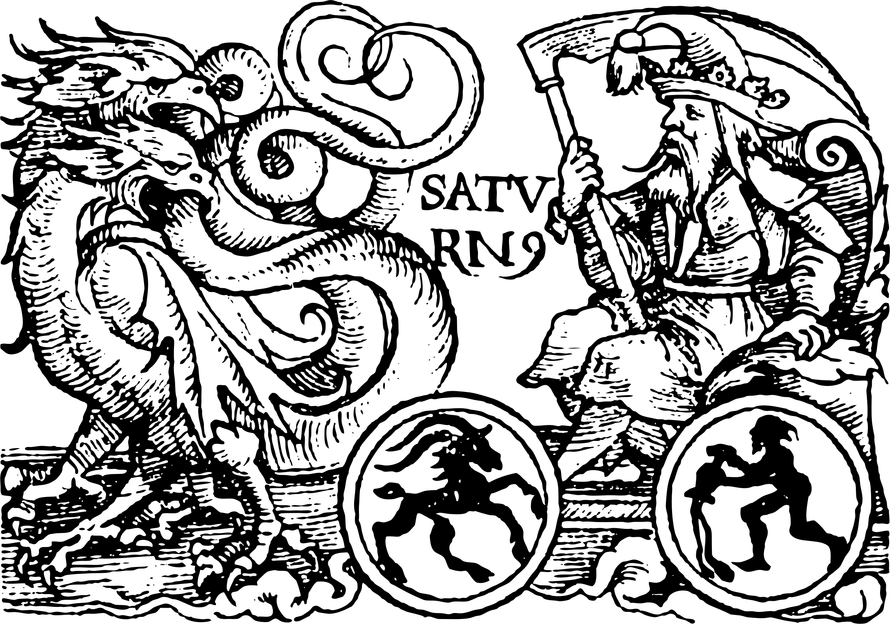
Saturn entered Aquarius on 21 March 2020 and will remain there until 1 July, when his retrograde motion takes him back into Capricorn. He re-enters Aquarius on 16 December, remaining there until 7 March 2023.
Saturn represents the totality of the known universe, as far as human perception can reach. In traditional cosmology, Saturn rules the outermost of the planetary spheres encircling the Earth: his sphere marks the boundary between the planetary spheres and the fixed stars, where the mythical, eternal forms dwell, more enduring even than the personal gods. This is also why Saturn rules boundaries, walls and locks; to pass beyond his sphere is virtually impossible. He represents the limits of our experience and understanding.
This exploration of Saturn’s journey through Aquarius and Capricorn—through his own domiciles, in other words—will take a somewhat different approach from the usual themes addressed in the many astrological articles on this transit. As the author of these lines, I believe this ingress has particular significance for a subject we have explored before, in the trilogy on the Age of Aquarius, which you can read here: The Age of Aquarius – Part One; The Age of Aquarius – Part Two and The Age of Aquarius – Part Three, or When Does the New Age Begin? I shall attempt to explain this view below.
Solve et Coagula
The medieval alchemists’ motto, “solve et coagula”, means “dissolve and coagulate”. The first step, dissolution, weakens material bonds and transforms solid matter into a finer, lighter substance. Once the Prima Materia has been broken down into its smallest constituent parts, the process moves on to coagulation, or gathering together, in which it is built anew, this time using purified or spiritualised Materia. The result is the Philosopher’s Stone, or Elixir of Life, a substance with legendary powers of healing and transformation.
This alchemical process is analogous to Saturn’s passage through Capricorn and Aquarius. Saturn moves into his diurnal domicile, Aquarius, leaving behind his nocturnal domicile, Capricorn. As a diurnal planet, Saturn is more “at home” in Aquarius. Aquarius, being a hot and moist sign, is also considered to provide a necessary counterbalance to Saturn’s extremely cold and dry nature. We might therefore describe Saturn in Capricorn as distinctly “yin”, initiating the “solve” phase, while Saturn in Aquarius is more “yang”, concentrating on the construction of new structures, or “coagula”. Saturn in Capricorn asks, “What must I let go of?”, while Saturn in Aquarius asks, “What can I rebuild?”
History supports both this argument and the ancient alchemical wisdom. The last time such a transition occurred, we witnessed the fall of the Berlin Wall, marking the end of socialist rule in the former Soviet bloc, followed, after Saturn entered Aquarius, by the dissolution of the USSR. Saturn in Aquarius compelled the world to grapple with this new phase and create an entirely new world order after the Cold War. We can therefore clearly see that Saturn’s transit through the signs he rules, over this five-year period, promises a sweeping breakdown of established forms, followed by an opportunity for growth.
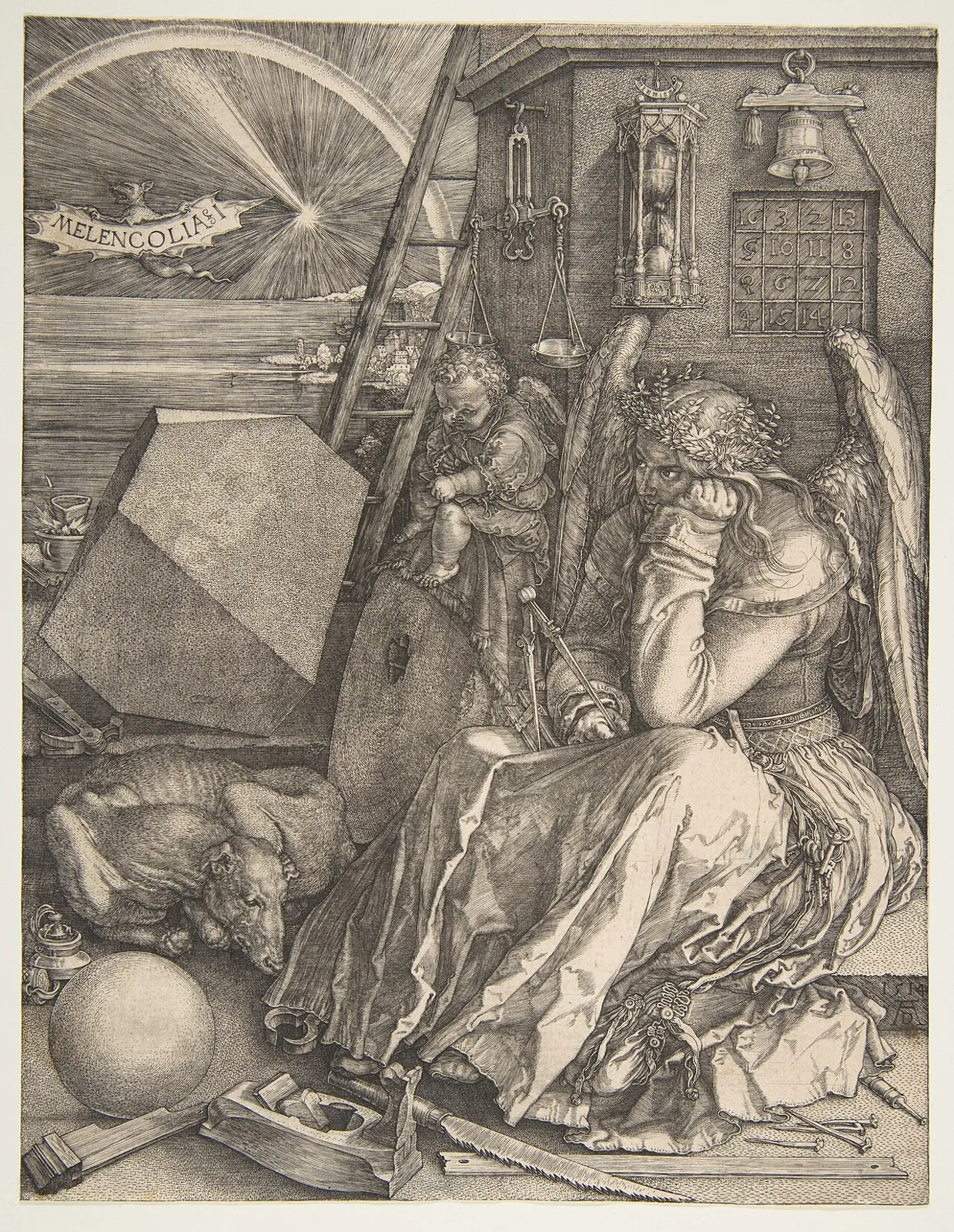
From an astrological perspective, the implications of this transit at the present moment may be considered even more significant than those already described. This is because this year brings a Great Conjunction of the chronocrators, beginning a new cycle of some 230 years as the conjunction shifts into the air triplicity. In the hierarchy of conjunctions used in mundane astrology, this is classed as a “middle” conjunction: it provides information about developments in religions, kingdoms and dynasties, and heralds the birth of a new religion or dynasty. In this context, it is worth remembering that Islam arose when this conjunction “moved” into the water triplicity. Yet the shift into the air triplicity carries another important indication, to which history also points. The last time the conjunction of the chronocrators entered the air triplicity, Europe faced the plague pandemic known as the “Black Death”.
It was one of the greatest pandemics of all time and marked the end of the Middle Ages. In 1346, Europe saw the arrival of what had been a nightmare for centuries, the very essence and empress of all deadly diseases: the Black Death, the plague, which spread from northern China, probably through infection carried by rats and fleas. In Italy, the most dramatic example was Siena, whose population fell from 50,000 to 10,000. Florence had not always been Tuscany’s foremost city; before the Black Death, that distinction belonged to Siena. “All roads led” from Siena to Rome and Paris: the lords of Siena were related to the kings of France, which is why Siena is the only city in Italy whose buildings were constructed in a purely French Gothic style. The greatest artists of the Middle Ages—Cimabue, Duccio di Buoninsegna, Simone Martini, the Lorenzetti brothers …—came from Siena. In a sense, Siena never recovered from that pandemic. Architecturally, the city was frozen for ever: when we visit Siena today, we return to the fourteenth century.
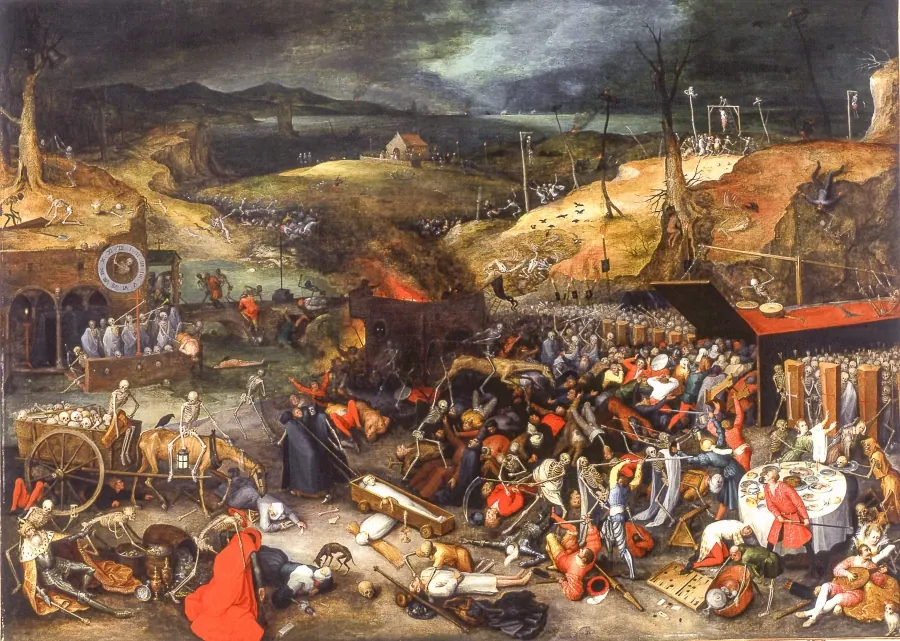
Beyond its devastating demographic consequences, the Black Death affected the spirit of society at the time. Surviving documents show that people regarded one another with suspicion and hatred. They sought an explanation, someone to blame for the disease; most often it was the Jews who were blamed, persecuted and lynched. Others, in fits of irrationality born of despair, attributed the epidemic to God’s will, as a punishment. Religious movements arose, such as the “flagellants”, who publicly punished themselves, scourging their bodies until they bled.
Although such phenomena are very difficult to predict, the medieval English astrologer John of Eschenden is reported to have successfully predicted the Black Death—the plague of 1348—from the eclipse of 1345, according to J. Lee Lehman in her book “Classical Astrology for Modern Living” (Atglen, PA: Whitford, 1996). The belief that the conjunction of 1345 would prove significant was widespread. A prediction of the Black Death also appears in this report from the Faculty of Medicine in Paris, dated 1348: “We say that the remote and first cause of this pestilence was signified by the configuration of the heavens: in 1345, by the conjunction of the three superior planets in the sign of Aquarius … Aristotle bears witness to this … saying that the mortality of peoples and the depopulation of kingdoms occur at the conjunction of Saturn and Jupiter.”
At the beginning of spring—the moment for which the mundane chart governing the period until the following spring is cast—Saturn and Jupiter were in close conjunction in Aquarius, with Mars separating from them and moving towards the end of the sign. John of Eschenden, mentioned above, predicted a “corruption of the air”. Gersonides was considerably more precise, offering a list of expected events that included “disease and death and evil that will endure for a long time”. When a conjunction occurred in a fixed sign, its influence would last for many days. Pingree cites Ibn Ezra as an authority on duration; indeed, Ibn Ezra states that “when a planet is in a fixed sign, it signifies all that is constant and enduring”. Gersonides calculated the syzygy preceding the Sun’s ingress into Aries, which was an eclipse and therefore especially important in medieval astrology. In doing so, he followed the rules of Ptolemy, who writes in the Tetrabiblos that “the first and most potent causes of such events [the general conditions of countries] are to be found in the syzygies of the Sun and Moon at eclipses”.
What followed this extraordinarily difficult period of mass death and the collapse of an old order is, in a sense, even more significant for us. This terrible drama, this appalling tragedy, laid the foundations for the Renaissance, because after such complete demographic and economic devastation, the world had to begin somewhere. After so much horror came a general recovery, a renewal of society; after so much pain and mourning, people turned to beauty and art, above all in Florence, which would infect the whole of Italy, and then Europe, with this magnificent new virus. The economy stirred into life, finding new models and new markets. Farmers, livestock breeders, artisans and merchants began to move again … in short, sweeping social changes followed.
The connection with present events is more than obvious. The current COVID-19 epidemic is very similar, and although it may not bring the same mortality and devastation as the Black Death described above, we can certainly expect it to cause or set in motion processes that will transform the world we live in. This epidemic is so serious and widespread because Saturn is entering an air sign as we move towards an era of conjunctions of the chronocrators in air signs, recurring every twenty years. Saturn’s ingress into Aquarius activates this 230-year cycle, since the conjunction itself takes place at precisely 0 degrees Aquarius. This ingress is therefore a “preview” of the coming cycle, and especially of Saturn’s transit through Aquarius. Just as the last series of Great Conjunctions in air signs brought the plague, which, like COVID-19, is transmitted through the breath—that is, through the air—we can expect this one, too, to have a transformative effect on the world, comparable to the changes that followed the Black Death.
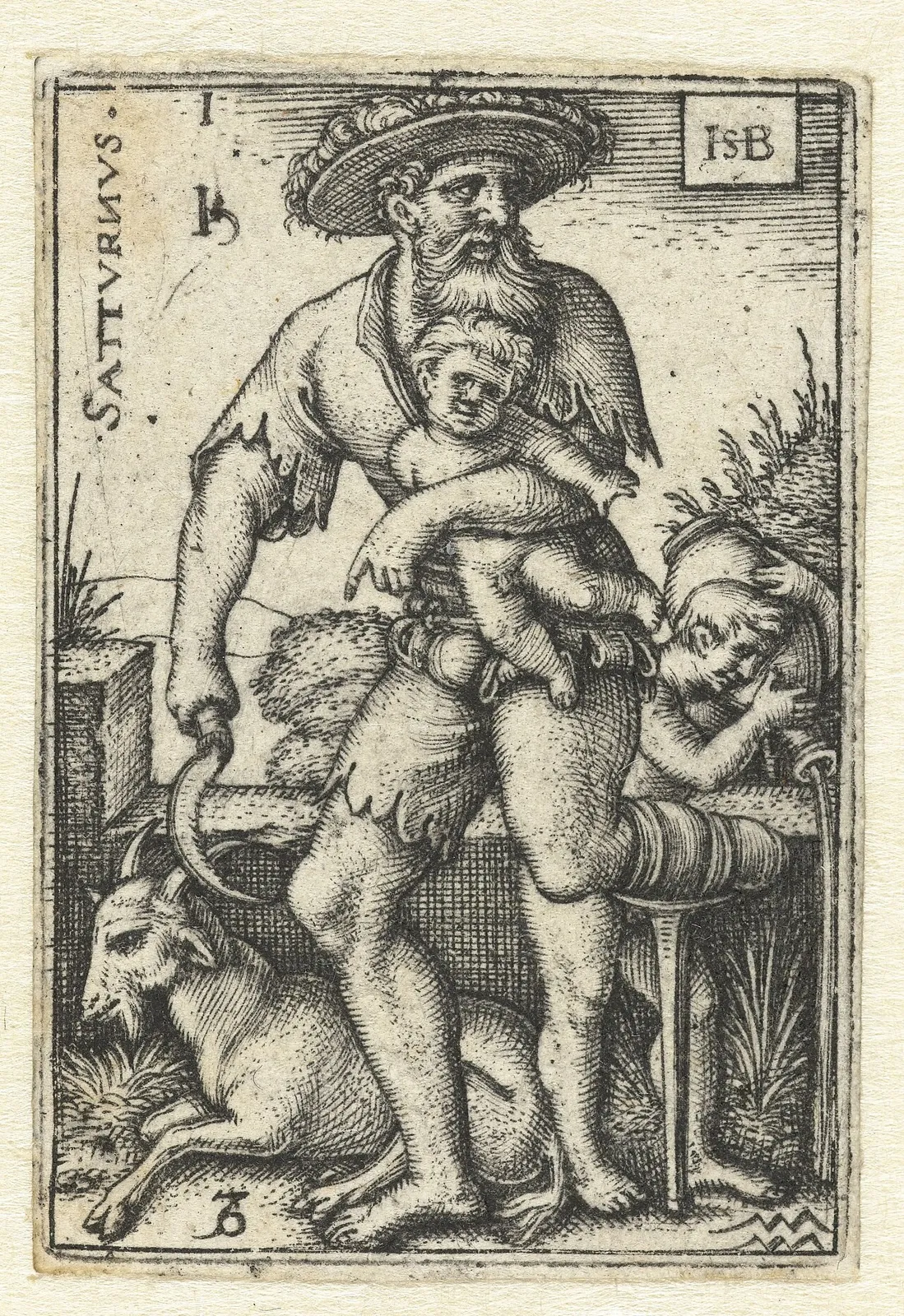
It is too early to predict how this whole story will unfold. The ultimate reach of the epidemic remains unknown, since it can only be halted through the development of a vaccine or the emergence of herd immunity. Either way, at least another year or two is clearly needed, so we cannot say with any certainty what its eventual health consequences will be, let alone its effects on the economy and society as a whole. In light of everything discussed above, I believe its overall significance will be far greater than it now appears, or than current attempts at prediction suggest. In any case, this period can clearly be understood as a “challenge” to our civilisation in Toynbee’s sense, a “time of troubles”, and our response to that challenge will determine the future course of our species. The trilogy on the Age of Aquarius explored its characteristics through mythology, esoteric philosophy and astrology, so those symbols are worth consulting for answers to the question of what form these changes may take. Broadly speaking, we can distinguish two possible outcomes. The first is a vision of a dystopian future in which the power of the total state—or, more precisely, a technocratic global government—reaches its height, and many of the measures and restrictions on freedom we now witness as “temporary” become permanent. Even if the present situation hardens into such totalitarianism, the seeds of its downfall inevitably lie within it, and it will collapse like every other Tower of Babel. This manner of “fighting the virus” favours the outcome described above, so we may reasonably ask whether it is also a struggle against Nature, which, as we have seen, has sometimes turned us towards a better Path even through suffering. Indeed, it is difficult to escape the impression that such pandemics are a natural process of purification that enables our evolution, with the potential to change our societies and expose our weakness as a species when confronted by these forces of nature. Here lies the other possible outcome: a heightened awareness of Nature, of our powerlessness before her, and of the fact that our survival depends on living alongside her, rather than on a hopeless attempt to conquer and rule her, just as we are now trying to “defeat the virus”. The answer probably lies somewhere between the two, or in the interplay of these opposing forces: totalitarian government and repression on one side, and resistance rooted in this awareness and in ancient wisdom on the other. According to the dialectical formula, these should give rise to a new synthesis, a new renaissance. Towards the end of the era of Great Conjunctions in the air triplicity, following the Great Plague, the Renaissance brought an explosion of learning and a love of the greatness of the human spirit unseen since antiquity. Need we remind ourselves here that Aquarius is a human sign? The essential point is that the seeds we sow now may not germinate for another two centuries, but their eventual emergence is inevitable. Air signs also rule engineering and science, whose advances we have witnessed over recent decades, yet I believe the greatest inventions still lie ahead. More than ever, such discoveries have the potential to bring about a decisive “shift” in consciousness.
In that much-mentioned trilogy, I identified the forthcoming Great Conjunction of the chronocrators as perhaps the most important turning point on the path towards a new Aquarian age. As we can observe, Saturn’s ingress into Aquarius is evidently activating this cycle. I therefore believe that even in the circumstances now prevailing, we can discern the outlines of that new age. More than this, the most decisive events are still to follow: events that will finally establish it and bring the Age of Pisces to an end, a process made visible through the dying away of forms belonging to that age and, more importantly, through the creation of new ones. Some of the dynamics of this process can be traced through the subsequent conjunctions at twenty-year intervals, though certainly not through these alone. The point is that we stand on the threshold of a new era. The world is already changing and will continue to change in keeping with this transition between ages, and we must let go of everything that disappears or “dissolves” in the process. We may therefore conclude that this transit of Saturn heralds that transition, according to the principle of “solve et coagula” outlined above.