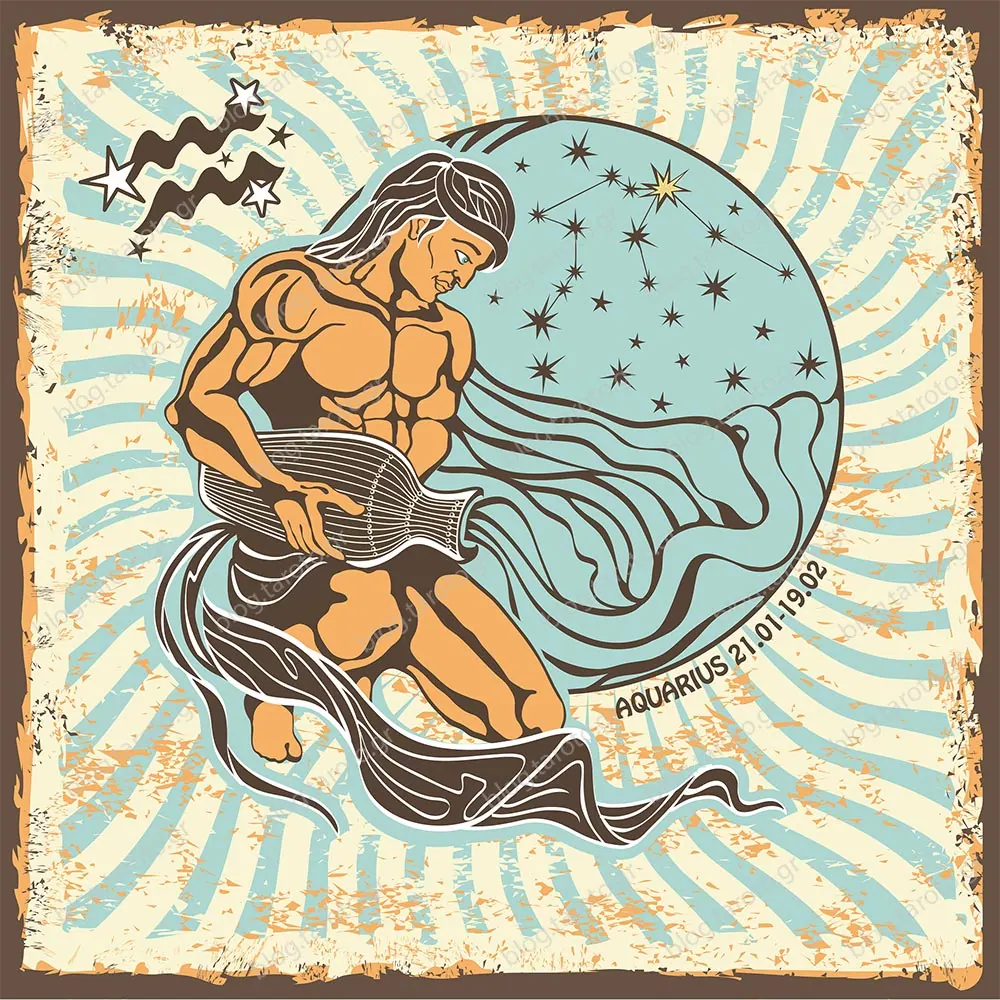
Aquarius and its age are among the most widely debated subjects in astrology—and well beyond it. Ever since the hippie movement of the 1960s and the famous “Age of Aquarius” anthem, we have been asking when this “golden age” will arrive, whether it is already here, what will characterise it, and so on. Some argue that its principal symbolic features are already apparent. Yet alongside promising developments, such as the liberation of the spirit, we can also discern certain negative trends. The twentieth century, in particular, witnessed the greatest loss of life in human history—60 million in the Second World War and another 40 million under Mao Zedong—as well as the atomic bomb and the most destructive weapons ever devised. At the same time, it brought rapid scientific and technological progress, and humanity ventured into space for the first time. Any assessment of this new age is therefore ambivalent, to say the least. Of particular importance is the paradigm that will prevail, since this will determine how future scientific achievements are put to use and, to a considerable extent, shape the course of events. In this enquiry, we have chosen to follow the thread of symbolic imagery: mythological, religious, esoteric and, of course, astrological. These are, after all, the most relevant sources, since all the currents of human history have their roots and ultimate origins in them.
Since the deepest symbolic meanings of a subject can be found in the relevant mythology, we shall begin with the myth associated with the constellation Aquarius. Myth is where all the symbolic threads are woven together that later become the defining characteristics of whatever they represent, whether an individual, a people, a state or an entire age. This arises from a kind of dialectical relationship between Mythos and Ethos. Ethos—put most simply, ethics—gives tangible expression to the underlying symbolism of myth through social rules that can be applied and, more importantly, are accepted at the level of collective consciousness. From these emerge increasingly concrete principles and rules, which in turn shape reality. Perhaps the closest illustration of this concept is the relationship between the Kosovo Myth and the Serbian people, whose entire ethical and religious outlook has been built upon it. In the same way, the myth of Aquarius surely offers enough symbolism for us to interpret its future ethos and thus identify the key features of the coming age.
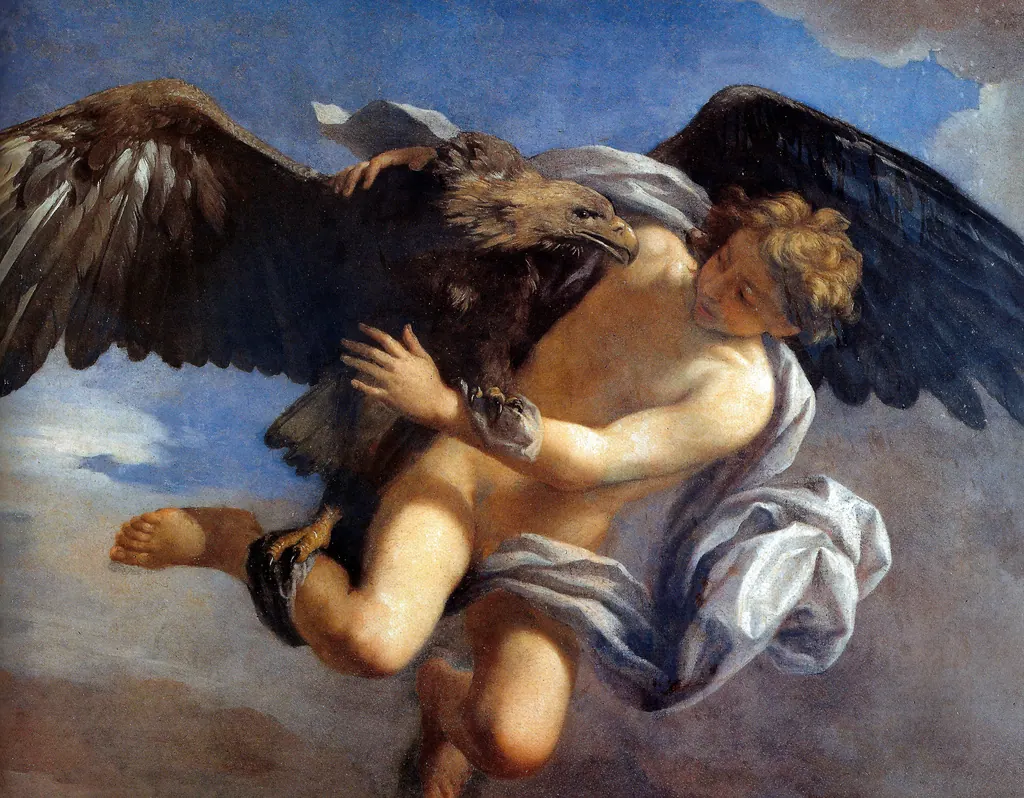
Aquarius is founded upon the myth of Ganymede, a familiar figure from the heroic age of ancient Greece. The myth first appears in Homer, who presents Ganymede as one of the three sons of Tros, the legendary founder of Troy. On account of his extraordinary beauty, Ganymede is abducted by the gods to serve as cupbearer to Zeus and enjoy an immortal life. As often happens with Greek myths, several versions of the story developed: various heroes are named as Ganymede’s father, while his abduction is attributed to the gods, to Zeus himself, or to someone acting on his orders. Where Zeus is the abductor, he either appears as a mortal, assumes the form of an eagle, or commands an eagle to seize the boy as he leads his flocks to Mount Ida. All the gods welcomed his arrival except Hera, who despised him. She complained that this was an affront both to herself and to her daughter Hebe, who had previously served wine to the gods. Her complaints, however, only angered Zeus, who then set Ganymede’s image among the stars as Aquarius. Some mythographers claim that this was why Hera opposed the Trojans in the Trojan War. Ganymede’s father grieved for his son. Taking pity on him, Zeus sent Hermes with two horses so swift that they could even run upon water. Hermes assured Tros that his son was immortal and served as cupbearer to the gods, and that he need not worry. Zeus’s love for Ganymede, so often mentioned in ancient sources, is another interesting aspect of the story. From an early period, the god and the boy were regarded as archetypal lovers. Sophocles, writing in the fifth century BC, speaks of Ganymede “kindling the might of Zeus with his thighs”. The pair also served to justify the homoerotic tradition. Thus Theognis, in the sixth century BC, cites Zeus and Ganymede as an example of the joys of loving a boy, ending one short poem with the words: “And so, Simonides, do not be surprised that I have yielded to love for a beautiful boy.” The myth inspired poets, appearing in Ibycus in the sixth century BC, and in Pindar and Euripides in the fifth. When Xenophon, in the fourth century BC, portrayed Socrates condemning intercourse between men, he felt it necessary to strip the Ganymede myth of its appeal by interpreting Ganymede’s name as referring to someone “pleasing in judgement”, rather than “pleasing in body”—or, more specifically, in his genitals—which would have been the more pertinent interpretation. (The Greek name Ganymede is a compound of the adjective ganos, meaning radiant, and medea, meaning male genitals, but also prudence or cunning—editor’s note.) As we can see, the myth of Ganymede has been interpreted in various ways. Plato believed that the Cretans had invented it to justify love affairs with boys or young men. Xenophon explained it as a moral allegory of the superiority of spirit over body, drawing on the etymology already mentioned: intellectual rather than physical excellence wins the favour of the gods and secures immortality. During the Renaissance, the myth was interpreted in connection with the Neoplatonic doctrine of furor divinus. In his commentary on Dante’s Purgatorio, Landino explicitly distinguishes between Neoplatonic and Christian interpretations. Plato says that Ganymede’s abduction represents “separation from the body and, as he forgets material things, complete absorption in the contemplation of heavenly mysteries”. This Neoplatonic interpretation was accepted by almost all the humanists/Alciato—Emblem IV/. In this connection, I find the eagle particularly interesting, since it is one of the forms of the constellation Scorpio, albeit the rarest. As Scorpio is the sign of occult initiation, the eagle in flight—the king of birds—represents its highest and most spiritual expression, in which it transcends the venomous, earthbound insect. We shall return to this connection later, when we consider astrological symbolism and its interpretation.
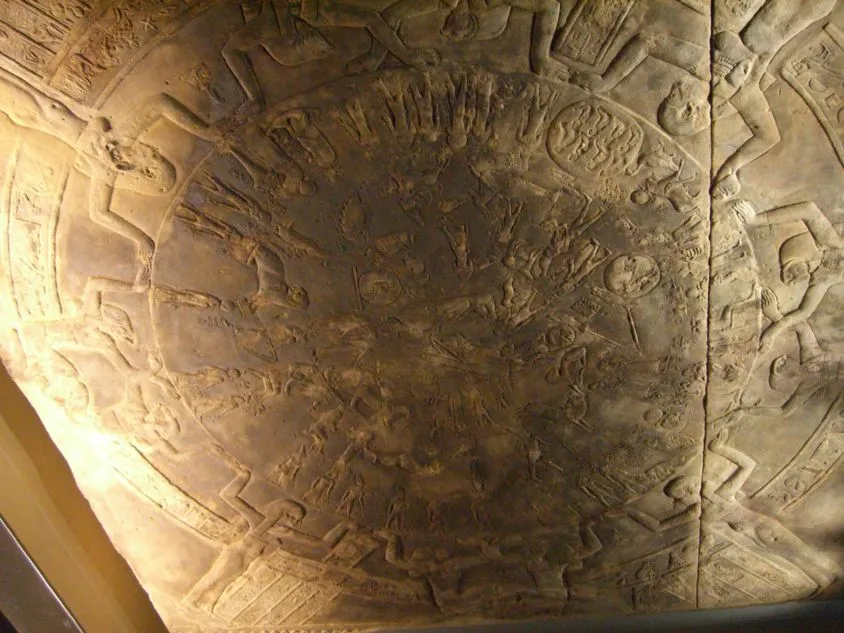
The constellation Aquarius, identified with Ganymede, originally represented the Egyptian god who presided over the source of the Nile, pouring water rather than wine from a pitcher (Pindar: Fragment 110). More precisely, this was Osiris, the symbolic god of the Nile. The Nile flooded in late July, a phenomenon associated with Leo, during the Full Moon in Aquarius. This act symbolised the dominion over the earth of Osiris, who was subsequently killed and dismembered, only to rise again at last. Aquarius therefore represents the vital force that renews and makes all things fruitful.
What exactly is the precession of the equinoxes, and what principles underlie it? Each year, the Sun makes a complete circuit of the zodiac and returns to its starting point—the vernal equinox—yet each year it falls slightly short of completing a full circuit of the heavens within the allotted time. As a result, it crosses the equator at a point slightly behind the position it occupied in the zodiac the previous year. Each zodiacal sign spans thirty degrees, and since the Sun loses one degree every 72 years, it moves backwards through an entire constellation, or sign, in approximately 2,160 years—the duration of one age—and through the whole zodiac in 25,920 years. This backward motion is called the precession of the equinoxes. Thus, over a period of some 25,920 years, constituting one Great Solar or Platonic Year, each of the twelve signs occupies the vernal equinox for almost 2,160 years before yielding its place to the preceding sign.
For ancient peoples, the Sun always symbolised the form and nature of the constellation through which it passed at the vernal equinox. For nearly 2,000 years, the Sun has crossed the equator at the vernal equinox in the constellation Pisces, the two Fishes. During the preceding 2,160 years, it passed through Aries, the Ram. Before that, the vernal equinox fell in Taurus, the Bull. During these ages, or aeons, religious worship assumes the form of the corresponding celestial sign—the sign whose identity the Sun is said to take on, just as a spirit takes on a body. In ancient Egypt during that period, Apis, the bull, was sacred to the Sun god, who was worshipped through the animal counterpart of the celestial sign filled with his presence as he crossed into the northern hemisphere. This is the meaning of the ancient saying that the celestial Bull “broke the egg of the year with his horns”. The Sun thus assumed the body of Apis, and the Bull became sacred to Osiris. In the Old Testament, we find a reference to the succession of ages when Moses returns from Mount Sinai to find his followers worshipping the Golden Calf, which he then destroys by casting it into the fire—itself a symbol of purification and rebirth. Then, in Genesis 22:13, we read: “And Abraham lifted up his eyes, and looked, and behold behind him a ram caught in a thicket by his horns: and Abraham went and took the ram, and offered him up for a burnt offering in the stead of his son.” During the Age of Aries, the Lamb was considered sacred, and priests were called shepherds. Sheep and goats were sacrificed upon altars, and the scapegoat was appointed to bear the sins of Israel. During the Age of Pisces, the fish became a symbol of divinity, and the Sun god fed the multitude with two small fishes. Not only was Jesus often called the Fisher of Men, but, as John P. Lundy writes: “The word Fish is an abbreviation of the entire title, Jesus Christ, Son of God, Saviour and Cross”; or, as St Augustine puts it: “If you join the initial letters of the five Greek words Ιησούς Χριστός Θεού Υιός Σωτήρ, you obtain ΙΧΘΥΣ, which means Fish, a word in which Christ is mystically understood, for he was able to live in the abyss of this mortality, as in the depths of the waters, yet without sin.” Aquarius is known as the sign of the Water-bearer, or the man with a pitcher of water upon his shoulder mentioned in the New Testament (Luke 22:10; Mark 14:13), where Jesus instructs the apostles, who are to prepare the Last Supper, to follow a man carrying a pitcher of water. As one of the fixed signs of the zodiac, Aquarius is also symbolised by the “Face of a Man” in the Book of Revelation. From a mystical perspective, this may also be understood as a direction to follow. Since the apostles have traditionally been associated with the twelve signs, the so-called houses of the Sun, entering the house to which the man with the pitcher leads them may be read as a reference to entering the Age of Aquarius—especially if the mythos of Christ is understood as a symbolic portrayal of the entire Age of Pisces, or Christianity. Aquarius is sometimes depicted as an angelic figure, supposedly androgynous, either pouring water from an urn or carrying a vessel upon its shoulder. Among Eastern peoples, the water vessel alone is used. In keeping with all this, the Sun will now assume the form of the zodiacal sign it occupies: Aquarius. This is a human sign, hence the emphasis on humanism, and the age will adopt the symbolism of this constellation in both its religious worship and its ethics.
Esoteric philosophy is the next field whose insights merit consideration here. The various Mystery Schools understood how to discern and employ these symbolic mythological images, often even creating particular myths themselves. We should therefore like to examine an esoteric aspect of time concerning the ages, or aeons, and their succession. Over the past few centuries, since occultism underwent a revival in the West and certain ideas began to circulate more openly, many mystical and esoteric traditions have periodically proclaimed the advent of a New Age, each naming and describing it differently. Some Masonic authors have announced the Age of Aquarius on the basis of their astro-theological inheritance; Theosophists have spoken of the ages of seven human races, drawing on the Hindu tradition of seven ages and declaring that we currently live in the age of the fifth, Aryan race; the Hindu tradition itself tells us that we live in the Kali Yuga; the Order of Nine Angles, although its conception differs somewhat from that of Theosophy, likewise recognises seven ages in the development of humanity, but calls the present one the Age of the Blood Mother; Aleister Crowley and the Thelemites believe that we are in the Aeon of Horus, the Child, following the earlier aeons of Osiris, the Father, and Isis, the Mother; Anton Szandor LaVey and others of his persuasion proclaim the Age of Satan, and so on. At first glance, anyone studying these teachings on the ages across the various traditions might suppose that they must contradict one another, and that all these ages cannot be entirely compatible. It scarcely needs saying that the followers of all the traditions listed above cling blindly and exclusively to inherited dogmas, generally denying the others. We see things rather differently. We find neither contradiction nor any genuine conflict between them; rather, we believe that they are all describing different aspects of the same period and the same approaching New Age. For example, the advent of what the “Age of Aquarius” is supposed to represent can already be felt: rapid and extraordinary spiritual and technological progress, together with an abrupt break from the traditions, values and religions that arose during the “Age of Pisces”. These achievements have been brought about predominantly by representatives of the Aryan race, if we recall the Theosophical classification. On the other hand, hypocrisy, injustice and folly also prevail, just as Hindu accounts of the Kali Yuga describe, alongside the emergence, in both East and West, of devotional and compassionate forms of religion that depart from traditional, restrictive ritualism. There is also a clear increase in the dominance of the feminine principle and the influence of women in society—not the maternal, nurturing feminine principle of the cave-dwelling age, but precisely the kind portrayed by the Order of Nine Angles through the archetype of the Blood Mother, manifesting as judge and executioner of the patriarchal system that has prevailed until now. Crowley, too, is right when he speaks of the Aeon of Horus the Child, which, as he himself described it, would be marked by widespread confusion, incoherence, greater freedoms, increasing bisexuality and homosexuality, and the outbreak of the most senseless and bloody wars. And, of course, LaVey was accurate in proclaiming the Age of Satan, since Satanism is increasingly accepted as an entirely legitimate religion, Satan is publicly worshipped, and all those things once regarded as “sin” or “the Devil’s work” are increasingly accepted as standard and normal. From an esoteric perspective, then, we regard all these portrayals of the New Age as different, mutually complementary aspects of one and the same age.
In the second part of this enquiry, we shall seek answers in purely astrological symbolism, which will offer further insights into the various aspects of this approaching new age.