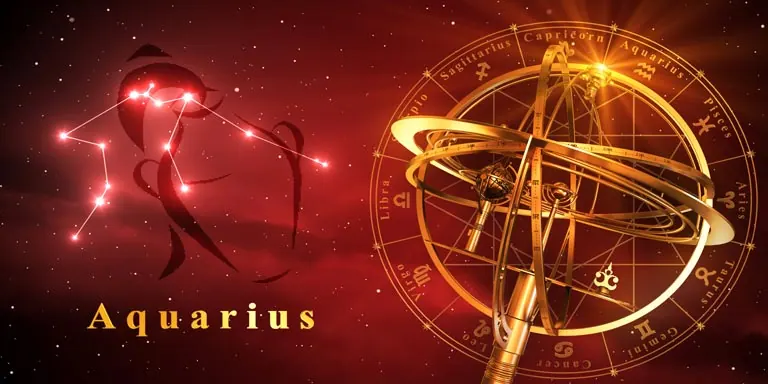
In the earlier articles, which now form a trilogy on the coming Age of Aquarius, we explored the character of this Age through various symbolic representations. In the first part, we considered the Age of Aquarius through the lens of mythology and esoteric philosophy, while the second part examined the astrological symbolism of the approaching change. In this final instalment, I shall try to find an answer to a question widely debated among astrologers: when will this New Age officially begin?
The Age of Aquarius is regarded as a spiritual turning point, both for society and for each individual. There is much speculation about when it begins. Has it already begun, is it still to come, or is humanity already halfway through it? Opinions are sharply divided: the International Astronomical Union (IAU) places its beginning in 2601, some astrologers declare 2375 to be the first year of the Age of Aquarius, and, as we shall see, the views of various mystics are equally inconsistent.
One difficulty we face is that the transition between such long spans of time is itself a lengthy process. Here, I believe we may reasonably apply one of astrology’s fundamental principles: when a planet or point in the chart occupies the last five degrees of a sign, it already begins to assume some of the qualities of the next. Why do these five degrees matter here? Precisely because, according to generally accepted astrological calculations, the precessing equinoctial point now stands at five degrees of Pisces. This may explain why we already feel the approaching change, with ever-increasing intensity, as previously described. I therefore believe that no fixed date can truly be assigned to this transition; rather, it is a gradual unfolding shaped by various turning points. One such turning point is the principal subject of this article.
It is worth returning once more to this much-discussed precession of the equinoxes. What does it actually mean? Each year, the Sun makes a complete circuit of the zodiac and returns to its starting point—the vernal equinox—yet each year it falls a little short of completing a full circuit of the heavens within the allotted time. As a result, it crosses the equator at a point in the zodiac slightly behind the one it crossed the previous year. Each zodiacal sign comprises thirty degrees, and since the Sun loses one degree every 72 years, it moves backwards through an entire constellation (or sign) in approximately 2,160 years—the duration of one age—and through the whole zodiac in 25,920 years. This retrograde motion is called the precession of the equinoxes. Thus, over some 25,920 years, constituting one Great Solar or Platonic Year, each of the twelve signs occupies the vernal equinoctial point for almost 2,160 years before yielding its place to the preceding sign.
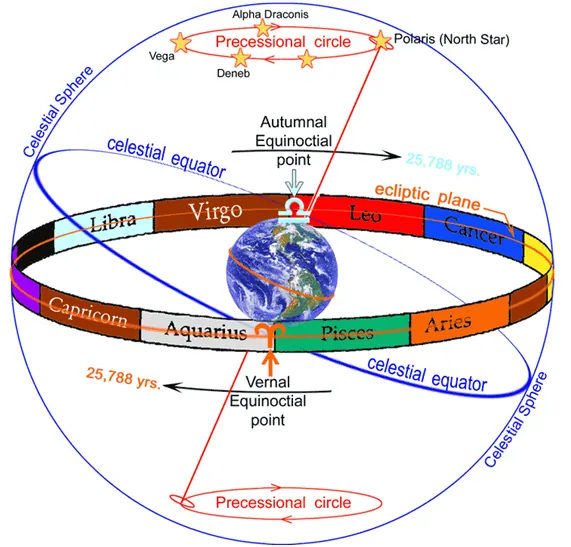
This gives us an important piece of information: an astrological age lasts approximately 2,160 years. To establish when Aquarius takes the throne, it would therefore be useful to know when the Age of Pisces began, and to count forward 2,160 years from that point. In this search, it seems to me that many have overlooked a very obvious reference: the calendar by which the whole of humanity orders its affairs. This calendar takes the birth of Jesus Christ as its starting point and marks the Christian era, the new era, dividing time into the periods before and after Christ. When we recall that Christianity provides the closest symbolic correspondence to the still-current Age of Pisces, we can quite clearly identify the Christian era with the Age of Pisces. On this basis, the calculation would be perfectly straightforward: the Age of Aquarius begins in 2160.
Why is religion so important in all this? In Abu Ma'shar’s understanding, “religion” precedes the formation of every ruling dynasty and is therefore the fundamental organising principle of every social order. It should be stressed that he nowhere says this “religion” must be non-secular. His explanation is simply that religion inspires people’s faith in the laws that arise from it. These laws, in turn, enable and legitimise the formation of dynasties from which rulers emerge. Once a religion and its laws have been established, it becomes possible to predict shifts in centres of power between nations, and even within a single nation—that is, between different ruling families. (1)
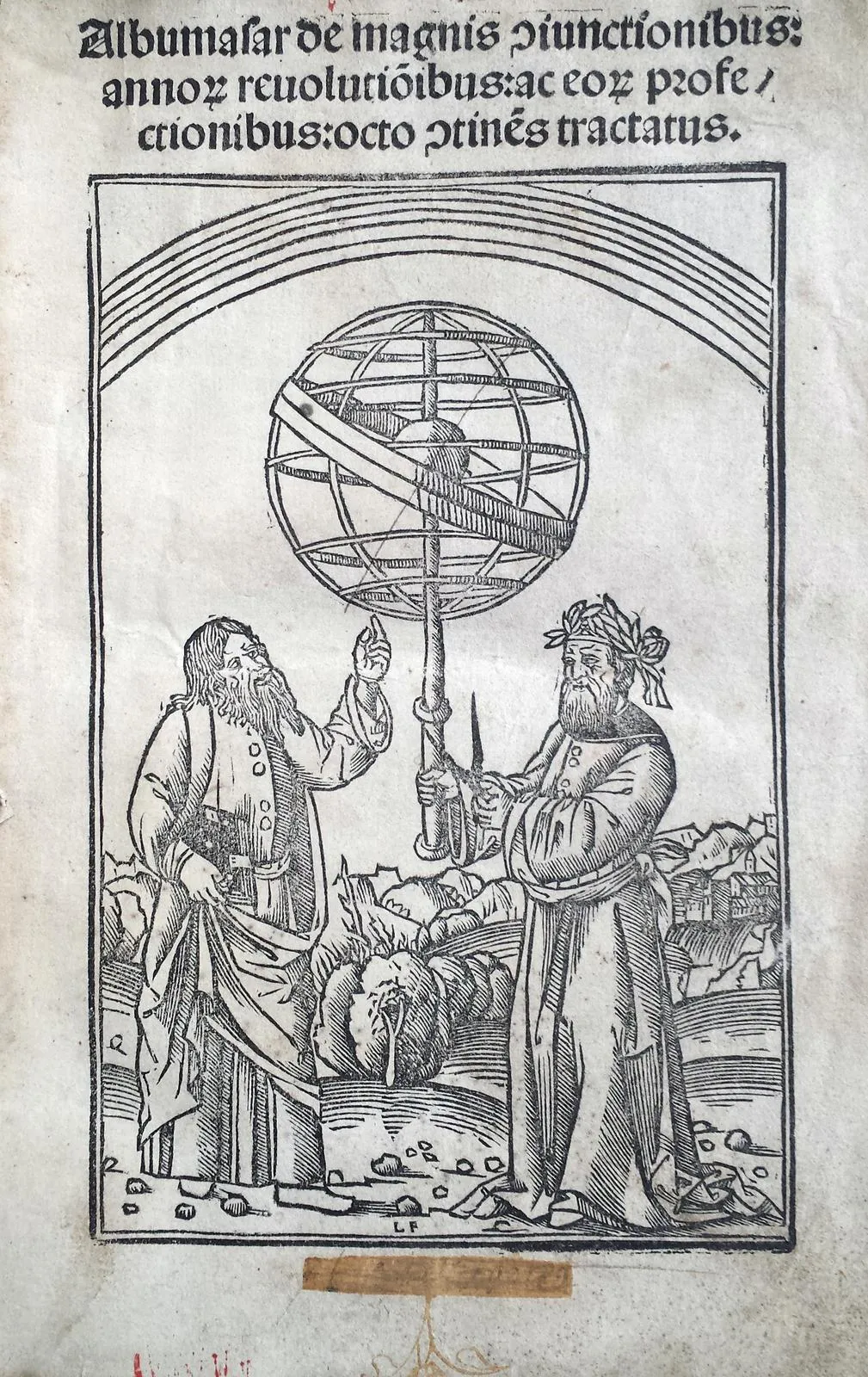
The true causes and agents of the greatest changes in the social order are therefore not the succession of individual rulers, but changes in religion, which holds the primary power to establish a new order. When “religion” is mentioned, we usually think of an esoteric doctrine that necessarily includes the concept of a “god”. Yet it is easy to forget that anything which must be accepted on faith constitutes a religious doctrine, whether this means belief in a “higher power” or the conviction that human ethics and morality are the highest authority (“democracy”). One distinction between these is that one is secular in character and the other is not.
Whether conscious of this important fact or not, many esoteric and other traditions have emerged proclaiming their religion or teaching to be the paradigm of the new age, and their doctrine the new world religion that will usher in the Age of Aquarius. We described many of these movements in the first part of this trilogy, observing that, symbolically, we do not regard them as mistaken, but as different aspects of a single current.
Aleister Crowley, for instance, proclaimed that the New Age began on 8 April 1904, when, between 8 and 10 April, he received from “heavenly powers” an obscure revelation called Liber Legis (‘The Book of the Law’), the “Bible” of the new epoch. According to his interpretation, the “Aeon of the Slain God” (Osiris) was then superseded by the “Aeon of the Crowned and Conquering Child” (Horus). In the 1938 edition of Liber Legis, Crowley reflects on the advent of the Aeon of Horus: “He rules the present period of 2,000 years, beginning in 1904. Everywhere his government is taking root. Observe for yourselves the decay of the sense of sin, the growth of innocence and irresponsibility, the strange modifications of the reproductive instinct with a tendency to become bisexual or epicene, the childlike confidence in progress combined with nightmare fear of catastrophe, against which we are yet half unwilling to take precautions.” In a similar vein, Anton Szandor LaVey founded the Church of Satan in 1966, likewise as a religion of the new aeon. The Theosophists, meanwhile, tell us through Alice Bailey that, according to the Tibetan teacher Djwhal Khul, powerfully supported by the Eastern Hierarchy of “Masters of Wisdom”, Aquarius was inaugurated at the full moon in June 1945. At that time, in the most powerful energy centre beneath the Gobi Desert, Christ-Maitreya took up the sceptre of power, supposedly becoming the World Teacher and Guide for the next 2,500 years: “At the centre of this triangle /= Light, Love and Power/ Christ took His stand: from this point His work in the Age of Aquarius begins, and will continue for 2,500 years. Thus He inaugurated the new age, and on the inner spiritual planes a new world religion began to take shape.” According to Jung’s astrology, we entered the Age of Aquarius on 7 February 1962, when most of the planets of the solar system were grouped in the zodiacal sign of Aquarius. The supposed American clairvoyant Jeane Dixon claimed that the great Antichrist had been born on 5 February 1962. The 1960s and 1970s certainly witnessed a degree of awakening among the masses, and the Aquarian wave began to make itself felt. Yet this stirring was raw, rebellious and heady with enthusiasm, as best illustrated by the hippie movement, which did much to turn opium and psychedelics into a religion for the people. Some saw these eccentric hippies, with their feeble and grotesque imitations of Christ, as those “preparing” the arrival of Aquarius in its full force.
It is now worth considering certain methods of mundane astrology, particularly the so-called great conjunction of the chronocrators—Jupiter and Saturn—which may offer significant insights here. In the first chapter of the first part of On the Great Conjunctions, Abu Ma'shar sets out the factors to be examined when making mundane predictions.
The first level concerns the passage, or return, of the Jupiter–Saturn conjunction into the signs of the fire triplicity: this is the so-called great conjunction. Abu Ma'shar says that this new beginning occurs in Aries every 960 years. Yet if we examine the sequence of conjunctions of the chronocrators over the past 7,000 years, we find that none occurred in Aries: all were in Leo, apart from the most recent, which took place in Sagittarius in 1663. Nor does this cycle last 960 years; its duration ranges from 795 to 854 years.
The precise number of years is, however, secondary. What matters is the underlying idea that the return of the conjunction of the chronocrators to a sign of the fire triplicity signifies a universal new beginning, a radical transformation of the existing order of things. The most recent such change therefore occurred in 1663, and it is interesting to note that it was followed by social and political changes strikingly consistent with the symbolism of Aquarius. These included the Age of Reason, the Enlightenment, numerous revolutions, including the French Revolution, and the founding of the United States of America. In a certain sense, the latter may be regarded as the epitome of the “new democracy” born of the French revolutionary maxim “Liberté, égalité, fraternité”, which also best encapsulates the guiding ideal of this brave new world. There was also the Industrial Revolution, followed within a mere few hundred years by enormous breakthroughs and advances in science and technology, culminating in quantum physics and the information age we witness today. Nevertheless, this “new democracy” faces many difficulties, so we cannot confidently regard it as the new religion of the coming age.
The second level concerns the so-called middle conjunctions, those that move from one triplicity to another. This change occurs at intervals of 179 to 238 years, the span of a series of 12–13 conjunctions of the chronocrators in signs of the same triplicity. This indicator provides information about developments within religions, kingdoms and dynasties, and heralds the birth of a new religion or dynasty. The second level is contained within the first, not the reverse: the first gives indications concerning the second, but the second cannot give indications concerning the first. This reveals the clear hierarchical principle underlying the theory, in keeping with the philosophy of astrology as a whole. Particularly interesting is the fact that just such a change—the passage of the great conjunction into the air triplicity—occurs on the winter solstice of 2020, at precisely 0° Aquarius!
What might this change bring? In light of the foregoing, it is worth recalling that the entry of this conjunction into the water triplicity, specifically Scorpio, brought about the birth of a new religion: Islam. Might we therefore interpret the next such conjunction, this time in the air triplicity, as heralding the emergence of a new religion, or more broadly a new doctrine, so necessary to the Age of Aquarius? In the sources of the astrological tradition, we find that Abu Ma'shar also ranks the strength of conjunctions according to the sign in which they occur, and explains how a conjunction’s passage into a new triplicity generally corresponds to geographical shifts in centres of power and influence. A conjunction in the air triplicity symbolises the rise of the peoples of the northern regions. Of these conjunctions, that in Aquarius is strongest in its indications, that in Libra intermediate, and that in Gemini weakest. Since the conjunction occurs in Aquarius, we should consider the regions traditionally associated with this sign. According to Ptolemy, these are Asiatic Russia; the wider region around the Amu Darya River along the northern border of modern Afghanistan; Tajikistan, Uzbekistan and Turkmenistan as far as the Aral Sea; the Arabian Peninsula; and the whole of East Africa. Vettius Valens assigns to Aquarius the Red Sea and Egypt, Syria, Iraq, Libya, and north-eastern Europe beyond the borders of ancient Thrace. The corresponding parts of the United States and Canada belong to this sign in the subdivisions, although their principal assignment is to the fire triplicity. Likewise, the north-eastern parts of any geographical territory may be assigned to the air signs, with the more northerly regions always belonging to Aquarius, the more southerly to Gemini, and the easternmost to Libra.
Broadly speaking, these are some of the regions in which significant changes might occur, shaping the principal current of the approaching Age of Aquarius in essential ways. I do not mean to proclaim 2020 as the year in which the Age of Aquarius begins, but merely to highlight this important symbolic configuration as particularly suggestive of the new age. Without wishing to dwell on extreme apocalyptic scenarios, I nevertheless think it important to bear in mind how numerous the possibilities are: the birth of a new world religion, the formation of a new bloc or alliance of states, perhaps the birth of a new leader, a revolutionary scientific discovery, or something of that kind. The form it takes matters less than the fact that it will fundamentally and decisively direct humanity’s development as a whole towards the symbolic expressions of the Aquarian Age, whose qualities were discussed in the previous part. This symbolism and these qualities, together with the geographical indications and forms of development outlined above, offer a means of following events after 21 December 2020, for the change in question will represent their most powerful distillation. In other words, this new religion or doctrine will possess all the qualities previously described and arise among the peoples of the north, providing what seems to me the most important impulse yet in the unfolding transition to the Age of Aquarius. This will create fertile ground for new archetypes, myths and urban legends, alongside the revival of ancient rural legends, opening a portal to something still mysterious: something that cannot be precisely expressed in the words we know, and which we therefore seek through the more congenial language of symbolism. The gradual revelation of this spiritual impulse is both a collective and an individual process, marked by various turning points. Humanity as a whole undergoes it, as does every individual human being. Accordingly, this observation of mine may concern only one more such turning point, which need not ultimately prove so decisive. Given its timing and symbolic significance, however, it certainly appears likely to exert the strongest influence yet.