INTRODUCTION
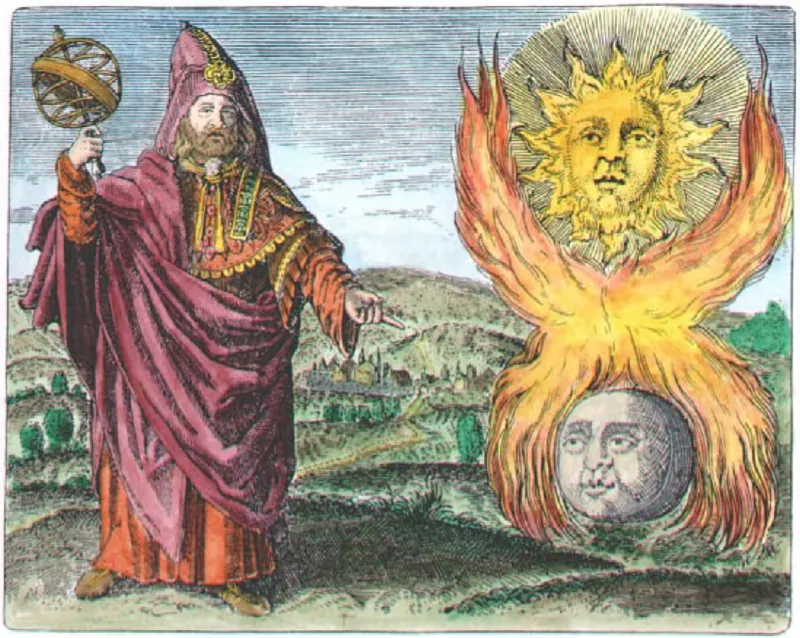
Properly understood, Occultism is a process of inner and outer alchemical Change. It is, in fact, an esoteric means—a Path, a method—of change, development and evolution. In essence, Magic opens up the latent regions of consciousness within us; it is a means of personal and worldly change. Magical techniques, such as ritual, are merely tools for achieving that end. For too long, Magic has been associated with ‘spells’, invocations and similar practices. Although these are integral to it, they offer only a glimpse of what it truly is. Magic is therefore the highest science on our planet, for it teaches both the metaphysical and metapsychic laws that operate on every plane. This science has been called magic since humanity’s earliest written records, yet it has always been reserved for select circles, composed chiefly of high priests and powerful rulers. They knew the truth but kept it secret. They were thoroughly acquainted not only with the synthesis of their own religions, but with that of all others too. The people, by contrast, were taught religion only through symbols. Many centuries had to pass before humanity became acquainted with even scant fragments of this science, and then only in a veiled form, understandably so. Since most people had undergone no proper magical training, they could grasp these fragments only from their own perspective, leaving their knowledge incomplete and one-sided.
Over time, particularly in recent centuries, many books on magic have been written and published, but usually in such a misleading and incomplete form that only small portions of their contents could be applied in practice. Only a few societies were able to initiate students into Hermetic science, or magic, directly from its original source, and even then this science remained strictly confined to specially chosen individuals. Consequently, it necessarily remained obscure and mysterious to those sincerely seeking Truth.
Throughout the Middle Ages, knowledge of magic was fiercely and repeatedly attacked by various religious orders, the historical inquisitions being the most striking example. Later, at the beginning of the modern age, magic came to be regarded as mere superstition, and anyone showing even the slightest inclination towards this science was ridiculed. Sects of mystics and the like were responsible for the disrepute into which the study of magic soon fell, and those who showed an interest in it were commonly pilloried ‘for practising black magic’. True magic was studied in the most ancient schools of prophecy and in secluded circles accessible only to adepts.
Magic is the science that teaches the practical application of laws ranging from the lowest laws of nature to the highest laws of spirit. Anyone intending to study magic must first understand how the lowest natural laws operate, in order to grasp the successive laws built upon them and, ultimately, the highest laws. Depending on the stage the reader has reached, or the laws with which they are currently concerned, magical science may, for clarity, be divided into three categories. The first is the lower magical science, encompassing the laws of nature, their effects, operation and control; this may, if desired, be called natural magical science. The intermediate level of magic concerns the application, operation and control of universal laws within the human being—the microcosm, or little world. Finally, the higher magical science concerns the application, operation and control of the laws of the macrocosm: the universe as a whole.
Since, according to the Emerald Tablet of Hermes, the universal axiom ‘as above, so below’, and its converse, applies to magic, it is not strictly correct to speak of lower, intermediate and higher magic. There is, in fact, only one unified magic, and the magician’s degree of maturity is the measure of their personal development. Universal laws remain the same whether applied with good or ill intent. Their application depends on the character and intentions of the individual. If magicians use their powers for good, they may choose the term ‘white magic’; if they use their abilities for harmful purposes, they may speak of ‘black magic’. Yet whether their actions are morally good or bad, precisely the same laws bring them about. This in itself further renders that division irrelevant, since moral principles cannot govern Magic: with all its techniques, it is simply a means or path of inner or outer change, a spiritual path directed towards the evolution of the individual.
But what draws someone to magic in the first place? Generally speaking, when spirituality is concerned, most people ‘latch on’ to religion, so that the two have unexpectedly become synonymous. This is essentially understandable, since religions ought primarily to concern themselves with matters of the spirit. Yet we have witnessed a different course of events. First, we must understand that religion arises in order to overcome death. Death has always been humanity’s greatest problem. Thus, as its very name suggests, religion arises from the need to transcend, to overcome death. Just as every derived twelfth house gives rise to the house preceding it and forms its foundation, so the eighth house, as the twelfth from the ninth, forms the foundation of the ninth. Fear of death and finality thus creates the need to find something that transcends death—to discover meaning, or something that exists beyond death, and to reconnect with it (religare).
The ninth house contains, joins and reconnects the eighth and ninth houses. This is, in practical terms, the idea behind the emergence of what might be called a system of religion, but it has little to do with the native’s personal faith, which is defined by the twelfth house. When seeking spiritual support, people far more often connect with the nature of their ninth-house cusp than with the nature of their twelfth house, simply because it is easier to belong to the crowd and seek collective support.
Yet there are also people driven by an entirely different impulse, an altogether different need: to believe that they can change things, that they can exercise control. These are the people described at the beginning: magicians and occultists.
This is their story, viewed through astrology.
Astrological Premises
Everything discussed above must now be translated into astrological language. This is no easy task, since there is a substantial difference between an inclination towards the occult and the innate abilities a person possesses. Although any discussion of abilities and powers ultimately concerns those that lie latent and dormant within every human being, we must nevertheless know how to awaken them—to bring them down to earth. Clearly, we are speaking here of great powers that people do not ordinarily express in everyday life. As such, these are always described by the transpersonal planets, which bear these powers or, more precisely, signify the transcendence of what we commonly call fate. We therefore assume that the transpersonal planets must be strongly emphasised in the natal chart, most often placed on the angles. Since their powers are brought into everyday life through the personal planets, we should expect aspects between them. Here I am thinking primarily of the personal planets that are the lower octaves of the corresponding transpersonal planets—Mercury–Uranus, Venus–Neptune and Mars–Pluto—but also of others, especially where they are connected with the eighth- or twelfth-house complexes, which are particularly significant in this research.
We have mentioned fate. In astrological terms, this means an inertial system such as the natal chart. It contains the fundamental code of fate and karma: everything inherited through past-life experience or genetics, everything inscribed in our etheric body or soul—in other words, the Moon. While we can interpret almost everything from this code, one thing we certainly cannot read is enlightenment. The horoscope is a circle, a field in which cause and effect operate, whereas enlightenment represents a personal effort that reaches beyond that circle. Here we find the connection with magic, for the fundamental aim of anyone seriously engaged in magical practice is to develop and elevate their own consciousness. The essence of this question of consciousness and the predisposition towards enlightenment lies in the nodal axis. The nodes constitute a primary opposition that existed before the native’s birth, whereas the other oppositions came into being at the moment of birth. They are opposing, unintegrated forces within the horoscope, and their integration requires a union. Within the circle, the planets aspecting the nodes can theoretically reconcile this opposition—the elements of consciousness represented by the nodes—bring about that union and, in some way, foster the development of consciousness. In our code, these planets should be connected with the eighth- and twelfth-house complexes, thereby showing the path the native follows in reconciling these opposites and thus elevating consciousness. For the magician, this has always been, and always will be, the path of personal spirituality—the twelfth-house complex—and the path of transformation, both outer and inner, of alchemical change—the eighth-house complex. From this we reach the logical conclusion that this path is a unified one, reflected astrologically in connections between the eighth- and twelfth-house complexes. Such connections may take many forms: the ruler of the eighth in the twelfth and vice versa; an aspect between the rulers of these houses; an aspect between their significators, or to the ruler of the eighth or twelfth; or the placement of an eighth-house significator in the twelfth, and vice versa.
Another distinctive feature we encounter when examining a natal chart is planetary configurations. These are often the most dominant structures in the horoscope, indicating great energy—as with the T-square or Grand Cross—or a particular talent, best described by the Grand Trine. That energy can often be restrictive, yet, if properly channelled, it can also become a source of immense strength, ‘a power that moves worlds’. Some configurations, such as the lotus and yod, are distinctly spiritual. Given their considerable strength in the natal chart, they are also highly relevant to this research. We might therefore expect the apex planet of a T-square, or the ruler of the point opposite it, to be connected with the eighth- and twelfth-house complexes, just as the closest square involving one of their representatives might activate the potential of a spiritual Grand Trine. Likewise, in yod and lotus configurations, we may expect the focal planets to be connected with occultism and spirituality, while a stellium might occupy the corresponding houses. Yet since almost all these configurations are either latent, like the Grand Trine, or highly unconscious, like the T-square or yod, an exceptional level of consciousness is required for their great potential to find creative expression. Through the examples of occultists, we shall see how beneficial this path can be for that purpose, although the final outcome will inevitably depend on the practitioner’s perseverance.
Every reality has three parts, and the fixed stars describe the deepest part of human reality: that which does not move, or that which leads a Soul through the centuries with the same story and role, both through numerous incarnations associated with a particular myth and through the native’s genetic inheritance. This also concerns the state of consciousness acquired through previous incarnations, enabling the Soul in this lifetime to undergo complete transformation and attain the essential freedom of Being. Such freedom means release from samskaras, from the cycle of cause and effect—or its transcendence—liberation from the constraints of the horoscope and the primary opposition of the nodes already discussed, or at least bringing the Self closer to that enlightenment through Magic. In the natal chart, this would be shown specifically through fixed stars traditionally associated with occultism and spirituality, now ‘awakened’ by the placement of a planet or house cusp. Although here too I believe that the planet and house should be connected with the eighth- and twelfth-house complexes, it seems more important that the planet should be a good conductor of the stellar influence. In theory, the Moon would be the most desirable, since it is itself a cosmic gateway and transmits the influence of every star most directly. Other important transmitters would be the Sun, Mercury, Venus, Mars, Jupiter and, to some extent, Saturn. The influence of the transpersonal planets would manifest primarily on the mundane level, although I would note that they too can operate personally as house rulers—especially of the eighth and twelfth—particularly when connected with personal planets in the manner described above.
While discussing this most mysterious part of astrology, often called the ‘Body of Astrology’, which incorporates things that operate in particular ways without our knowing why, or which resist ‘everyday logic’, we must also mention the degrees of the Zodiac alongside the fixed stars. Of greatest interest here are degrees associated with occultism, mysticism and spirituality, which we should expect to find activated in these people’s horoscopes. Among these, 29° of any sign stands out. We might say that it represents the final stage of something, or the last phase of a development, and can therefore indicate a higher evolutionary level, even bestowing clairvoyance or, at least, exceptionally strong intuition. On the other hand, it also signifies the end of something, symbolised both by the planet occupying it and by the sign whose final degree is activated; it is therefore considered anaretic. This degree is highly favourable for spirituality and frequently appears in the horoscopes of deeply spiritual people, while being regarded as equally unfavourable for matters of ‘earthly’ existence. Other degrees significant for occultism are 27° of every sign, with 27° Pisces especially associated with leaders in this field; also 16° Aries, 1° Taurus, 10° Taurus, 11° Cancer, 19° Cancer, 6° Scorpio, 11° Capricorn, 15° Pisces and 26° Pisces. Here too, we would naturally expect these degrees to be activated by planets connected with the eighth- and twelfth-house complexes. As with the fixed stars, however, this is not a rule: what matters is that they are emphasised in the natal chart.
In summary, the basic astrological code would comprise the following:
A connection between the eighth- and twelfth-house complexes: the ruler of the eighth in the twelfth, the ruler of the twelfth in the eighth, Mars or Pluto in the twelfth, Jupiter or Neptune in the eighth; an aspect between the rulers of these houses, or aspects between the significators of these complexes and the rulers of the eighth and twelfth.
A planet aspecting the nodal axis by conjunction, square or opposition (0°, 90° or 180°), connected with the eighth- or twelfth-house complexes, or secondarily with the ninth-house complex.
Connections between the transpersonal and personal planets, primarily their lower octaves—Mercury–Uranus, Venus–Neptune and Mars–Pluto—but also the rulers of the eighth and twelfth.
Transpersonal planets on the angles of the horoscope.
The Moon, personal planets or rulers of the eighth and twelfth on one of the fixed stars associated with occultism and spirituality:[1]
- Sadalmelik (03° Pisces)
- Fomalhaut (03° Pisces)
- Achernar (15° Pisces)
- Khambalia (06° Scorpio)
- Acrux (11° Scorpio)
- Zosma (11° Virgo)
- Skat (08° Pisces)
- Sadalsuud (23° Aquarius)
- Dschubba (04° Sagittarius)
- Al Pherg (26° Aries)
The rulers or cusps of the eighth and twelfth houses, or significators of the eighth- and twelfth-house complexes, on degrees associated with occultism and magic: above all 29° of every sign, followed by 27° of every sign, with 27° Pisces especially associated with leaders in this field; also 16° Aries, 1° Taurus, 10° Taurus, 11° Cancer, 19° Cancer, 6° Scorpio, 11° Capricorn, 15° Pisces and 26° Pisces.
THE CODE IN THE CHARTS OF PROMINENT OCCULTISTS
Peter J. Carroll (8 January 1953, 1:30 AM, Durrington, England)
Peter J. Carroll, together with Ray Sherwin, is regarded as the founder of Chaos Magic as an independent field of magical research. He studied science at the University of London, subsequently worked as a schoolteacher, and spent four years in India and the Himalayas. Carroll and Sherwin then founded the IOT[2]. In 1995, he decided to relinquish ‘the roles of magus and pope of the Chaos movement’. [3] Carroll wrote articles for the magazine ‘Chaos International’ under his own name and as Stokastikos, his magical name within the IOT. In 2005, at Robert Wilson’s invitation, he became an instructor in chaos magic at the Maybe Logic Academy, subsequently founding Arcanorium Occult College with other prominent chaos magicians, including Lionel Snell, Ian Read and Jaq D. Hawkins. Carroll has written many important books and essays on Chaos Magic, notably Liber Null, Psychonaut, The Apophenion: A Chaos Magic Paradigm, Liber KKK and Liber MMM.
‘For me, Chaos Magic means a handful of basic techniques that must be rigorously observed to obtain results, but beyond that it offers a freedom of expression and intent unimaginable within earlier systems of magic.’ (Peter J. Carroll)
In this sense, chaos magicians employ a variety of techniques regardless of the magical systems from which they originate, without binding themselves to those systems’ dogmas or paradigms. The sole criterion is how effectively a technique works for the individual. As Sherwin put it: ‘If Chaos Magic had a credo, it would run thus: I believe in nothing. I know what I know (gnosis), and I formulate theories which may or may not enter my system of adopted beliefs once they have been tested. There are no gods or demons except those I have been conditioned to acknowledge and those I have created myself. I create and destroy beliefs according to their usefulness. Or, in the words of the wise: Nothing is true, everything is permitted.’
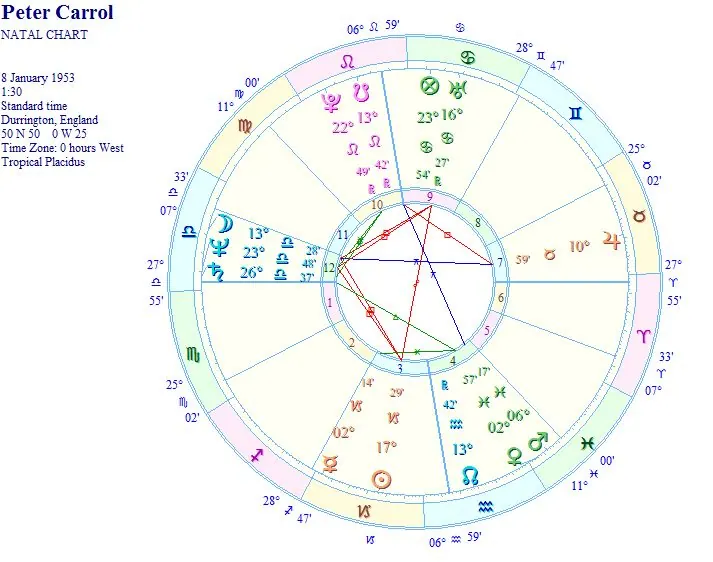
In Peter J. Carroll’s chart, we can trace a very distinctive magical signature. Let us begin with the relationship between the eighth- and twelfth-house complexes. Venus rules both houses, so for this assessment we also take Mercury as the second ruler of the eighth. We find these two planets in an exact sextile! Furthermore, Saturn, the dispositor of Mercury as ruler of the eighth, occupies the twelfth in conjunction with its significator, Neptune. Venus, ruler of the twelfth, is also conjunct Mars, a significator of the eighth-house complex. The connections between the eighth and twelfth are therefore striking. Turning to the nodal axis, Pluto, an eighth-house significator, is conjunct the South Node and consequently opposite the North Node. The Moon, as second ruler of the ninth, is also in the twelfth, in a wide conjunction with Neptune, and forms an exact trine/sextile to the nodal axis. This indicates that personal spirituality is precisely the path through which the primary opposition may be transcended and consciousness developed. Among the configurations in this nativity, we find a T-square with this very Moon at its apex! The point opposite falls at 13° Aries, ruled by Mars, which is conjunct Venus, ruler of the twelfth. Venus lies exactly on the fixed stars Sadalmelik and Fomalhaut, both highly spiritual stars. Sadalmelik in particular confers occult knowledge that can help a person succeed, as well as a reputation through occult work—undoubtedly true of Carroll. Neptune is also on Spica, symbolising profound insight and knowledge, and success through religion and philosophy, among other things, and on Arcturus, to which certain mystics attribute an exceptional spiritual influence and development of consciousness. Among the other stars associated with spirituality, Zosma occupies the eleventh-house cusp, bestowing, among other things, an aptitude for divination. The ruler of that house is S, which also rules the eighth. Among the important degrees associated with occultism, we find the Ascendant itself at 27° Libra, Jupiter—a twelfth-house significator—at 10° Taurus, the South Node at 13° Leo and the eleventh-house cusp at 11° Virgo.
Thus, the only feature missing from this horoscope that would make it a textbook example of the code described above is a connection between the corresponding personal and transpersonal planets, although Neptune is close to the Ascendant and conjunct the Moon. Pluto also occupies the angular tenth house.
Samuel Liddell MacGregor Mathers (8 January 1854, 10:56 AM, Huckley, England)
Samuel Liddell MacGregor Mathers is one of the most influential figures in modern occultism. He is best known to the wider public as a founder of the Hermetic Order of the Golden Dawn and as a translator of ancient grimoires such as ‘The Key of Solomon’, ‘The Book of the Sacred Magic of Abramelin the Mage’ and ‘The Kabbalah Unveiled’[4]. He became a Freemason in 1877 and joined the Societas Rosicruciana in 1880, where he associated with Kenneth Mackenzie, William Wynn Westcott and William Robert Woodman. Following Mackenzie’s death, he founded the Golden Dawn with Westcott and Woodman in 1888. He wrote the Order’s rituals, based on Kenneth Mackenzie’s Cipher Manuscripts, as well as those of the Golden Dawn’s Second Order, the R.R. et A.C.[5] He was the genius behind the Golden Dawn’s magical system, integrating Qabalistic, Egyptian and Enochian Magic into a single system of Elemental and Astrological Magic, unique in the history of occultism. During his time in Paris, he received advanced teachings on spiritual sexuality, together with certain techniques of ‘Hermetic Inner Alchemy’ and ‘Alchemical Magic’, intended for inclusion in the projected Third Order of the Golden Dawn. In 1906, he founded the Rosicrucian Order of the Alpha et Omega (A.O.). He died in 1918 before mastering these techniques sufficiently for them to be incorporated into the Third Order. He is regarded as Aleister Crowley’s magical mentor, although the two became embroiled in legal disputes over the copyright of Golden Dawn rituals and texts that Crowley published in his own works.
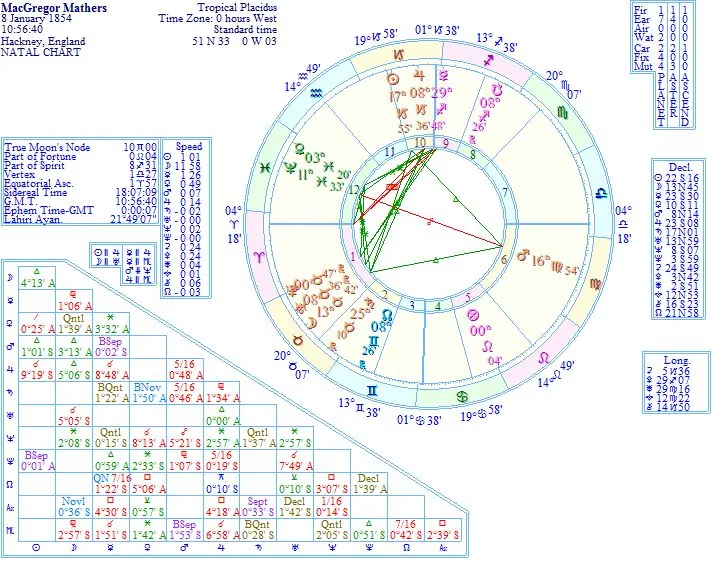
MacGregor Mathers’s horoscope likewise presents a striking picture of occult work. The connection between the eighth and twelfth is immediately apparent in the conjunction of their rulers in the first house. Venus, the dispositor of this conjunction, is in the twelfth, on Sadalmelik and conjunct Neptune—the magician’s aspect. Mars, as co-ruler of the eighth, also trines both rulers of the twelfth, Uranus and Saturn, and opposes Neptune, ruler of Pisces intercepted in the twelfth. Jupiter, although ruler of the ninth here, is also highly significant, forming an exact trine to Uranus, ruler of the twelfth: personal spirituality. Once again, the connections between these complexes are emphasised. As for the nodal axis, Venus in the twelfth squares it, while Uranus makes an exact semisextile/quincunx to it, highlighting the path of personal spirituality and transformation. Unlike the previous example, here the transpersonal planets are connected with their lower octaves, allowing these powerful forces to be brought down and controlled: Venus conjunct Neptune, Mercury trine Uranus. Among the significant configurations, we find an impressive Kite. In its pure form, this configuration is highly astral and operates on very elevated levels; usually, another configuration is needed to activate its potential. The essential purpose of this Kite is always to transfer what lies at one end, in the planet receiving two trines, and unite or fuse it with what lies in the planet receiving two sextiles at the other end of the opposition. This is the purpose of the Kite: the complete union of opposites. Uniting opposites means developing consciousness, which, as discussed earlier, is also the fundamental aim of anyone seriously practising magic. In this example, the planets seeking that union are Neptune, ruler of the twelfth, receiving two sextiles from Jupiter, ruler of the ninth, and Uranus, another ruler of the twelfth; and Mars, ruler of the eighth, receiving trines from those same two planets. What configuration activates this potential? It is the exceptionally spiritual lotus formed by Mercury at 29° Sagittarius and Pluto, ruler of the eighth, at 0° Taurus—as well as Uranus at 08° Taurus—with Venus at its centre, on Sadalmelik in the twelfth and conjunct that same Neptune! Viewed from another angle, the Kite fundamentally represents the essence of an awakened human being, already expressed in its form through the caduceus, the staff of Hermes, or the spine itself, through which an energy field rises from its base: the energy we call kundalini. Regarding the fixed stars, we have already noted exalted Venus on Sadalmelik at the apex of the lotus. I would also mention Skat at 08° Pisces, at the very midpoint of the Venus–Neptune conjunction, receiving exact sextiles from Jupiter, ruler of the ninth, and Uranus, ruler of the twelfth. In this context, it confers exceptional intelligence combined with powerful intuition, and may indicate the highest degree of spirituality. Among the important degrees, we should note Mercury at 29° Sagittarius, Pluto at 0° Taurus and the fifth-house cusp at 19° Cancer.
Gareth Knight (3 April 1930, 11:15 PM, Colchester, England)
Gareth Knight is one of the most respected authorities on ritual magic, the Western Mystical Tradition and Qabalistic symbolism. He received his magical training in the Fraternity of Inner Light[6], under the auspices of Dion Fortune. Progressing rapidly through the grades, he was initiated into the Greater Mysteries in 1959, when he also became the Order’s librarian. He devoted his life to rediscovering and teaching the principles of magic as a spiritual discipline and a method of self-realisation. In 1973, he founded his own Order, based on the principles of the Fraternity of Inner Light. He has written more than forty books on magic, tarot, Qabalah and Rosicrucianism.
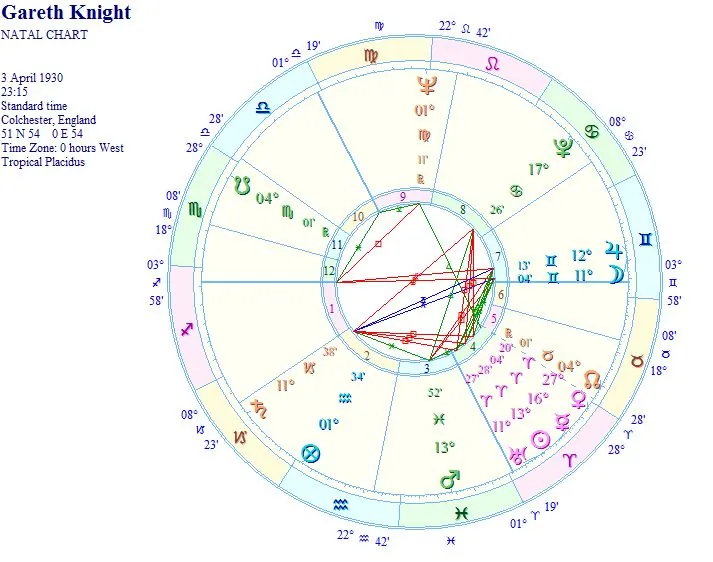
Here too, we find the code present. As before, we begin with the connections between the eighth- and twelfth-house complexes, noting Pluto, ruler of the twelfth, in the eighth. The Moon, ruler of the eighth, also squares Mars, the other ruler of the twelfth. This Moon is conjunct Jupiter, ruler of the Ascendant, which is also a twelfth-house significator and, in this case, dispositor of the ruler of the twelfth.
Furthermore, Neptune—a twelfth-house significator and dispositor of its ruler—is the planet forming a trine/sextile to the nodal axis, again emphasising the spiritual path; it also occupies the ninth house. Here we also find strong connections between the transpersonal planets and their corresponding personal planets: Mercury conjunct Uranus, Venus trine Neptune and Mars trine Pluto. These connections are made through exceptionally favourable aspects, especially in the case of Mars and Pluto, which also rule the twelfth. Among the configurations, we find a cardinal T-square with a stellium of the Sun, Mercury and Uranus at its apex. The first two rule the ninth house, directing us once more towards spirituality and towards Neptune in the ninth, favourably aspecting the nodal axis. That same Neptune trines Venus, ruler of the opposite point, at 27° Aries. Turning to degrees, besides Venus at 27° Aries, Mercury—the apex planet of the T-square, ruler of the ninth and dispositor of the eighth-house ruler—occupies 16° Aries. Saturn too is on a degree important for occultism, at 11° Capricorn. Finally, we must complete the picture with the fixed stars. Most significant is Mars on Achernar, a fortunate star that emphasises profound spiritual experiences, indicating distant journeys—in Spirit, specifically, since Mars here rules the twelfth. In its ultimate manifestation, this is pure knowledge coming from Pluto, and this description finds its fullest confirmation in this nativity: Mars, ruler of the twelfth, trines Pluto in the eighth!
Živorad Mihajlović Slavinski (4 December 1937, 08:45 PM, Belgrade, Serbia)
Živorad Mihajlović Slavinski is a psychologist by training and probably the best-known parapsychologist in our region. More than twenty years ago, he pioneered the publication of books on occultism and parapsychology. He has created several spiritual techniques and systems and is now an internationally recognised researcher in spiritual technology, giving seminars throughout the world.
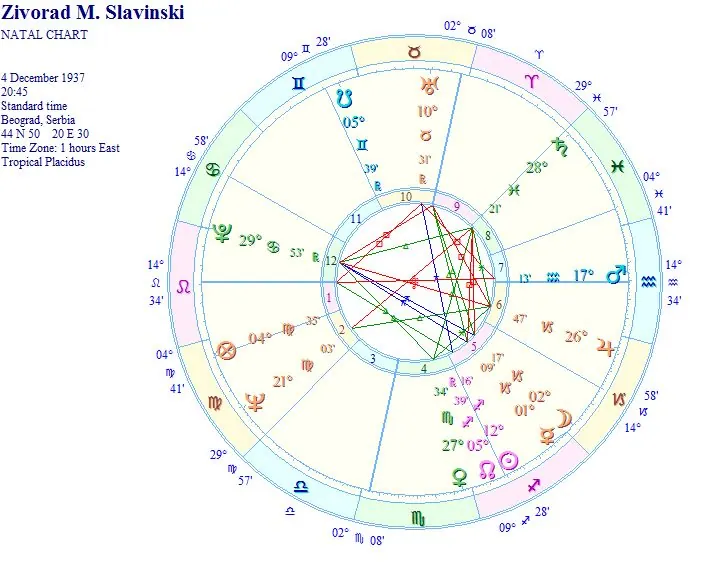
In the chart of our best-known occultist, we can identify many significant indicators that fit our code. First, Pluto, an eighth-house significator, occupies the twelfth at 29° Cancer, a degree often emphasised in spiritually engaged people. Pisces is on the eighth-house cusp, and Saturn, dispositor of the twelfth-house ruler, occupies that house, trining Pluto and, more importantly, sextiling Jupiter, ruler of the eighth. The twelfth-house cusp falls on Jupiter’s exaltation degree, Jupiter here being ruler of the eighth. Jupiter opposes Pluto in the twelfth, while Neptune, as the other ruler of the eighth, sextiles Pluto. Thus, although there is no particularly obvious connection between the rulers of these two houses, the two complexes are nevertheless linked, showing that this relationship can manifest in many different ways. Among the connections between transpersonal and personal planets, only the Mars–Pluto link is absent: Mercury and Uranus are trine, and Venus and Neptune sextile. The Sun, as second ruler of the twelfth, is conjunct the North Node and therefore opposite the South Node, confirming that almost invariably a planet associated with the eighth- or twelfth-house complexes aspects the nodal axis. This describes spirituality and transformation as a path to developing consciousness through the reconciliation of opposites. Configurations are especially prominent here. Consider the deeply spiritual water Grand Trine formed by Pluto at 29° Cancer, Saturn at 28° Pisces and Venus at 27° Scorpio—all on spiritual degrees! As we know, a Grand Trine is not sufficient in itself and often remains latent without a square to activate it. Here that role is assumed by the Moon, ruler of the twelfth, which squares Saturn. Slavinski has therefore developed his powerful spiritual potential through personal spirituality and direct personal knowledge—gnosis. Saturn also links this Grand Trine with another highly spiritual configuration, a lotus, at whose centre stands Jupiter, ruler of the eighth. This connection between the paths of personal spirituality and transformation—the only true path of magic—describes Slavinski’s entire body of work. He has developed numerous techniques, of which the Gnostic (twelfth house) Intensive (eighth house) perhaps best embodies this synthesis. Besides the degrees already mentioned—Venus at 27° Scorpio and Pluto at 29° Cancer—we also find Uranus at 10° Taurus. Saturn is on Scheat, a star indicating strong spirituality, while Neptune, ruler of the eighth, is on Denebola, a fixed star that brings change, a symbolism Slavinski has fulfilled through his innovative magical techniques. The North Node is on Dschubba, which describes all secret and ‘forbidden knowledge’, with Isidis and Acrab very close by. Together, these give the image of someone researching matters whose nature is secret and hidden—occult.
Austin Osman Spare (30 December 1886, 03:53 AM, London, England)
Austin Osman Spare was born in 1886, the son of a London policeman. At thirteen, he left school to work in a glass factory while attending evening art classes. His teachers soon recognised his talent, and, as the outstanding student, he received a scholarship to the Royal Academy of Arts in Kensington. Later, he became very close to an elderly fortune-teller whom he called Mrs Paterson in his writings. She was Spare’s first and only teacher in occult matters, and he maintained that he had never met anyone whose powers equalled hers. In his youth, Spare briefly belonged to Crowley’s organisation, the ‘Silver Star’[7]. From his visionary insights and Mrs Paterson’s teachings, Spare developed an original system of magic, which he presented in the privately published ‘The Book of Pleasure’ in 1913. Over three decades, he refined this system, naming it Zos Kia after its two key elements. ‘Zos’ was his magical name, which he defined as ‘the body considered as a whole’, encompassing the physical organism, astral body and spirit. ‘Kia’ was the cosmic Self, which used Zos as its field of activity and the vehicle for its manifestation on earth. The system is based on the polarisation of sexual energy into positive and negative currents, expressed on the plane of individual human existence through the symbols of the hand and eye. Zos and Kia, hand and eye, are magical instruments for activating the energies of the Id. The entire system centres on eliminating the conscious mind and its characteristic mode of expression: conscious, logical thought. For the conscious mind is a younger and inferior level compared with the boundless depths of the unconscious. Within Zos Kia, Spare developed three practical occult methods: a system of magical seals or sigils, the alphabet of desire, and the use of sentient symbols. Spare claimed to have discovered a mathematical formula capable of expressing the ultimate essence of otherworldly dimensions, which formed the foundation of his mystical philosophy. He died in 1956 before committing it to paper, and it has not been discovered among the writings found after his death. Besides ‘The Book of Pleasure’, he wrote ‘The Focus of Life’, ‘Earth Inferno’, ‘A Book of Satyrs’ and ‘Anathema of Zos’, all privately published. His paintings were exhibited chiefly in London, both during his lifetime and posthumously.
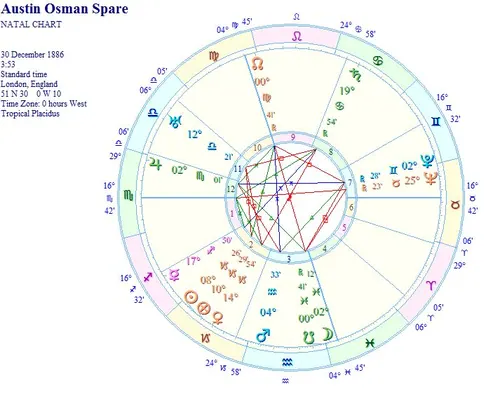
In the chart of this magician, distinctive in every sense, we can again readily identify the code, although expressed in a somewhat different language. Strictly speaking, there is no direct connection between the eighth- and twelfth-house complexes through an aspect between their primary rulers, or through the ruler of the eighth in the twelfth or vice versa. Nevertheless, the connection exists. Mercury rules the eighth, and its dispositor, Jupiter, is in the twelfth! The second ruler of the eighth, the Moon, forms an exact trine to Jupiter in the twelfth, as well as an exact square to Pluto, ruler of Scorpio, the predominant sign in the twelfth, and therefore the second ruler of that house. Jupiter in the twelfth disposits both rulers of the eighth, Mercury and the Moon. Pluto, an eighth-house significator and ruler of the twelfth, is also conjunct Neptune, a twelfth-house significator and dispositor of the Moon, the second ruler of the eighth. Saturn, dispositor of Mars as ruler of the twelfth, is likewise in the eighth. Connections between the transpersonal and personal planets are also quite pronounced: Mercury sextiles Uranus, and Mars trines Pluto. Venus and Neptune are unaspected to one another, although Venus is Neptune’s dispositor. The nodal axis presents a particularly interesting situation. First, the Moon is conjunct the South Node; Jupiter in the twelfth makes a trine/sextile to the axis; and Pluto squares it. As noted just above, all these planets are associated with both the eighth- and twelfth-house complexes—a situation encountered previously, and now emerging as a regular pattern. I would emphasise that all three planets form exact aspects to one another and constitute the dominant structure of this horoscope. The Moon in Pisces is especially powerful and, in astrological symbolism, portrays Spare’s work itself: work with the subconscious and unconscious levels of the personality, often involving so-called blackouts—for example, the death posture—as well as dream work. Among the configurations, we find a cardinal T-square formed by Saturn in the eighth, ruler of the third and dispositor of the twelfth-house ruler; Venus in the second, ruler of the twelfth; and Uranus in the eleventh, ruler of the third and dispositor of the twelfth-house ruler. Uranus is the apex planet of this T-square. In the eleventh, it emphasises Spare’s originality and inventiveness and provides an excellent channel for new possibilities. It also disposits Mars, ruler of the twelfth, so this could certainly concern spirituality. This is confirmed by the ruler of the point opposite the apex planet: that very Mars, which trines the apex planet with an orb of 8°. Uranus’s dispositor is Venus, ruler of the twelfth. Turning to the fixed stars confirms our conclusion about the powerful Moon. Besides all the factors already mentioned and its angularity on the fourth-house cusp, this Moon occupies Sadalmelik and Fomalhaut, which we have encountered in earlier examples. I have already stressed that the Moon is the best conductor of fixed-star influences, and here it is also the second ruler of the eighth! The influence of these two stars, so strongly associated with occultism, has been described above. The Moon makes that exact trine to Jupiter in the twelfth, on Princeps, a star associated, as its name suggests, with establishing principles and with research. With Jupiter in the twelfth, the subject is clearly spirituality, and Spare’s inventiveness undoubtedly established new principles in occultism. Neptune is on Algol, a malefic fixed star bearing enormous passion that can readily manifest through the full range of Plutonian symbolism in the most direct sense. In this nativity, Neptune is conjunct Pluto. Among the important degrees, the twelfth-house cusp at 29° Libra immediately catches the eye: a degree characteristically emphasised in deeply spiritual people, activated here by the twelfth-house cusp itself. We should also note Saturn, dispositor of the twelfth-house ruler, at 19° Cancer, and the Lot of Fortune very close to 11° Capricorn.
Francis Regardie (17 November 1907, 6:10 AM, London, England)
Regardie is one of the most important occultists of the twentieth century. Born into a poor Jewish family, he emigrated to the United States at fourteen and studied art there. During this period, he explored numerous writings, with particular emphasis on Theosophy, Indian philosophy and Yoga, and joined a Rosicrucian order. After encountering Crowley’s work, he began corresponding with him, eventually becoming his secretary in 1928. In 1934, he joined the Order of the Golden Dawn. Following the Order’s dissolution, Regardie gathered its documents and published ‘The Golden Dawn’, containing its rituals and other secret writings, for which he was accused of breaking his oath. Nevertheless, the Order’s direct successors owe their existence and popularity to this very man. At thirty, he went to New York to study chiropractic, subsequently opening a practice and teaching psychotherapy. His many books include ‘The Tree of Life’, ‘The Middle Pillar’, ‘A Garden of Pomegranates’ and ‘The Eye in the Triangle’, a biography of Aleister Crowley.
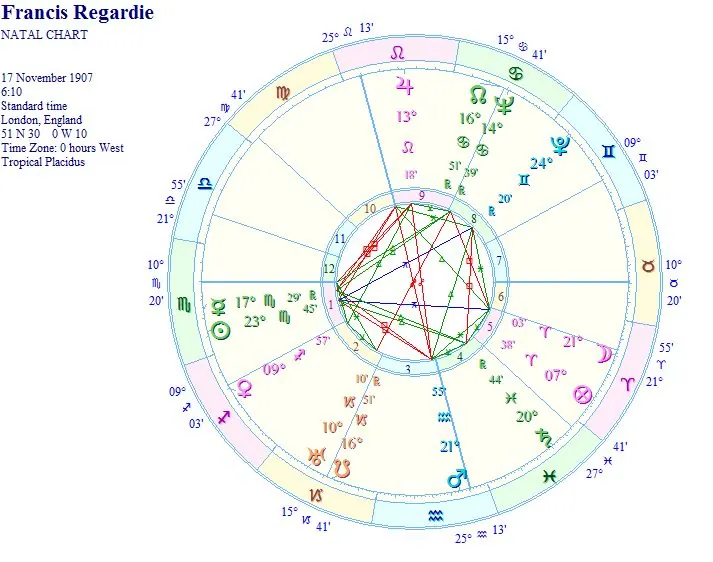
Here, the connection between the eighth- and twelfth-house complexes is first apparent in Pluto’s placement in the eighth, since it is the second ruler of the twelfth. Pluto also rules the Ascendant, while the ruler of the eighth occupies the first, indicating a powerful orientation towards Hermetic and occult practices. This link is further reflected in Pluto’s trine from the eighth to the twelfth-house cusp, as well as Mars’s exact trine to that cusp. Connections between the transpersonal and personal planets are also present: Mercury sextiles Uranus, Mars trines Pluto, and Venus and Neptune form a wide applying quincunx. The planet making a very close trine/sextile to the nodal axis is Mercury itself, ruler of the eighth in the first, emphasising the path of occultism and magic. The configurations again tell a fascinating story. We begin with a fixed T-square formed by Jupiter, dispositor of the twelfth-house ruler; Mars, second ruler of the twelfth and dispositor of the eighth-house ruler; and Mercury, ruler of the eighth, at its apex! The ruler of the opposite point, which together with the apex planet allows the T-square’s powerful energy to be transformed, is Venus, ruler of the twelfth. As we know, this configuration is usually the dominant force in a natal chart. When it connects the eighth and twelfth so strikingly, occultism is precisely the path the individual should follow in developing consciousness. We must remember that the T-square is a highly unconscious configuration, and few people can direct it. We also find a yod formed by Pluto in the eighth, the Moon as ruler of the ninth, and the Sun as ruler of the tenth. This Sun is conjunct the ruler of the eighth in Scorpio and is strongly coloured by that influence. Although technically we cannot take Mercury as the apex of the yod, we can certainly associate the Sun with occultism by virtue of its placement. Among the important fixed stars, it is crucial to note the Ascendant itself on Acrux, which is associated with an orientation towards the occult and mystical dimensions of reality. It confers the ability to live spirituality in practice, and all fields of occultism are therefore characteristic of it. Mars, ruler of the Ascendant and second ruler of the twelfth, is on Sadalsuud, a star associated with occultism and alternative spirituality in general. From there, it forms an exact sextile to the Moon, ruler of the ninth and second ruler of the eighth. Among the occult degrees, besides 11° Scorpio, we find the fifth-house cusp at 27° Pisces and the seventh-house cusp at 10° Taurus. We should also note the ninth-house cusp on Jupiter’s exaltation degree.
Conclusion
As will be apparent, this study has not concerned itself with inclinations towards the occult—that interest which, in itself, enriches the spirit, though far less than the experience of an Adept of Magic, a Magus, a Magician, or whatever name we give to someone who has devoted their life to the Path of Knowledge. Such inclinations can certainly be investigated: simply by opening a chart and synthesising its symbolism, we can see how the personality relates to the occult. The images would vary: the Ascendant connected with the eighth- and twelfth-house complexes; Mercury or the third-house complex coloured by esotericism; or pronounced intuition through the twelfth-house complex. The Moon may lead us along this path through the emotions, appearing in water signs, the corresponding houses, and so forth. This study, however, attempts to penetrate those deepest factors that enable a person actually to accomplish something on that Path. As the examples have shown, the factors initially proposed as the magician’s code have left a powerful imprint on these nativities, making them significant indicators. Yet this study is far from having supplied every key to decoding them. Its greatest contribution is to have identified certain important elements that can help us recognise the magician’s signature. Every nativity is, of course, a story in itself. Even among these few examples, the ‘trigger’ that allowed an inclination to become a great ability differs in each case, so generalisation is of limited value. Moreover, the examples given are people who have left their mark on this field. Many others work alone, without seeking recognition or prominence, skilfully directing in secrecy and silence the Force that Éliphas Lévi described in ‘Dogma and Ritual of High Magic’:
‘There exists in Nature a Force incomparably mightier than any known, and whoever masters and directs it can change the face of the whole world. This Force was known to the ancients; it comprises the Universal Agent whose supreme law is Equilibrium, while its direction is bound to the Great Arcanum of transcendental Magic. By directing this agent, it is possible to alter the succession of the seasons, produce the phenomena of day by night, communicate in an instant between the two ends of the earth, behold what passes on the other side of the world, heal or wound at a distance, and render speech universally intelligible. This agent is precisely what the initiates of the Middle Ages called the First Matter of the Great Work. The Gnostics represented it as the fiery body of the Holy Spirit. It was the object of adoration in the secret Rituals of the Sabbath and was represented in the Temple by the hieroglyphic figure of Baphomet, or the Androgyne.’
This study is therefore simply an attempt to present a portrait of these people, painted in the infinite colours of astrological symbolism, in a somewhat less abstract form—at least for those inclined towards the astrological art. More precisely, guided by the maxim from the Necronomicon[8], ‘Everything has been told to us; nothing has been explained’, it seeks to bring at least a small part of this astrological description closer to understanding. I hope that, as such, it will contribute to future research.
[1] All fixed-star positions given here have been calculated for 1 January 2000.
[2] Illuminates of Thanateros
[3] Carroll, Peter J. (1995). PsyberMagick: Advanced Ideas in Chaos Magick, ch. 59
[4] Kabbalah Unveiled (Kabbala Denudata)
[5] Rosae Rubeae et Aurae Crucis
[6] Fraternity of Inner Light
[7] Astrum Argentum A:.A:.
[8] The Necronomicon, or Šotenerom, is the Book of the Dead: a collection of magical texts and grimoires composed at different times, based on the mythology and traditions of the peoples of Sumer, Akkad, Assyria and Babylon.