Simply put, the “planetary joys” are the mundane houses in which each planet most delights: those most congenial to its nature, where it can express that nature more fully than elsewhere. As such, they also constitute a form of accidental dignity a planet may possess.
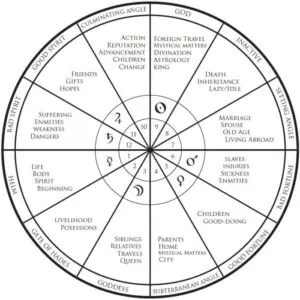
Venus therefore rejoices in the fifth house, which is associated with children, entertainment and pleasure. She can be strengthened by placement here, since such a place is fundamentally suited to her character. The greater benefic, Jupiter, rejoices in the eleventh house of “good fortune, benefactors and friends”, and tradition considers him strengthened when placed there. Mercury rejoices in the first house, where he can exert a considerable influence on the intellect and our ability to express ourselves eloquently. The Moon, the traditional significator of messages, couriers and writers, rejoices in the third house, which naturally governs these very matters. The Sun, traditionally associated with prophecy, divination and the apprehension of truth, rejoices in the ninth house: the house of counsel, divination, guidance and religion. The malefic Saturn rejoices in the twelfth house, which supports the theme of restriction, while Mars rejoices in the sixth, generally considered an unfortunate house because of its associations with illness and arduous labour.
This is the basic arrangement, and it seems perfectly sensible. Yet the question remains: what “logos” underlies it? Since astrology is a coherent system grounded to a considerable extent in Hermetic principles, we shall explore these questions in greater detail here.
The joys appear to provide a basis for the convention by which certain houses received their names. Rather than being numbered from the rising sign onwards—for example, “the fifth house”—houses were once designated by particular names. The customary names in the Hellenistic tradition associated with the planetary joys are:
- The ninth house is called the “House of God”, or simply “God” (Theos)
- The third house is called “Goddess” (Thea)
- The eleventh house is called the house of the “Good Spirit”
- The sixth house is designated “Bad Fortune” (kakē tuchē)
- The twelfth house is “Bad Spirit” (kakos daimōn)
- The first house is also called the “helm” (oiax), as on a ship.
The other houses were also given names, although these have no direct connection with the joys, since no planet rejoices in them:
- The second house is also called the “Gate of Hades” (Haidou pulē)
- The eighth house is designated the house of “Idleness” (argos)
- The tenth house is the Zenith, the summit of heaven (mesouranēma)
- The seventh house is designated the “setting place” (dusis)
- The fourth house is called the “subterranean place” (hupogeion)
As we can see, the names of the angular houses—the fourth, seventh and tenth—are purely descriptive, reflecting their astronomical positions. No such connection can be established for the other houses; instead, their names are evidently determined by the planets that rejoice in them. The Sun rejoices in the ninth house, the House of God. Opposite it, the Moon rejoices in the third, the House of the Goddess. The two benefics, Jupiter and Venus, are associated with the two benefic houses: the house of the “Good Spirit” (eleventh) and the house of “Good Fortune” (fifth). Conversely, the two malefics, Saturn and Mars, are associated with the two unfortunate houses, named the house of the “Bad Spirit” (twelfth) and the house of “Bad Fortune” (sixth).
This close correspondence between the meanings of the house names and the astrological symbolism of the planets that rejoice in them suggests a connection between the two concepts. The fourth-century astrologer Firmicus Maternus confirms this connection when he states in the introduction to his “Mathesis” that the fifth house “is called the house of Good Fortune, because it is the house of Venus.” Similarly, he says that the sixth house is called the house of Bad Fortune “… because it is the house of Mars.” Later in the same century, the astrologer Paulus Alexandrinus describes the third as the “house of the Moon”, the fifth as the “house of Venus”, the sixth as the “house of Mars”, and so forth.
The Basic Patterns of the Joys
Of the many patterns within the arrangement of the joys, two stand out. The first relates to the Hellenistic doctrine of sect. According to this doctrine, the planets are divided into two “factions” or “sects” (hairesis). There is a daytime, or diurnal, sect led by the Sun, and a night-time, or nocturnal, sect led by the Moon. The planets are then divided equally between these two sects, so that each receives one benefic and one malefic. Jupiter and Saturn join the Sun as diurnal planets, while Venus and Mars join the Moon as nocturnal planets. Mercury is neutral, joining the diurnal sect when appearing as a morning star and the nocturnal sect when appearing as an evening star.
The immediately apparent pattern in the arrangement of the joys is that the three diurnal planets are grouped together in the upper hemisphere of the chart, while the nocturnal planets occupy the lower half, beneath the earth. This seems to be connected with another, separate doctrine concerning sect, according to which diurnal planets rejoice above the earth by day and below the earth by night. The reverse applies to nocturnal planets: they rejoice above the earth by night and below the earth by day.
Mercury, being able to join either the diurnal or the nocturnal sect, rejoices in the first house. This is one of only two houses in which a planet can lie on either side of the horizon while remaining in the same house, owing to the use of whole-sign houses in Hellenistic astrology.
In connection with this pattern relating to sect, it is worth noting that the luminaries, benefics and Mercury rejoice in the so-called “good houses”, which behold the rising sign through one of the classical aspects—that is, conjunction, sextile, square, trine or opposition. The two malefics, by contrast, rejoice in two of the “bad houses”, which form no such aspect to the rising sign.
The joys also seem to admit of an explanation through the triplicities, which may even be their original basis. The older triplicity system assigns two planets to each element; the later system adds a third to the overall scheme as a corrective or balancing factor. In this way, seemingly incompatible elements are brought together: earth and fire, in the case of the fire signs, through Saturn’s participating rulership of the fire element; or fire and water, through fiery Mars’s primary rulership of the water element. The triplicity scheme is a defining feature of the methodology of the Hellenistic astrological author Dorotheus of Sidon, and takes the following form:
Fire: the Sun by day, Jupiter by night (Saturn as the balancing ruler) Earth: Venus by day, the Moon by night (Mars as the balancing ruler) Air: Saturn by day, Mercury by night (Jupiter as the balancing ruler) Water: Venus by day, Mars by night (the Moon as the balancing ruler)
The joys can thus be explained by the planets’ occupation of sectors around the four angles of the horoscope—the Ascendant, Medium Coeli, Descendant and Imum Coeli. The Medium Coeli falls under the rulership of fire, so Jupiter receives the eleventh house as his joy, while the Sun takes the ninth, on the other side of the culminating point. The air triplicity is associated with the Ascendant, just as the first, vernal equinox is associated with spring, so Saturn is exalted in the twelfth and Mercury in the first. Mercury’s very glyph lends support to this scheme from a mystical perspective. The glyph of Venus, symbolising sensual desire, is “enriched” by a semicircular halo: a symbol of rational contemplation, which makes the human being unique. In this way, human rational power comes under the control of Spirit, symbolised by the Sun, with which the Ascendant has direct connections. The Imum Coeli, or point on the lower meridian, is besieged by the water triplicity: Venus on the fifth-house side and the Moon on the third-house side. Finally, Mars—the eccentric masculine planet ruling a feminine element—receives sole and sovereign command of the region around the Descendant, namely the sixth mundane house. In this way, the scheme completes the pairs of benefics, malefics and luminaries. Jupiter stands 180 degrees from Venus, Saturn from Mars, and the Moon from the Sun. Mercury, as the androgynous component, remains neutral at the first angle.
Ultimately, all of the above may be best conveyed in an image:
Sources: “The Planetary Joys and the Origins of the Significations of the Houses and Triplicities” – Chris Brennan Nataša Karalić Koprivica, traditional astrology blog, link“Planetary Joys”, tutorial by Deborah Houlding