How often have you heard someone say, “You don’t really strike me as a Scorpio, a Leo…” or something similar? I have heard it countless times. The emphasis on the Sun sign—the sign occupied by the Sun on the day of your birth—as the determining factor in assessing someone’s character, together with the accompanying psychoanalysis, is a product of the so-called “reformation” of astrology. In reality, it is nothing more than a trivialisation of the subject intended to make it appeal to the widest possible audience. This has debased the Art, which is hardly surprising in a society where culture has been reduced to entertainment. As the Nobel laureate Mario Vargas Llosa once put it: “The culture of contemporary society seeks to entertain, and so becomes superficial. The firm convictions we once held, and which our ancestors held, no longer exist; we no longer believe in them. Today we have artists who are not artists, but clowns. Culture today is becoming a spectacle, a superficial spectacle, and this is happening not only in the developed world but in less developed countries too.” Replace “culture” with “astrology”, and “artist” with “astrologer”, and this quotation also describes the state of astrology today. Or, as Robert Zoller explained: “Perhaps the most devastating contribution to the Western world’s disapproval of astrology comes from the modern astrologer himself, who takes neither himself nor his astrology seriously enough, inventing doctrines and practices which, like the fiction of a novel, are unverifiable, bear no relation to the essence of astrology, and are deceptive and strange. Publishers encourage booksellers to sell the rubbish produced by the unnatural marriage of astrology and the laws of the modern marketplace. The intellectually curious, the half-educated and the bored buy this ‘new and different’ material.”
Dividing people up and filing them away in one of twelve boxes—the zodiac signs—is precisely what newspaper Sun-sign columns do. We all complain about it, so why do we perpetuate it? I suspect the answer may be that people simply know no other way. They know that Sun-sign astrology is superficial, but do not know how to move beyond it, to take things a step further. Modern astrological writing does nothing to help; on the contrary, it merely sustains the illusion. Despite advising us to consider the whole chart in interpretation, these texts continue to define people’s personalities by the sign occupied by the Sun at the moment of their birth. This continues throughout their numerous articles on transits and their annual or monthly forecasts for Leos, Arians, Aquarians, Taureans and so on.
These days, then, people quite often ask when first meeting someone: “What’s your star sign?” As though this would somehow provide a better insight into that person’s character. I often hear people tell me, “I’m a Sagittarius”, or “We Aquarians are like that…” and so forth. This not only reduces personality to an inaccurate correspondence, but reduces the whole person to a zodiac sign. And not even to the sign itself, but to our imperfect—and often mistaken—conception of it. Rather than accepting people as genuine individuals who embody a multitude of different “energies”, we resort to stereotypes, using categories we do not really understand.
Before all this Sun-sign madness, if there was one place in a nativity from which to begin forming a clearer picture of someone’s personality, it was the rising sign or Ascendant. Indeed, the very word “horoscope” refers to it. Etymologically, it comes from the Greek ὡρόσκοπος, “nativity, horoscope”, literally “observer of the hour [of birth]”, from ὥρα, “time, hour”, and σκόπος, “observer, one who watches”, referring to the sign rising at the hour of birth. The rising sign signifies a person’s physical body, health and general fortune. If a planet occupies the Ascendant—or indeed the first house—it takes the leading role. We must then consider the sign on the house cusp and the planet ruling that sign.
In the tradition, zodiac signs never possessed a “personality” that could automatically be applied to everyone born on a particular date. The approach was different.
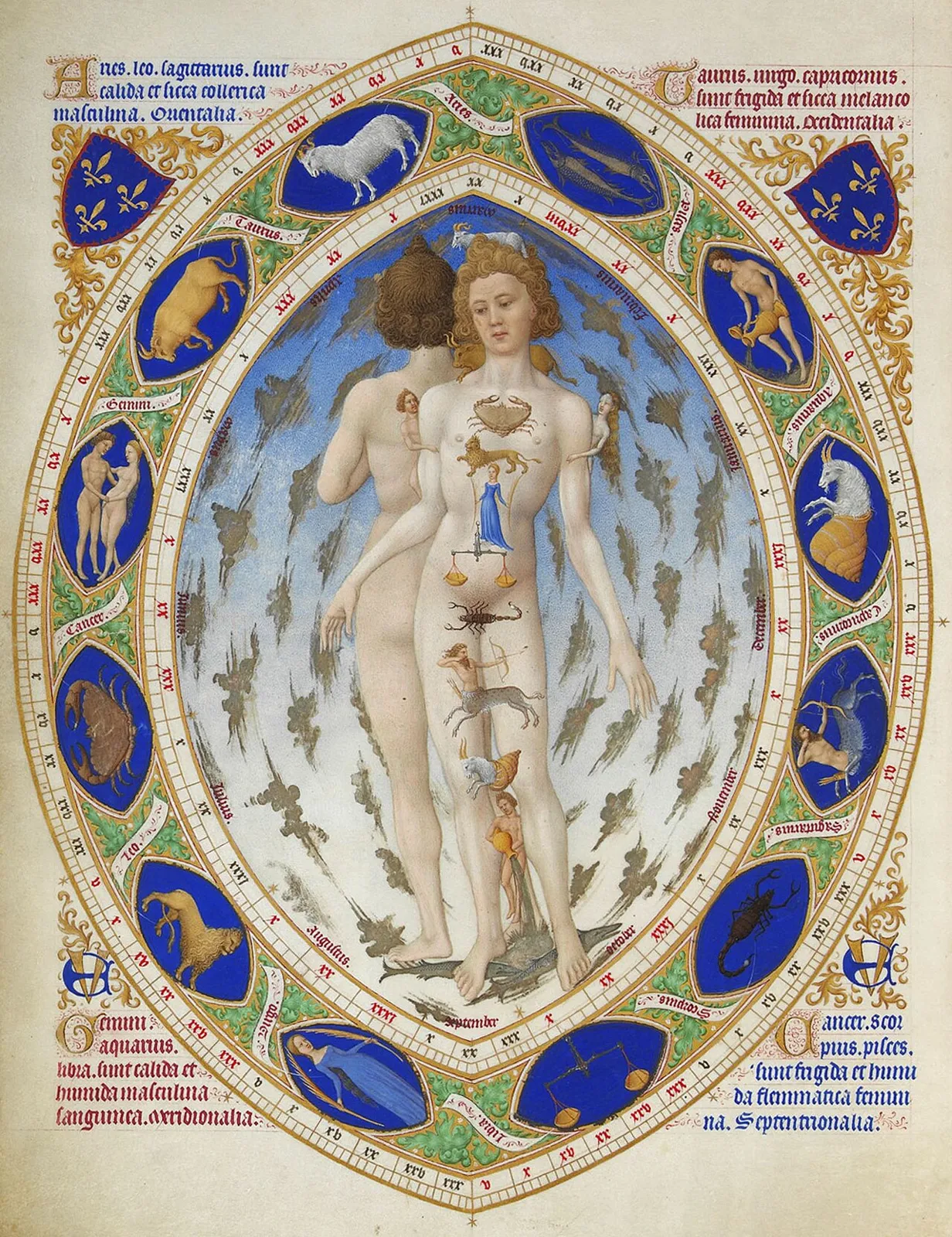
Traditional authors do not give “descriptions” of the signs. Generally, they list their qualities, followed by the things associated with them: professions, animals, places, colours and so forth. Aquarius, for example, is fixed, airy—and therefore hot and moist—diurnal rather than nocturnal, masculine, human rather than bestial like Aries or Leo, vocal rather than mute like the water signs, and Saturn’s principal sign, among other things. Logical conclusions can be drawn from these qualities, but they must remain consistent with them. Aquarius would therefore be talkative, as a human and vocal sign; stubborn, through its fixed quality; intellectual, as an airy and human sign; inclined towards structure, through Saturn; and so on. Being a masculine, airy, human and intellectual sign makes Aquarius more future-oriented and inclined to move forwards than, say, Capricorn, Saturn’s other sign. But this does not free it from its fixed, Saturnian nature, so it cannot be quite so independent, rebellious or prone to sudden and unexpected changes.
If we are to speak of psychological portraits and comprehensive descriptions of character, the planets would seem better suited to that role. Even when discussing the Ascendant sign as one of the most important traditional indicators, more of the interpretation would be drawn from the planet ruling the Ascendant. Thus, if Capricorn were rising, rather than interpreting the meaning of that sign, you would look for Saturn in your chart, consider its placement and condition, and interpret the person’s character more through Saturn’s expression. We can see this connection between planets and character in everyday speech too. A cheerful, good-natured person is often described as “jovial”, an astrological term meaning “Jupiterian”. Someone changeable and perplexing may be called “mercurial”. Perhaps the most obvious example is Mars, which signifies warlike people: in English, this quality has given its name to the fighting disciplines, or “martial arts”.
Besides the planets already mentioned—the ruler of the Ascendant, planets on the Ascendant or those aspecting it—there are also the Lord of the Geniture and the significator of manners. The Lord of the Geniture is usually taken to be the planet with the greatest essential and accidental dignity, which can often emerge as a dominant quality in the expression of the personality. In the third volume of Christian Astrology, William Lilly says of this planet: “And I am confident, the whole actions of the Native will more or less partake of the nature of that Planet, and so his conditions, complexion, temperament and manners shall be much regulated to the properties assigned that Planet (consideratis, considerandis)***”*.** Yet this is far from saying that a single planet determines everything, or that its general characteristics will find expression in an unmodified form. No: that expression will be modified, beginning with the foundation provided by an assessment of temperament, which shapes how the planet manifests, and then by the planet’s own placement and relationships with other planets. Only then do we arrive at a somewhat fuller picture of the native. Fixed stars of the first and second magnitude also have an influence when they lie directly on the Ascendant or the significator of manners, and even then according to the planetary nature attributed to them. The significator of manners has already been touched upon in the discussion of planets on the Ascendant. What is interesting, however, is that the luminaries do not play so prominent a role in judging manners, despite being the most important bodies in the natal chart. More importantly, Ptolemy also uses the Moon and Mercury as significators of the soul—or personality, as we would understand it. They provide the first level of enquiry into personality in every respect, including the intellectual. He distinguishes the Ascendant and Moon in relation to the temperaments of body and soul, but, taken together, the Ascendant, Moon, Mercury and ruler of the Ascendant frame the basic description of personality. All the other planets are then considered according to the faculties they universally signify: Venus, desire and the capacity for union; the Sun, the degree of ego and volition; Mars, courage and combativeness; and so forth. The ancients also had far greater respect for this relationship between matter and spirit—body and soul—than we do today. As early as Aristotle, we find the principle that the body does not exist without the soul, nor can the soul exist without the body. Hence, once again, the particular precedence given to the Ascendant and Moon over the other factors.
Where, then, does the Sun fit into all this? Does its symbolic representation of the ego actually reflect our pervasive egocentricity, and is that why it is so popular? As we have seen, there is no basis in the astrological tradition for treating the Sun and its sign as the chief or primary indicators of character, let alone as its defining factors. The Sun was considered in an entirely different way.
Traditionally, the Sun signifies honour, fame and achievement. It therefore has relatively little to do with personality unless it is “accidentally” connected with it. For example, the Sun rules Leo; if Leo is rising, the Sun and the sign it occupies will have some influence on personality, because the Sun rules the rising sign. Likewise, if the Sun is in the first house—the closer to the Ascendant, the better—it will clearly help determine character traits. If the Sun sign and rising sign are the same, as always happens when someone is born around dawn, there is another obvious connection. Finally, if the Sun aspects the Ascendant itself, or its ruler, by one of the five Ptolemaic aspects, it will also bear upon first-house affairs: the body, health and fortune.
Although the Sun is indeed used as a key personal point in determining the hyleg and calculating the Lots of Fortune and Spirit, it did not traditionally occupy the central role in determining character that it does today. Certainly not in the same way as the Ascendant and Moon. Naturally, we consider the Sun as the ruler of a particular house, and it will therefore carry certain significations for that area of life. Yet this is hardly unique to the Sun. In assessing temperament, it is primarily the Sun’s season that is considered, rather than its zodiac sign. This does not mean that the sign is wholly irrelevant, but that its manifestation differs from that of the Ascendant, Moon or even Mercury.
Anyone familiar with traditional astrology knows the principle of planetary sect, and will therefore appreciate how crucial the Sun’s position above or below the horizon is in determining whether the planets are strengthened or weakened in relation to their sect. A planet’s relationship with the Sun also determines its phase and how it will express its nature. The domicile rulerships likewise reflect the seasons determined by the Sun’s declination: summer in the northern hemisphere is assigned to the signs ruled by the luminaries, Cancer and Leo, while the coldest part of winter is assigned to Saturn’s signs, Capricorn and Aquarius.
In Hellenistic astrology, and particularly in Vettius Valens, the Sun is regarded as the natural significator of Nous, or the higher mind. Valens accordingly describes it as the “light of the mind”. There also seems to be some sense in viewing it as our expression of free will, in contrast to the predetermined fate of the Moon. We can see this in the Hellenistic understanding of the Lots of Fortune and Spirit. The Lot of Fortune is regarded as the Moon’s lot and represents our predetermined fate, while the Lot of Spirit is the Sun’s lot precisely because it reflects our expression of free will and our intellectual and spiritual potential. The Sun’s spiritual associations and its connection with the higher mind are undoubtedly also why it rejoices in the ninth house, as I discussed in the previous article. Only the higher mind can communicate with the divine. Thus, even when we examine the Sun’s role across different periods of the tradition, we inevitably reach the conclusion that the importance attached to the Sun sign today has no foundation. This is reductionism: the trivialisation of the subject to the point of absurdity.
Another product of this approach is the notion of astrological “series”, whereby mundane houses are equated with celestial ones—that is, with the zodiac signs. This takes us still further into absurdity. Leo, for example, as the fifth sign, is now used as a reference point for fifth-house matters, namely children, even though we know that the tradition regards Leo as a barren sign! And as though this delineation were not already mistaken enough, mundane houses have come to be viewed as psychological extensions of the native: the second house is said to represent “self-worth”, for instance, while the seventh describes our position in relationships and our attitude towards them. I see these developments as connected because, just like the whole Sun-sign phenomenon, they have reduced astrology to mere psychoanalysis, which no longer even attempts to predict anything. The element of fate has thus been removed from astrology, effectively negating the art itself. I would much rather retain the old principle whereby the first house represents the native and all the others describe the world—spiritual and temporal—that surrounds us.
Ultimately, I hope this article has offered a broader understanding of just how imprecise, at the very least, it is to define ourselves through our Sun sign. Astrology in fact entails a far deeper and more detailed analysis of character and personality: the only proper approach, without generalisations of any kind. Yet it is credited with precisely the opposite, and so readily dismissed, because those who sought to “popularise” it made an enormous mistake by participating in “the secularisation and demystification that characterise the reductionism of the modern world”.
Sources drawn upon in part:
Chris LaFond’s blog Skyscript forum Ben Dykes – The Signs They Are a-Changin’Traditional Astrology Forum