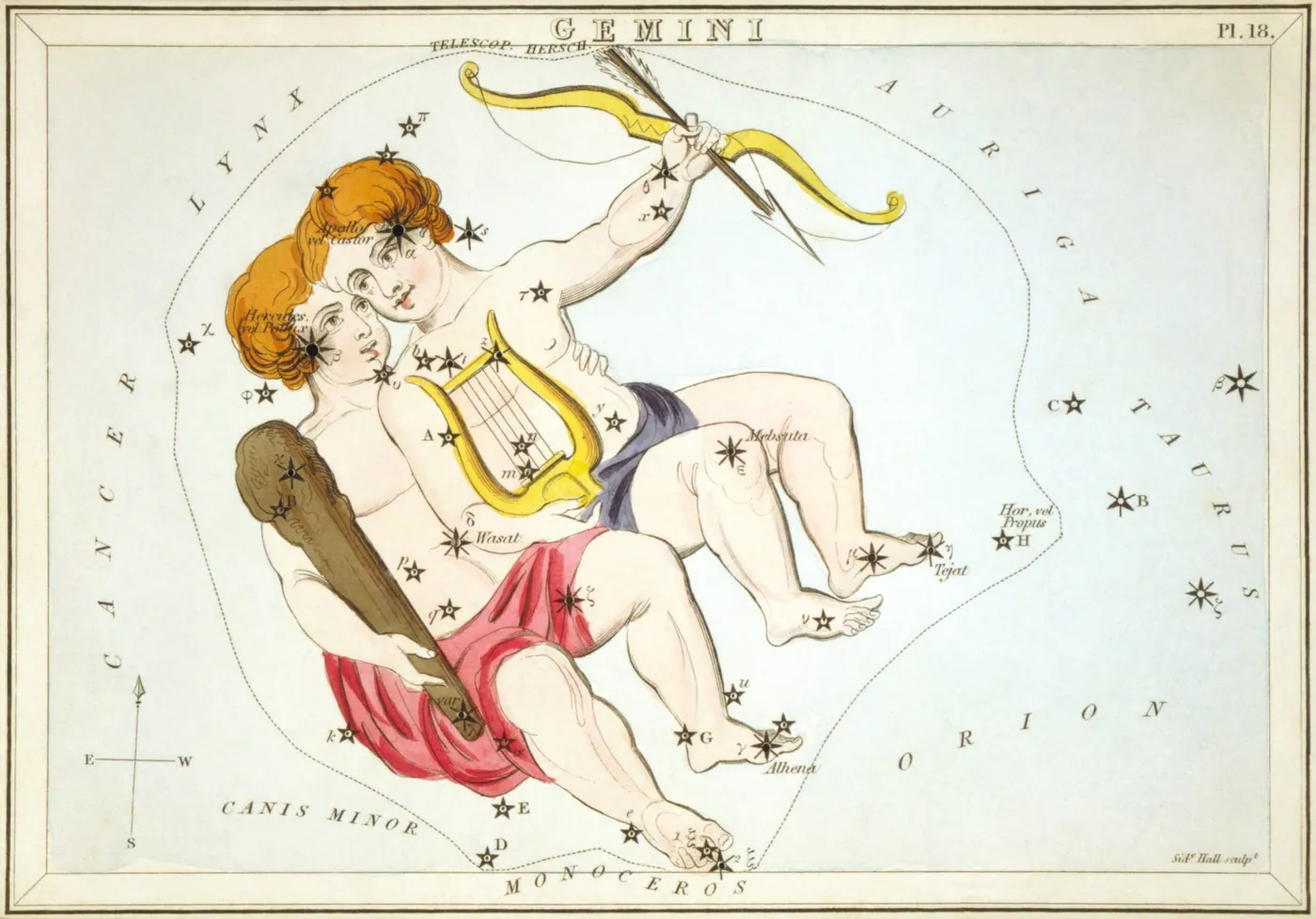
Castor and Pollux: the story of these twins begins in Sparta, and involves not only the two brothers but also their two sisters, born at the same time. Zeus, the tireless seducer, fell in love with Leda, wife of the Spartan king Tyndareus. One day he transformed himself into a swan and seduced her beside a river. That same night, Leda slept with her husband, and from these two unions came two eggs, from which the brothers Castor and Pollux and their sisters Helen and Clytemnestra were born. Pollux and Helen were the children of Zeus, and thus immortal demigods, while Castor and Clytemnestra were the mortal offspring of King Tyndareus.
This makes it clear that the myth of Gemini concerns not only the duality of the divine and the earthly, but also that of male and female. Castor and Pollux were inseparable, and never appear separately in mythology. Castor was a skilled horseman, while Pollux was best known for his prowess in combat. They feature in many heroic adventures, most famously those of the Argonauts. The Spartans held games in their honour.
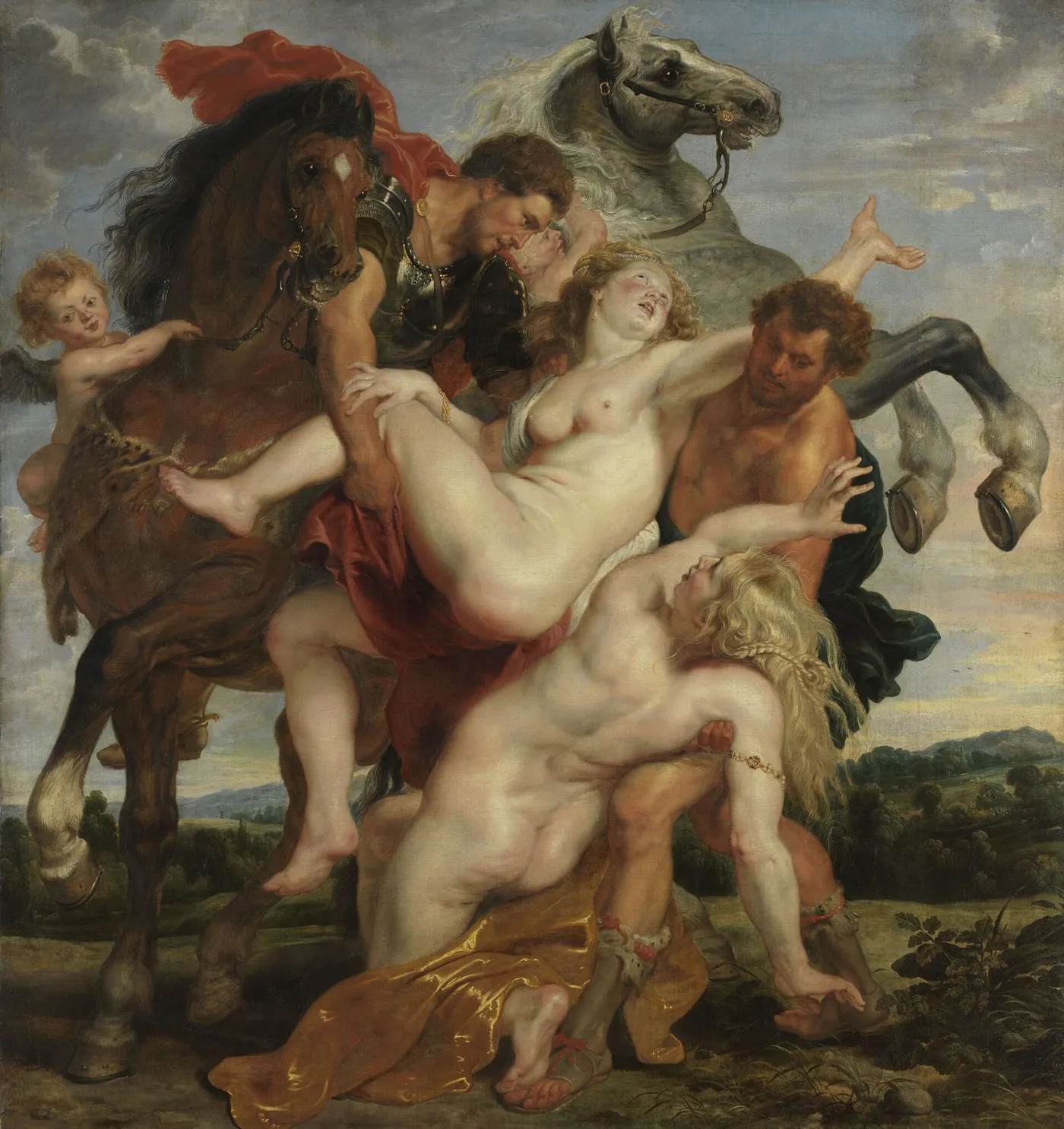
There are several versions of how they came to be placed among the stars. In one, they abducted Phoebe and Hilaeira, the betrothed of another pair of twins, Idas and Lynceus. A conflict followed, in which the mortal brother Castor was killed. Grieving for his brother, the immortal Pollux asked Zeus to find a way for him not to outlive Castor**.** Zeus granted his request and placed them both in the heavens as the constellation Gemini. Yet because one of them was mortal, they had to spend half the year in the underworld, when the constellation is not visible at night, and half the year in the heavens. The cult of the divine twins appears among many Indo-European peoples. In India, they are known as the Ashvins (‘horsemen’), whose history reaches much further back, to the origins of the Vedic horse-sacrifice ritual performed in their honour: ashvamedha.
The female side of this myth brings together the divine yet passive Helen, wife of the Spartan king Menelaus, who fell in love with Paris and thereby provoked a ten-year war and the destruction of Troy**;** and Clytemnestra, Agamemnon’s wife, whose actions were driven by far more earthly, human desires for power and passion.
The story later passed from Greek into Roman mythology. It can thus be found in ancient accounts of the battle against the Latins at Lake Regillus in 496 BCE, which record that the battle was decided by the Roman cavalry, led by the twin brothers Castor and Pollux.
Among the Slavs, the constellation of Kupala is associated with Gemini. Here, the twins are Ovsen and Kolyada. Their mother is Zlatogorka Maya and their father Dazhbog. Ovsen was born before Kolyada, and harnessed the horses to the celestial chariot to prepare the way for his brother, who represents the descent of the god Krishna himself to earth. This is why the constellation is called the Charioteer. Both appear at the summer and winter solstices. On the feast of Kolyada, Ovsen bids farewell to the old year, while Kolyada welcomes the new year, or the new Sun. Christians also adopted this festival, celebrating it as Christmas.
Kupala and Kostroma (Castor and Pollux), who were brother and sister, are also regarded as the Twins. Unaware that they were related by blood, they married; when they discovered the truth, they drowned themselves in a river out of grief. For this reason, Gemini carries the symbolism of death, represented by the constellations of the Wolf and the Wolf Cub beneath the feet of Kupala and Kostroma. The Greeks called these constellations Canis Minor and Canis Major.
The Age of Gemini
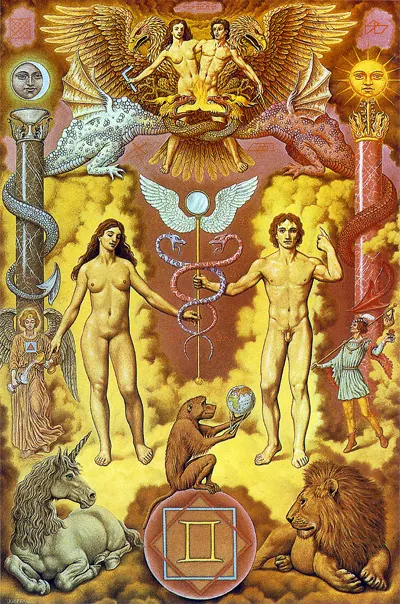
It began around 6450 and ended around 4300 BCE. This is a period for which we have no written records. Much has been lost to history, but archaeology offers some information. The first cities emerged at this time: the earliest urban settlements, connected by the first roads, which established their first contacts with one another through trade.
The principal cult of this age centred on the serpent, best remembered through the staffs of Hermes and Asclepius from a somewhat later period. During the Age of Gemini, the cult of the feathered serpent Quetzalcoatl arose in Central America, from whom all the peoples of that region were descended. Quetzalcoatl was regarded as the god of the morning star, Mercury, and his twin brother Xolotl as the god of the evening star, Venus. The cult of the Dragon emerged in China, while India developed the concept of kundalini, symbolically depicted as a serpent lying coiled at the base of the spine. The ancient Egyptians associated the serpent with the initiation of Osiris, who was also born a twin, alongside his sister Isis.
Remnants of this age survive today only in confused fragments: the association of snakes with healing, and an irrational fear of them.
Astrology
These two stars are the Twins, and although it might be convenient to classify them in broad terms as the ‘good guy’ and the ‘bad guy’, it is more useful to understand their influence as involving a dialogue between polarities. William Blake had Castor on the Descendant while Saturn rose on his Ascendant, and he spoke of reconciling the two sides of himself, giving expression to this in his work. R. Ben Johnson quotes him as saying ‘that we should go to heaven for form and to hell for energy, and then marry the two’. Moreover, Castor and Pollux seem, through their struggle with these polarities, to produce writers. Besides the poet and artist William Blake, many writers have either Castor or Pollux active in their natal charts: the writer James Joyce, the songwriter John Lennon, the poet William Wordsworth, the novelist Lewis Carroll, the novelist George Eliot, the poet Alfred Tennyson and the novelist Charles Dickens, to name only a few. Castor and Pollux probably have less to do with writing itself, or the urge to write, than with successful storytelling by someone skilled in combining good and evil, allowing them to overlap until both they and the whole are transformed. Writers capable of doing this will be successful. Once again, Castor and Pollux concern the blending of opposites, acknowledging them and building bridges between them. If only one of these stars is prominent in your natal chart, all the concepts described above will still apply, but with a bias towards that star’s particular polarity. If Castor is the active star, you will tend to find the brighter side of a story or situation. You are aware of the polarity, but approach it from its lighter side. If Pollux is more prominent, you will likewise be aware of the polarity, but more entangled in the darker side of events, often accompanied by negative feelings or an attitude towards the situation expressed through anger and pain. We shall now consider their individual influences: Castor
In the constellation Gemini, at 20° 14’ Cancer A double star, bright white and pale white, situated in the head of the Northern Twin. It represents Castor, the mortal twin, renowned for his skill in taming and managing horses. It is sometimes called Apollo, and bears the symbolic name ‘A Ruler Yet to Come’.
Influence: According to Ptolemy, it is of the nature of Mercury; Wilson, Simmonite and Pearce liken it to Mars, Venus and Saturn, while Alvidas gives the Moon, Mars and Uranus. It is associated with violence and adversity, and often with broken arms and legs. Nevertheless, it is considered a purely Mercurial star: depending on its placement, it may confer exceptional mental acuity, while an adverse placement can lead to nervous breakdowns. It gives distinction, a keen intellect, success in law and publishing, much travel, a love of horses, and sudden fame and honour, often followed by a loss of fortune and honour, illness, trouble and profound dejection. Those born under its influence are said to be malicious and prone to violence.
On the Ascendant: blindness, weak eyesight, injuries to the face, disgrace, stabbings, wounds and imprisonment. With the Sun: prominence in occult pursuits, a government position connected with foreign affairs; serious accidents, blows, stabbings, shootings, shipwreck, injuries to the face, blindness, infections, violent fevers, an evil disposition; rape or murder, whether as perpetrator or victim; imprisonment, exile and beheading. With the Moon: timidity, sensitivity, a lack of confidence, occult interests and psychic abilities, blindness, injuries to the face, disgrace, stabbings, wounds and imprisonment. With Mercury: pronounced psychic powers that attract criticism and ridicule, but ultimately receive due recognition; unfavourable for financial gain. With Venus: an unusual and distinctive life, many extreme reversals of fortune; unfavourable for marriage. With Mars: an evil disposition, much travel, an aimless life and many ups and downs. With Jupiter: an interest in occultism and philosophy, losses through the law, speculation or travel, and danger of a judicial sentence. With Saturn: timidity, mistrust, eccentricity, originality of mind that is difficult to express, greater ability as a writer than as a speaker, considerable intellectual powers, a love of detail, prejudice against established opinions; unfavourable for marriage, unusual family circumstances, illness among the children in their early years, and gains towards the end of life through hard work. With Uranus: awareness, emotional sensitivity, susceptibility, considerable psychic power attracting much public criticism, a desire to please everyone; favourable for marriage and financial gain, few children, if any, but harmonious relations with them; loss of the parent of the opposite sex in early childhood. With Neptune: sensitivity, romanticism, a love of pleasure and entertainment, involvement or fame in occupations connected with water, an interest in the occult, work in the theatre and acting, especially in speaking roles; frequent changes of residence and much travel, some domestic discord and separation, marriage at a very young age, especially for women; favourable for gains, though losses also occur through friends or speculation; trouble through one or more children, and death from a disease ruled by Cancer.
Pollux
In the constellation Gemini, at 23° 13’ Cancer An orange star situated in the head of the Southern Twin. It represents Pollux, son of Zeus and Leda, the immortal of the two Twins, renowned for his skill in boxing. It is sometimes called Hercules, and symbolically ‘The Merciless Judge’.
Influence: Unlike Castor, who can be considerably more intelligent, Pollux is cruel and insolent. The two stars seem to embody the good cop–bad cop combination. Here, a person often becomes harsh through some deception or unfortunate circumstances dealt by fate. Under very favourable conditions, the person can channel the star’s energy into noble self-sacrifice for another. Pollux therefore signifies actions that are somewhat reckless, yet sufficiently daring that those who undertake them are remembered for them, their names becoming immortal. It is favourable for martial arts. According to Ptolemy, it is of the nature of Mars, while Alvidas likens it to the Moon, Mars and Uranus. It produces a subtle, strong, spirited, brave, audacious, occult and rash nature, a love of boxing, malice beneath a dignified bearing, and an association with poisons. On the Ascendant: weak eyesight, blindness, injuries to the face, illness, wounds, imprisonment, and honours and advancement that prove fleeting. At the Midheaven: honours and advancement, but with danger of disgrace and ruin. With the Sun: an interest in occultism and philosophy, blows, stabbings, serious accidents, shootings, shipwreck, murder as perpetrator or victim, serious illnesses and infections, fevers, stomach disorders, an evil disposition, wealth and honours followed by eventual ruin, blindness, injuries to the face and head, quarrels, rape as perpetrator or victim, banishment, imprisonment for embezzlement, violent death and beheading. With the Moon: hatred from common people, disfavour among women, danger from thieves, violent death, power, pride, illness, misfortune, wounds, imprisonment, injuries to the face, damaged eyesight or blindness, especially when Mars or the Sun squares it from Aries. If Mars or the Sun squares it from Libra, there is danger of accidents and legal or marital difficulties; an opposition from Capricorn threatens the mother’s reputation and honour. If Mars is conjunct, death by suffocation, drowning or murder. If Mars is with Arcturus in the first, seventh, ninth, tenth or eleventh house, death by suffocation. With Mercury: mental imbalance, unpopularity and an unusual occupation, trouble with the father through relatives or enemies, domestic discord, fears, and losses involving land, property and minerals. With Venus: strong and unbridled passions, danger of seduction for women, losses through women, and danger of poisoning. With Mars: violence, murder as perpetrator or victim, high position followed by eventual ruin, violent death by suffocation, drowning or murder, especially if the Moon is also present. With Jupiter: losses through the law, high position with danger of demotion, trouble through relatives, exile or imprisonment. With Saturn: a bad disposition, bitterness, sarcasm, loss of an arm or leg, loss of a parent or trouble with a stepmother or stepfather, much help from friends, an incomplete education; sudden death while pursuing an occupation involving horses or large animals. With Uranus: an interest in the occult, psychic abilities, selfishness, dejection, vanity concerning one’s reputation, success through government, companies or electrical work, a harmonious marriage in later life; favourable for children, though the end of life is less favourable than its middle years. With Neptune: changeability, much travel, an excellent linguist, many influential friends; favourable for partnerships, unusual marital circumstances, often with a foreign spouse; an occupation involving research or zoological or botanical work in foreign countries, minor accidents; death in isolation from a fever or infectious disease.