
Like Canis Major, the constellation of the “Lesser Dog” or “Little Dog” (Canis Minor) is known by the name of its leading star, which classical authors called Procyon, before the dog, because it rises shortly before Sirius. Like Sirius, Procyon is a first-magnitude star, white and yellow in colour. It is likewise associated with a quick temper and violent activity, but can also bring wealth, honour and renown when well placed. William Lilly describes it thus: “The Lesser Dog-star, in almost 9 degrees of Cancer, forms a petulant, saucy fellow, prone to anger, pride, carelessness, violence, sedition.”
Whereas Sirius has the nature of Jupiter and Mars, Procyon is assigned that of Mercury and Mars: equally prone to excess, but swifter and less stable in its effects. Sirius is known as the “Dog Star”, while its companion, which rises before it, has the quick reactions, abundant energy and impetuous nature that in many ways suit the description of a “puppy”—one of the names by which it was traditionally known.
In mythology, Procyon was Helen of Troy’s dog. Her grief at losing him was so great that she prayed for him to live again in the heavens. Obvious connections were drawn with the danger of dog bites—or bites from wild animals more generally—when the star was involved in unfortunate planetary configurations. Firmicus Maternus maintained that it brought danger from wild beasts when on the Descendant and in an adverse aspect to Mars, while Vivian Robson cites two charts with a prominent Procyon in which a dog bite caused death or serious injury.
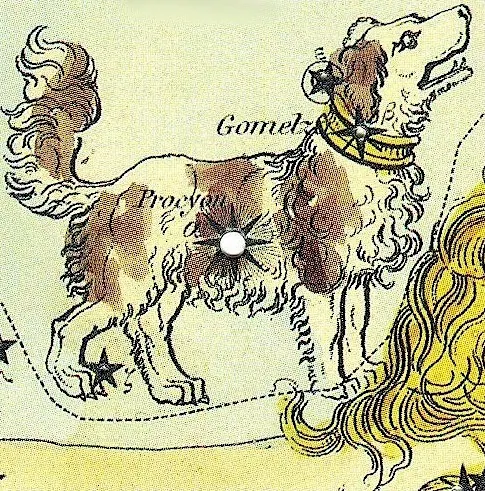
More generally, it is said to bring violence, danger or adversaries, together with a stubborn, active disposition that gives a powerful drive, a readiness to act and dignity to those who consciously put these energies to effective use. When well placed, Procyon can be considered a highly fortunate and powerful fixed star—it is, after all, the eighth-brightest star in the sky—but there is usually also a danger of insolence and impudence, or what Ebertin describes as a tendency to “ram one’s head through a brick wall”. Consequently, the benefits Procyon brings are said seldom to last.
Given its Mars–Mercury nature, the placement of personal planets with Procyon traditionally indicates a propensity for military achievement, or active involvement in verbal or physical disputes, strategy or conflict. Writing in the first century AD, Manilius describes its influence as strong among those who make weapons for hunting or sport. Lilly tells us that the direction of the Sun to this star “presages military preferment, after much contention, expense and revolt, and strong opposition of eminent mercurial men, or secretaries, or chancellors, or commanders, endeavouring to hinder it.” He also states that, like Sirius, Procyon brings “kingly honours” when culminating or rising with the Sun. Ebertin and Hoffmann, on the other hand, while attributing to it “a sharp mind”, give details of four charts in which a prominent Procyon brought danger through enmity, including that of Elsbeth Ebertin herself: “several times she was the target of extreme aggression”. They cite only one case in which the placement proved benign—that of Field Marshal Hindenburg, who, they suggest, managed to channel this violent energy constructively through the battles he fought.
A good example of the interpretation of this star in classical astrology appears in “The Bright, Passionate, Harmful and Beneficial Stars”, written in AD 379. Speaking of this and other prominent stars of a Mars–Mercury nature, our a
These stars have the nature and temperament of Mars and Mercury, and make men warriors and military leaders: courageous, capable, skilful, strong and lively, as well as energetic, versatile, cunning and crafty, able to turn their hands to many different pursuits and proficient in many things. These stars also raise up wise and perceptive men, men with shrill voices, deceitful men, and men who prosper and achieve good results; but also the wilful and stubborn, the rash and impulsive, those insatiable and greedy in their desires, corrupters of young boys and maidens, and perjurers—especially in nocturnal nativities. If they rise on the Ascendant of a diurnal nativity, they make such men bold and courageous, fierce, prone to remorse and changes of mind, false and deceitful, thieves, impious, friendless, lying, shameless, men who defile themselves with murder, forgers, swindlers and cheats; and these natives sometimes meet an unhappy death. This occurs especially in a diurnal nativity.
Much of this interpretation formed the basis of later accounts of the star’s influence. We can therefore see that Procyon’s positive attributes resemble the effects of Mercury and Mars in a favourable aspect, while an unfortunate placement produces effects similar to those of an adverse aspect between these two planets. Since most authors agree that fixed stars intensify or magnify the effects of the angles or planets with which they are placed, it is hardly surprising that such a star should receive such varied descriptions: promising great success and honour when well placed, yet also great danger and violent reactions when activated by malefics.
In meteorological astrology, a difficult Mars–Mercury combination typically signifies stormy, turbulent weather: Mercury is itself a traditional significator of strong winds and storms, particularly when in contact with a malefic. Similarly, an afflicted Procyon warns of possible damage from storms or floods. Robson defines Procyon as a star that “gives activity, violence, sudden and violent misfortune”, although this is naturally more pronounced when it is configured with malefics. Yet Procyon has a long-standing association with drowning, or an inability to withstand the harmful effects of water. It is therefore worth exploring its connections with the Arabic myth described by Richard H. Allen in Star Names: Their Lore and Meaning, where Procyon is called “watery-eyed” or “the weeping one”.
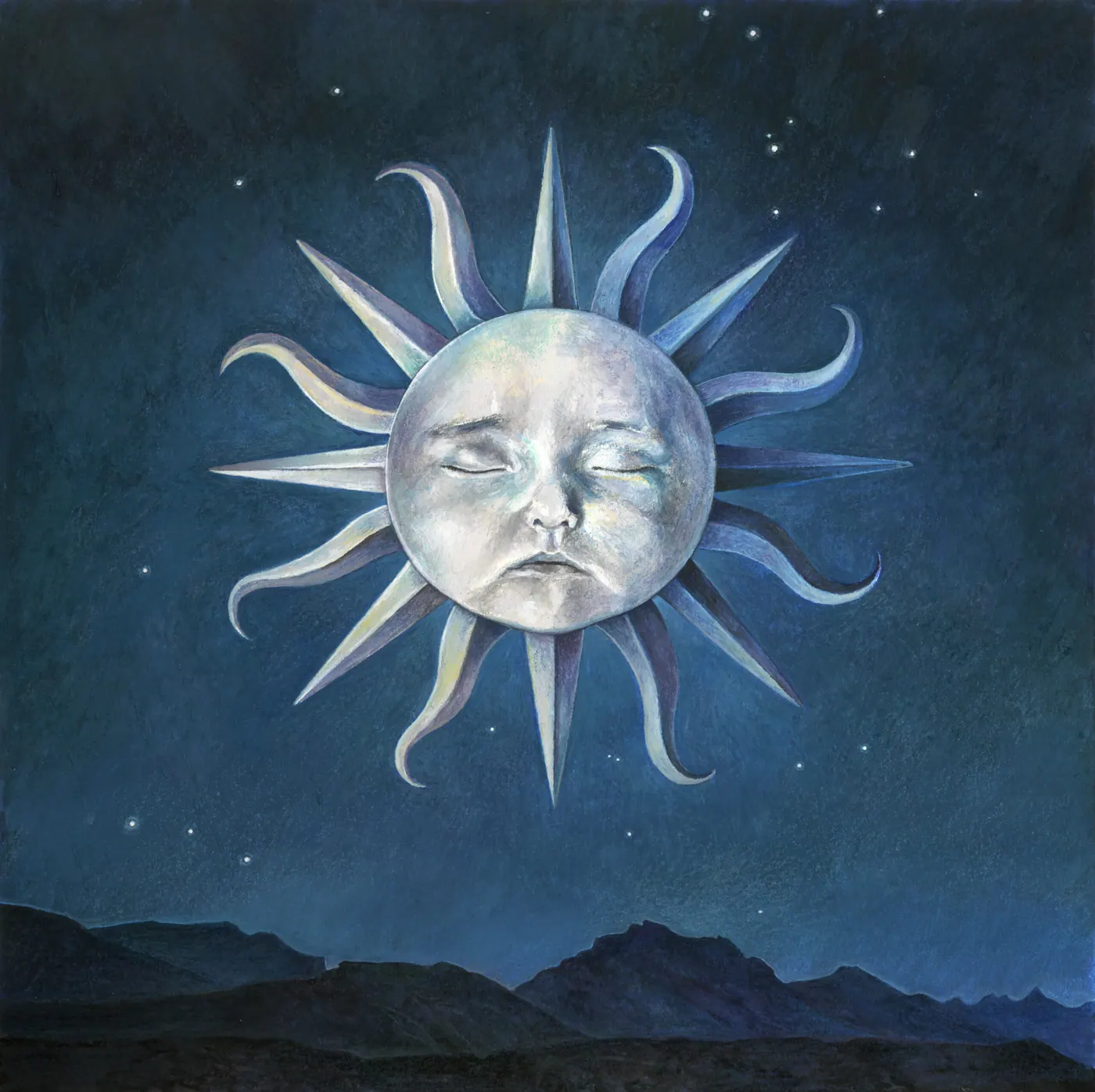
The myth describes Sirius and Procyon as two sisters who tried to follow their brother Canopus across the sky, until they encountered the Great Celestial River—the Milky Way. Both entered the river and tried to swim across, but only the elder, stronger sister, Sirius, succeeded, and she can now be seen on its southern bank. The younger, weaker sister, Procyon, could not cross and remained weeping on the northern bank, overcome by the river’s strength. Thereafter, Sirius was described as “she who crossed over”, while Procyon became “she who weeps”, reinforcing her association with drowning and floods. The myth may be very ancient and alludes to the Euphratean name for Procyon, “the star of the crossing of the Water-dog”. This refers to its proximity to the Milky Way, the “Celestial River”, suggesting that the star stands at a crossing where opposing forces collide.
Some earlier cycles of retrograde Saturn crossing Procyon have further contributed to this reputation for storms, floods and drowning. At the time of the Boxing Day tsunami in 2004, Saturn was only a few minutes of arc from conjunction with the star. During its previous contact in 1975, Saturn was within half a degree of Procyon at the time of the floods of China’s Yangtze River, recorded as the third-worst natural disaster of modern times, killing some 200,000 people.
More specific descriptions of its influence with planets and angles follow:
On the Ascendant: cunning, skilful, dissembling; wealth through violence and plunder; lust, extravagance, loss and ruin; military achievement, quarrels, losses through trade or servants.
With the Sun: great help from friends, gifts and inheritances if unafflicted; military achievement after many struggles and expenses. If rising or culminating, royal honours.
With the Moon: occult interests; restless, never staying long in one place; quarrels with friends, partners and employers. If the Sun and Mars are at the same time with Deneb Adige (5° Pisces) or Vega (14° Capricorn), above the horizon, death from the bite of a rabid dog.
With Mercury: occult interests, a minor position of authority under the government, trouble and scandal through the opposite sex; favourable for health and gain.
With Venus: many benefits from influential friends connected with the Church; favourable for gains.
With Mars: cruelty, violence, scandal and slander, disgrace and ruin; danger from dog bites.
With Jupiter: much travel, trouble through relatives and the Church or the law; help from friends.
With Saturn: sound judgement, a high position of trust, often connected with land; the native may be adopted by an elderly couple from whom a substantial inheritance may be received; benefits from older friends, good health, domestic peace, marriage to a person of higher standing.