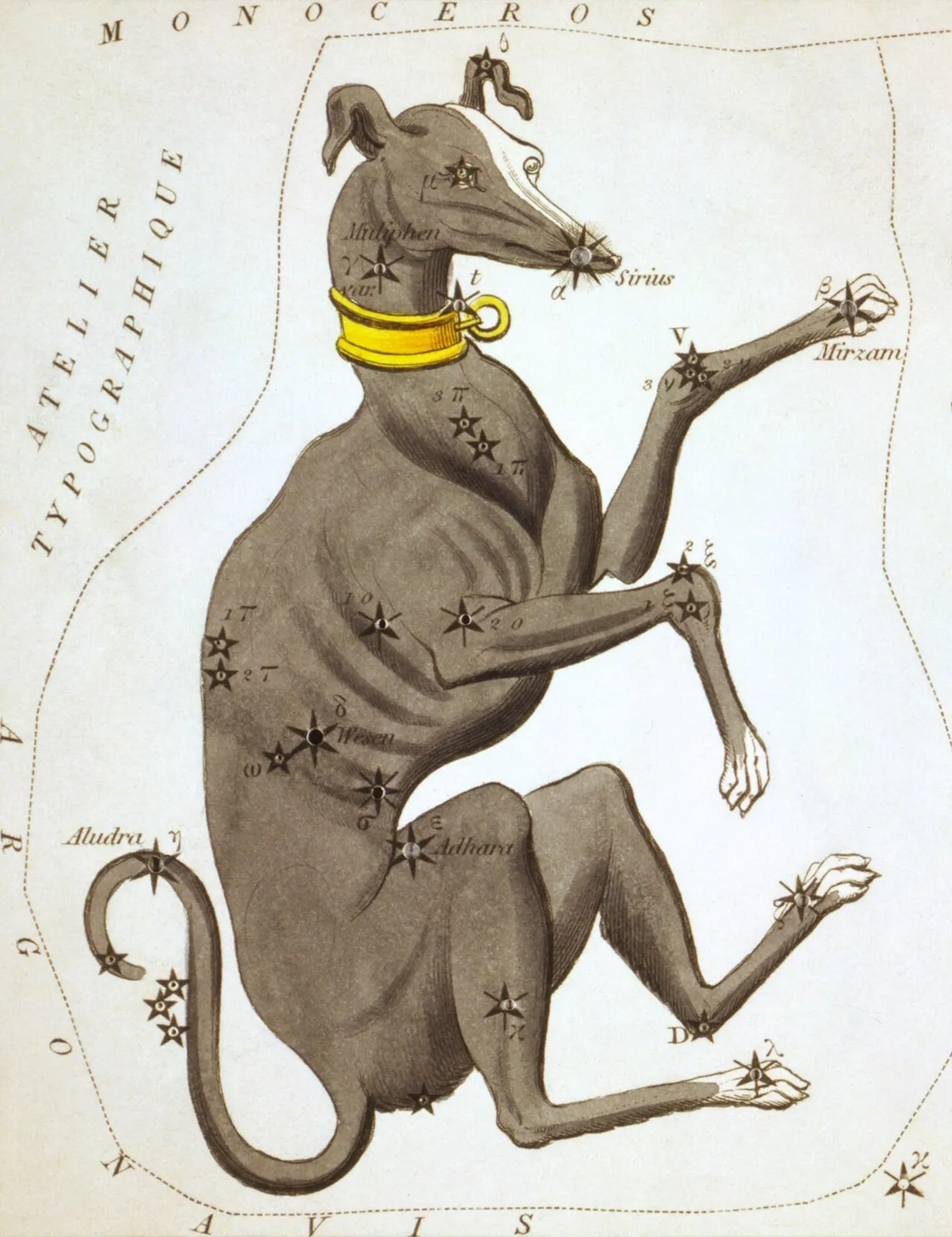
Sirius is the brightest star in our sky, visible low on the horizon in late autumn and winter. It belongs to the constellation Canis Major, the Great Dog, and follows close on the heels of Orion.
Sirius lies about 8.3 light years away, making it one of our nearest stellar neighbours. Its magnitude is −1.4, compared with −4.4 for Venus and −26.7 for the Sun. If you see an object in the sky brighter than Sirius, other than the Moon or Sun, it must be a planet. Sirius has a companion, making it a binary star system. The principal star is designated Sirius A, and its companion Sirius B. Sirius is estimated to be twice the diameter of the Sun.
Sirius in Mythology and Folklore
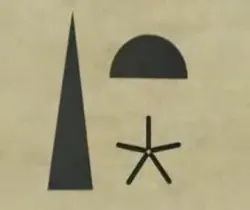
The hieroglyph representing Sirius contains three elements: a “phallic” obelisk (representing Osiris), a “womb-like” dome (representing Isis), and a star (representing Horus).
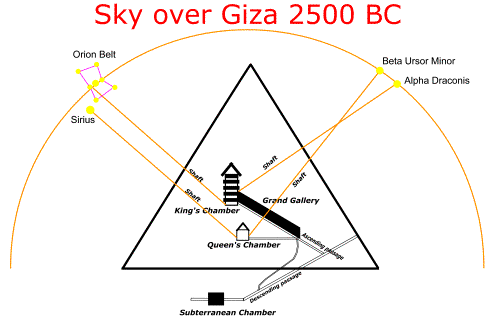
Sirius is the brightest star in the night sky. The ancient Egyptians called it Sothis, and it was the most important star in their heavens. The pyramids of Egypt are arranged like the stars in the constellation of Orion the Hunter, and point towards Sirius in Canis Major. The Egyptian annual calendar originally developed around the flooding of the Nile, in rhythm with the appearances of Sirius. Around 2800 BC, the appearance of Sirius became the basis for determining the date of the Egyptian New Year. Of particular importance to the ancient Egyptians was the fact that the heliacal rising of Sirius occurred almost simultaneously with the annual inundation of the Nile, lending this astronomical phenomenon a special significance and mystique. Knowledge of the cycle of Sirius thus enabled them to predict the Nile floods, upon which Egypt’s economy and life depended. Sirius consequently became an object of worship, believed to be the dwelling place of Isis and Osiris, the Goddess and God of Heaven and Earth. It is mentioned specifically in the Egyptian Book of the Dead as the point towards which the soul of the deceased was directed. More generally, the deceased was believed to become one with the stars after death. This meant that the two circumpolar stars bestowed immortality.
From the earliest times, the Egyptians paid particular attention to Sirius. It became a symbol of the virgin in whose womb the divine child Horus was conceived, and Sirius was therefore said to be the birthplace of God. Isis, impregnated by Osiris, who is symbolised by Sirius A, thus formed with him a divine couple: the parents of the divine pharaonic couple on Earth.
Isis and Osiris were two of four children born from the womb of the sky goddess and fathered by Ra, the Sun. The other two were Seth and Nephthys. Osiris and Isis were the first rulers of Egypt. Osiris was brutally murdered and dismembered by his jealous brother Seth, a story that very probably gave rise to the account of Cain’s murder of his brother Abel. Isis gathered together the pieces of Osiris’s dismembered body, but could not find his phallus. She therefore fashioned an artificial one. In this way she became pregnant, and gave birth to their son Horus in the marshes of the Nile. The Pyramid Texts and other religious writings make it clear that this myth has stellar connections. Isis is identified with Sirius, and Osiris with the constellation Orion. Note the image below, which shows the alignment of the pyramids with the stars. Orion, associated with Osiris, aligns with the King’s Chamber, while Sirius, associated with Isis, aligns with the Queen’s Chamber.
The Chinese call this star Tianlang (the Celestial Wolf), and consider its afflictions always to be connected with attacks by thieves.
There is also an intriguing story linking Sirius with the Dogon, an African people who have maintained a cult of this star for centuries. Early in the last century, two English researchers spent several years among the Dogon, who told them of the existence of the dwarf star Sirius B, whose existence scientists have confirmed in modern times using powerful telescopes. The Dogon call Sirius B “Po Tolo”, meaning “the smallest star”. They also maintain that it is the heaviest star, and that it is white. Modern astronomy recognises a class of stars known as “white dwarfs”, to which Sirius B belongs. These are small, massive, white stars. The Dogon also describe a third star. The existence of Sirius C has not been officially confirmed. There are no photographs, but some French astronomers have proposed that changes in the star’s orbit can only be explained by the existence of Sirius C. It remains unclear how the Dogon could have known of this star without telescopes or other instruments, since Sirius B is invisible to the naked eye. They claim that beings from Sirius visited their ancestors in the distant past. The Dogon believe that their deities come from those planets, and knew the structure of this system long before we discovered it in the 1960s.
Interestingly, Sirius is also mentioned in the Qur’an, specifically in Surah an-Najm, verse 49: “And He is the Lord of Sirius”, and then in verse 9 of the same surah: “He was at a distance of two bow-lengths or nearer.”
Beyond the obvious analogy, the numerical value 49.9 is also interesting here. Recall that Sirius consists of two stars, Sirius A and Sirius B, which orbit one another in a double arc every 49.9 years. This fifty-year cycle was also known to the Dogon mentioned above, who hold a celebration called the Sigui every half-century. They say that a “sign” invariably appears a year beforehand: a great rock that has always stood at the entrance to the oldest Dogon settlement, Yougo Dogorou, is bathed in red light, and gourds that no one has planted begin to sprout in the fields (?!?).
In our own region, Sirius has been known since ancient times by the names Volujarka, Volarica and Volujarica. Folk tradition describes Volarica as the star by which to judge when oxen should be taken out to pasture and brought back, when they should be fed at the manger, and when they should be led into the fields to plough. We might conclude that this is how the star acquired its name, but it is more likely that some mythical tradition connected it with oxen, or with horned cattle in general. It appears in several folk songs about marriage through the agreed abduction of a girl, as well as in songs known to be indirectly associated with the ritual cycle of ranilo. This would suggest that Volarica was linked in these songs to the spring awakening of nature and the beginning of the agricultural year. This is curious, since it conflicts with the fact that Sirius is now visible from our region only in late autumn and winter: its association with the summer season could therefore have arisen only several thousand years ago.
Sirius in Occult Symbolism and Secret Societies
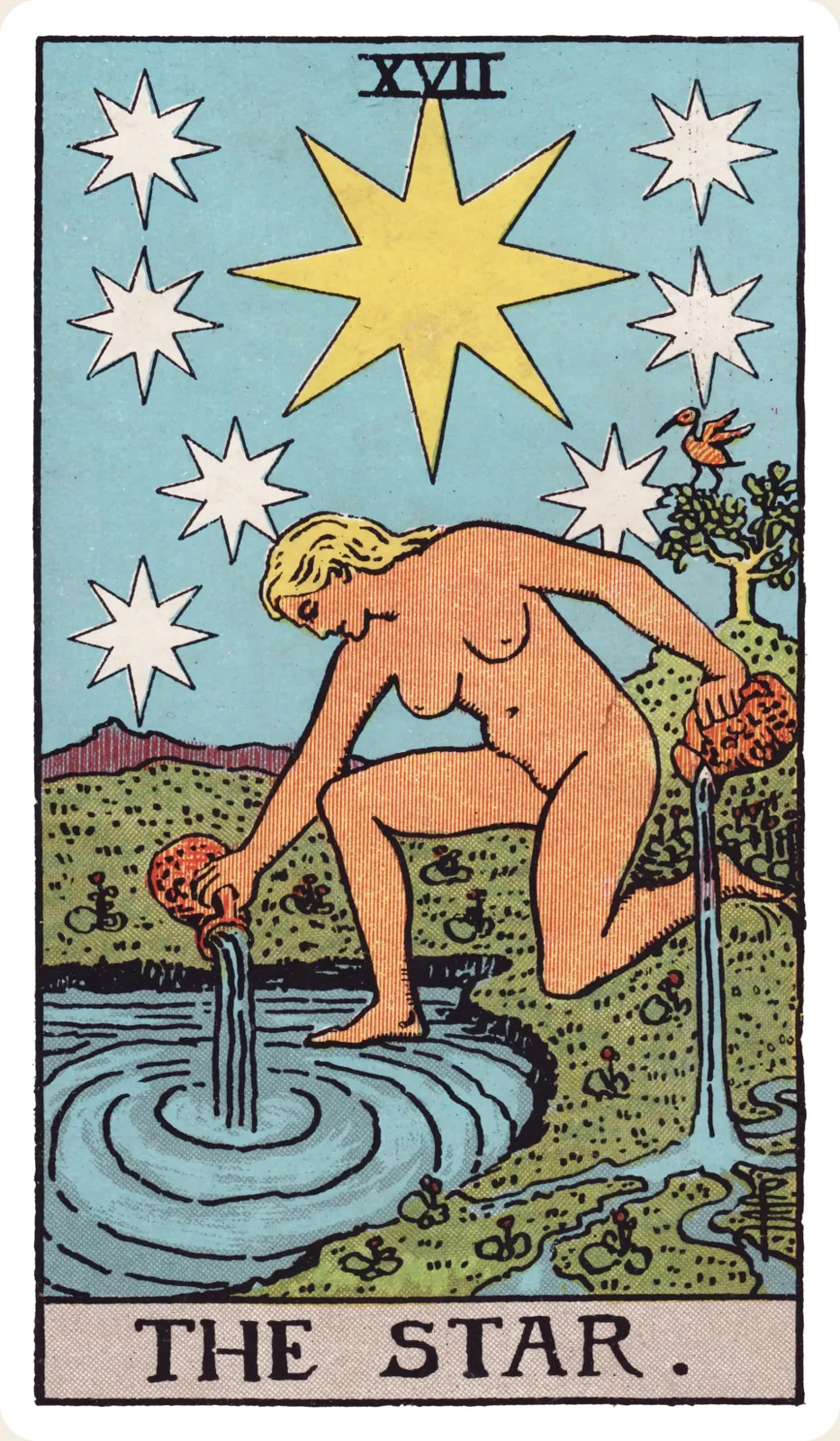
“The seventeenth card of the Major Arcana is called Les Etoiles (French for the star), and depicts a young girl kneeling with one foot in the water and the other on land, her body somewhat suggesting the symbol of the swastika. She holds two urns, whose contents she pours upon the earth and sea. Above the girl’s head are eight stars, one of which is exceptionally large and bright. Court de Gébelin considers that the great star may be Sothis or Sirius; the other seven are the sacred planets of the ancients. He believes the female figure to be Isis in the act of causing the inundation of the Nile which accompanied the rising of the ‘Dog Star’.” (Manly P. Hall, The Secret Teachings of All Ages)
In Masonic lodges, Sirius is known as the “Blazing Star”, and even a glance at its prominence in Masonic symbolism reveals the supreme importance accorded to it. The Masonic author William Hutchinson says of Sirius: “It is the first and most exalted object that demands our attention in the Lodge.” Just as the light of Sirius found its way into the great pyramids during initiations, so it is symbolically present in the Masonic lodge. Or, as Albert Pike puts it: “The ancient Astronomers saw all the great Symbols of Masonry in the Stars. Sirius glitters in our Lodges as the Blazing Star.” Masonic teaching holds that the Blazing Star symbolises divinity, omnipresence (the Creator is present everywhere) and omniscience (the Creator sees and knows all). Sirius is therefore the “sacred place” to which all Masons must ascend. It is the source of divine power and the destination of divine individuals. This concept is often depicted in Masonic art. To attain perfection, the initiate must fully understand and internalise the dual nature of the world (good and
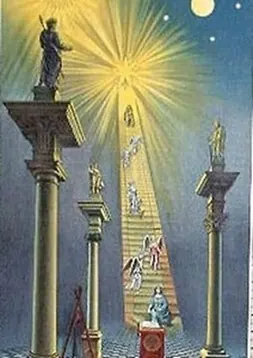
evil; male and female; black and white, and so on) through an alchemical metamorphosis. This concept is symbolically expressed in the union of Osiris and Isis, the masculine and feminine principles, to give birth to Horus, the star-child: the perfected man of Masonry, identified with the Blazing Star.
Helena Blavatsky and Alice Bailey, two leading figures in Theosophy, regarded Sirius as a source of esoteric power. Blavatsky spoke of Sirius as manifesting mystically, directly influencing the whole living heaven, and being connected with every great religion of antiquity. Like many esoteric writers, Bailey also attributes a powerful influence over human life to Sirius: “First and foremost is the energy or force emanating from the sun Sirius. If it may be so expressed, the energy of thought, or mind force, in its entirety, reaches the solar system from a distant cosmic centre via Sirius. Sirius acts as the transmitter, or focal centre, from which emanate those influences which produce self-consciousness in man.” (Alice Bailey, Initiation, Human and Solar)
Kenneth Grant wrote explicitly and extensively about the “Dog Star”. In his many books, he frequently describes Sirius as a powerful centre of magical magnetic force. His belief that this star held the master key to the mysteries of the Egyptian and Typhonian traditions strengthened over time and became the central focus of his research. One of Grant’s most important and controversial propositions was the discovery of the so-called “Sirius/Set current”: essentially an extraterrestrial dimension connecting Sirius, Earth and Set, the Egyptian god of chaos, who was later associated with Satan. “Set is the initiator, the opener of man’s consciousness to the rays of the Undying God typified by Sirius—the Sun in the South.” (Kenneth Grant, The Magical Revival)
Sirius in Popular Culture
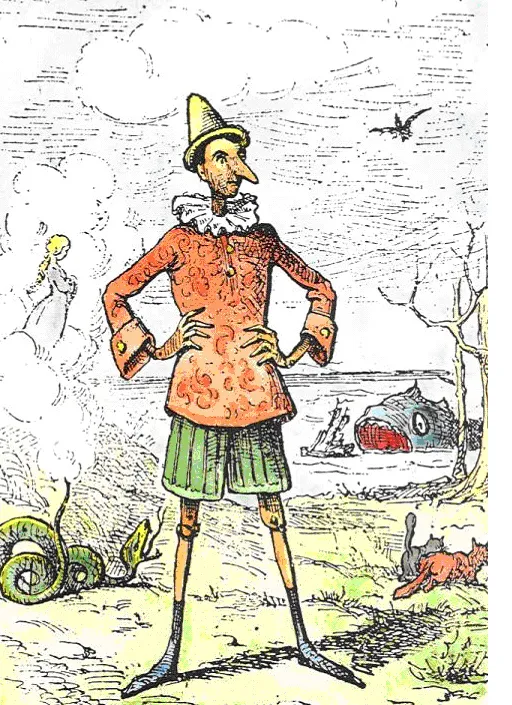
Direct references to Sirius in popular culture are too numerous to list here; consider, for example, the name and logo of the world’s leading satellite radio service. A more interesting aspect of popular culture to analyse is its coded references to Sirius. Major films have indeed made hidden and profound allusions to the “Dog Star”, evidently intended for those “in the know”, in which the star invariably appears as the revealer of mysteries: an initiator and divine teacher. We shall give just one example here. In Disney’s Pinocchio, based on the story written by the Freemason Carlo Collodi, Geppetto prays to the brightest star in the sky for a “real boy”. The Blue Fairy—her colour a reference to the pale blue radiance of Sirius—then descends from heaven to give Pinocchio life. Throughout the puppet’s quest to become a boy, an allegory of esoteric initiation, the Blue Fairy guides Pinocchio along the “right path”. Sirius is thus presented as a source of life, a guide and a teacher. The song from Pinocchio is also an ode to Sirius.
Astrology
This exceptionally powerful star indicates that, through the effort you invest, you may gain far more than you expected. In some respects, Sirius is not an easy star to “work with”, since it demands that you find some form of self-expression in life; yet the tremendous success it can bring may also “burn” you.
Sirius was believed to be a “distant” Sun illuminating distant planets, and the central star around which our stellar cluster revolves. Indeed, because the Sun was thought to revolve around Sirius just as the Earth revolves around the Sun, it was even proposed that Sirius be called the Sun of the Sun. Its influence must therefore be associated with “superpower”, and with those who exercise control over people who are already powerful. Interestingly, the Sun in the horoscope of the United States is on Sirius, so it is hardly surprising that the country is a superpower. Sirius is also the guardian of Europe—a title originating with the Romans, Custos Europas—and we know that the United States often behaves in this way, intervening in wars on European soil. In any favourable placement, Sirius signifies power, wealth and good fortune. In a less favourable position, however, it indicates ill-considered words and insults, impetuosity and passion. There is also a constant danger of bites from dogs or other animals, together with a susceptibility to injury. Sirius is an excellent star for those working as guards, bodyguards, guardians, curators and the like; in private life, too, it brings a desire to safeguard tradition, family and everything belonging to the private sphere.
Dupor allows it an orb of 1.30 degrees. With the Moon, it brings the love of women, but with even a slight affliction from Saturn, death at the hands of soldiers, savages or animals. With Jupiter and Mars in the 10th house, it brings great honour; on the Ascendant, it makes the native ambitious, generous and a founder of organisations, but brings a danger of assassination. On the MC, it gives a position of command.
According to Ptolemy, Sirius is of the nature of Jupiter and Mars, while Alvidas gives the Moon, Jupiter and Mars. It brings honour, renown, prosperity, ardour, loyalty, devotion, passion and resentment, and makes those born under its influence curators, overseers and guardians. It also brings danger from dog bites, illustrated by the two examples given under Procyon.
Manilius says that Sirius:
“fashions unbridled spirits of impetuous heart; upon his sons he will bestow torrents of anger, and draw upon them the hatred and fear of the whole populace. (The speaker’s impetuosity drives him to utter words before he has time to adapt them to logic or grammar.) Their hearts pound at the slightest provocation, and when they speak their tongues rage and bark, with a constant gnashing of teeth. Their faults are intensified by wine, which gives them strength and fans their savage wrath into flame. They fear neither woods nor mountains, neither fierce lions nor the tusks of wild boars, nor any weapon with which nature has endowed wild beasts; they will vent their burning rage upon any lawful prey. Marvel not at such tendencies under such a constellation: see how the constellation itself hunts among the stars, striving in its course to catch the Hare before it.” (Astronomica, Book V, lines 206–233)
The fourth-century Roman astrologer Firmicus Maternus perhaps exaggerates its violent qualities, describing those in whose charts it is prominent as “estranged from every human feeling and intent upon violent crimes”.
William Lilly, on the other hand, maintains that this star rising or culminating with the Sun brings “kingly honours”, while of the direction of the MC to Sirius he writes that “the native is likely to increase his estate and reputation”.
When favourably connected, Sirius promises fame, honours and wealth. On the Ascendant and in combination with Mars, it can be quite dangerous: advancement is then accompanied by excessive ambition, exposing the native to injury or even an attempt on their life. According to tradition, Sirius grants a celebrated death and posthumous honours, especially when placed in the 8th house. In good aspect to Mars and Jupiter and close to the MC, it appears to promise the acquisition of great wealth, with the native enjoying good fortune in commercial ventures or matters of government. So placed, this star is excellent for military personnel, lawyers and civil servants. Sirius conjunct the Sun and well placed in the natal chart is found in the nativities of many important and celebrated people.
At the Zenith of the horoscope: high government office, with considerable income and prestige. With the Sun: success in business, an occupation connected with metals or martial pursuits, domestic harmony. If on the Ascendant or at the Zenith of the horoscope, royal preferment follows. With the Moon: success in business, influential friends of the opposite sex, favourable for the father, good health, beneficial changes at home and at work. If a malefic is with Scheat, death by bayonet or wild beasts. If Saturn is with the Moon, death by wild beasts or soldiers. With Mercury: outstanding success in business, assistance from influential people, unnecessary worries, connections with the Church, physical impairment through an accident. With Venus: ease, comfort and luxury, extravagance, gain through inheritance. With Mars: courage, generosity, military advancement, work involving metals. With Jupiter: success in business, travel, assistance from relatives, advancement within the ecclesiastical hierarchy. With Saturn: steadfastness, reserve, a diplomatic manner, perseverance, high position attained through friends, favourable for the home, gifts and legacies, family harmony. With Uranus: gain and distinction in pursuits ruled by Uranus, assistance from influential friends, gain through a harmonious marriage, especially for men; sudden death. With Neptune: well-developed intuition, an interest in the occult, piety, good organisational abilities, success in commercial affairs, favourable for financial gain and family matters, a natural death.