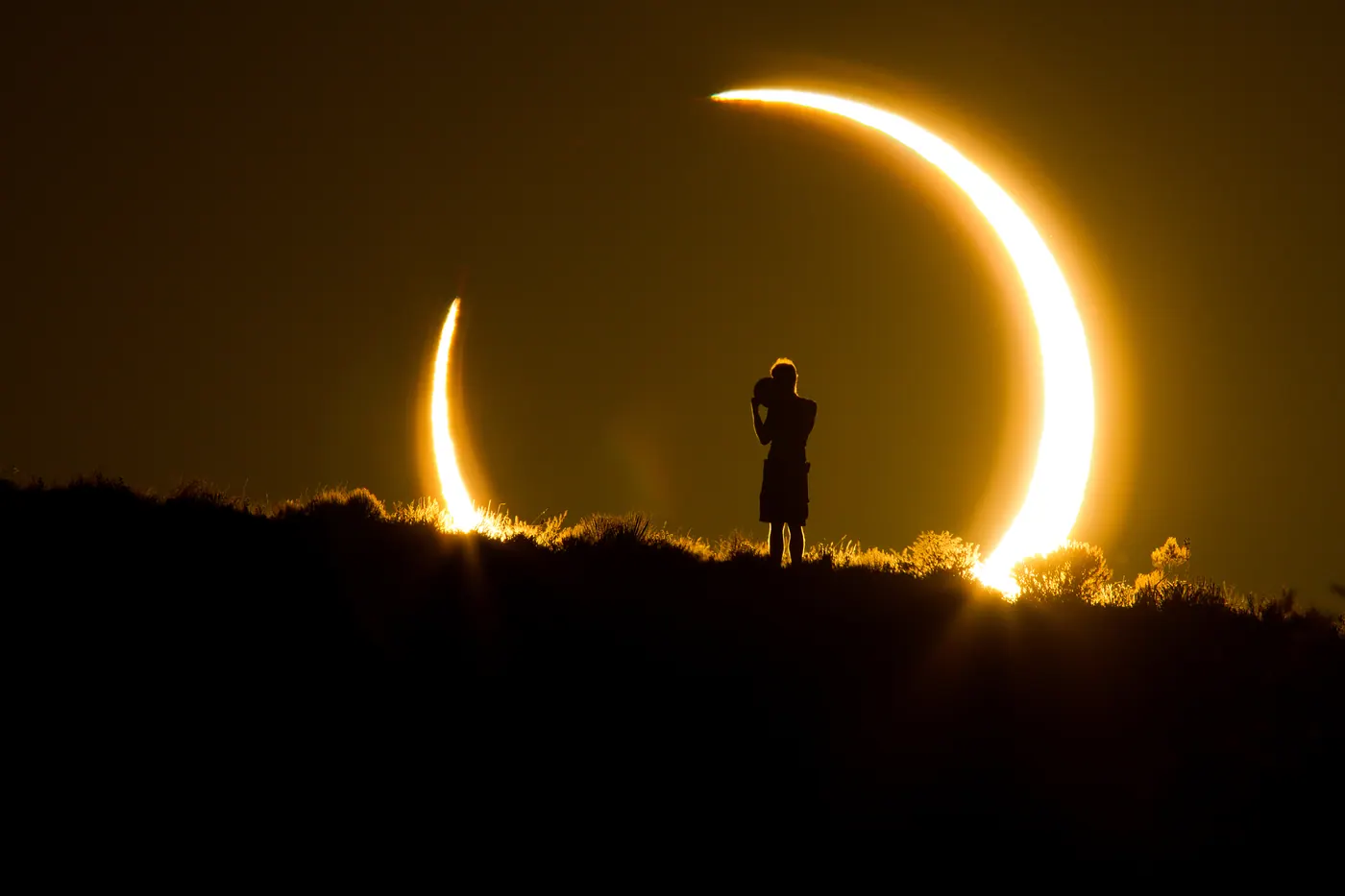
Eclipses have always been regarded as immensely powerful signs, wondrous and magical in their proportions, heralding great change. This was especially true of solar eclipses, which turned day into night. In ancient China, solar and lunar eclipses were considered celestial omens foretelling the Emperor’s fate. The ancient Chinese believed that solar eclipses occurred when a celestial dragon swallowed the Sun. They also believed that this dragon attacked the Moon during lunar eclipses. In Chinese, the word for eclipse is “shi”, which also means “to eat”. The ancient Greeks likewise recorded eclipses. The poet Archilochus described the eclipse of 6 April 674 BC as follows:
Nothing is beyond hope, nothing can be sworn impossible, nothing is marvellous, since Zeus, father of Olympus, made night from day, hiding the light of the shining Sun, and grievous fear came upon men.
A solar eclipse occurs when the Moon passes between the Sun and the Earth, partially or completely obscuring the Sun with its disc. What I wish to emphasise here is that not all eclipses are alike, nor can they produce the same effects. This article will therefore focus primarily on the rules for interpreting eclipses, with particular reference to the total eclipse of 21 August 2017. Before turning to these rules, it is worth stressing at the outset that eclipses manifest primarily on the mundane level: regions associated with the sign in which an eclipse occurs, and where it is visible, will be affected by its influence. Mundane charts take precedence over all others—natal, horary, electional and so forth. What exactly does this mean? It means that if a mundane chart indicates adversity for a particular region, all its inhabitants will be affected to a greater or lesser extent, irrespective of their natal charts. At the same time, few eclipses produce striking effects in individual charts. For the individual, the most important consideration is whether there is a prenatal eclipse, since an eclipsed luminary, whether the Sun or the Moon, may indicate physical or mental afflictions.
- In nativities, eclipses are important when they fall within 1° of conjunction or opposition with the Sun, Moon or angles.
- In mundane affairs, eclipses affect nations and cities traditionally associated with the eclipse sign—especially if the eclipse falls on the natal Ascendant, MC, Sun or Moon in the foundation chart.
- Countries may also be affected if the eclipse falls on the natal Ascendant, MC, luminaries or their rulers.
- Although many astrologers maintain that eclipses are relevant even when they fall below the Earth, especially in the fourth house, it is generally accepted that they “extend their influence most powerfully when above the Earth, more weakly and less vigorously when below it”.
- Eclipses on the Ascendant affect recently begun ventures and young people; on the MC, kingdoms, rulers and the middle-aged; on the Descendant, wars, disputes and the elderly.
- The effects of a solar eclipse are stronger when the Sun is rising or on the MC than when it is setting. Lunar eclipses are more destructive in the western hemisphere than in the eastern.
- Any bright star of the first or second magnitude on the preceding angle is considered, as is any star on the following angle. For example, if the eclipse falls in the twelfth, eleventh or tenth house, a fixed star on the MC should receive primary consideration, while one on the Ascendant has a secondary influence. There is general agreement that the star should have a low latitude and lie close to the ecliptic.
- The nature of an eclipse is described by its planetary ruler and the fixed star prominent at the time. The eclipse ruler is the planet with the greatest dignity and aspectual connection to the eclipse degree and the following angle: the MC if the eclipse falls in the seventh, eighth or ninth house, or the Ascendant if it falls in the tenth, eleventh or twelfth.
- If one planet rules the eclipse degree and another the following angle, preference is given to the planet ruling the eclipse, while the ruler of the angle is taken as a co-significator.
- When Saturn rules an eclipse, it signifies harm through cold, prolonged illness, poverty, imprisonment, fear, mortality—especially among the elderly—malice, envy, and arduous litigation and lawsuits. It brings cold, foggy, icy and gloomy weather; storms and damage at sea; flooding and pollution of rivers; loss and scarcity of the fruits of the earth, and a general withering of nature.
- When Jupiter rules, it brings peace, prosperity, fertility, happiness and abundance. Physical and spiritual health improve, the population increases, laws are administered justly, and the government favours the people. The weather is favourable for agriculture, with temperate, moist winds and gentle rain prevailing. In nativities, the eclipse promises fame, prosperity, health and peace of mind.
- Mars as eclipse ruler brings harm through dryness, fire, arson, violence, murder, lawlessness, fevers, war and the sudden death of those in the prime of life. The weather is afflicted by lightning, hurricanes, drought and destructive winds. Sudden storms and violent shipwrecks occur at sea. Fields suffer from excessive heat, damaging winds and fire.
- With Venus, as with Jupiter, we find a benefic influence. In nativities, it promises fame, pleasure, marriage, children, prosperity and health. The weather is clear, calm, temperate and moist—favourable for agriculture. It is a time of elegance and abundance, accompanied by friendly relations between governments.
- Mercury adapts its influence to the nature of the planet with which it is strongly connected. Acting alone, it produces swift, subtle and persistent activity; when it rules an eclipse alongside malefics, it brings fraud, theft, and unsuccessful journeys and trade. It also affects priests, the worship of the gods and divinatory practices, and brings changes in customs and laws. The weather is changeable and unsettled, with a risk of hurricanes, earthquakes, thunder and lightning. Occidental Mercury brings fear of drought; when oriental, it brings floods.
- The zodiacal signs in which eclipses occur and their planetary rulers, together with the constellations of their ruling stars, reveal the nature of their influence. When the signs and constellations concerned pertain to the sea, they affect the sea and ships; human figures affect people and political affairs; animal figures affect wild beasts and livestock; terrestrial figures affect crops and earthquakes, and so forth.
- In general, eclipses in fire signs signify the deaths of prominent people, discord, wars and fires; earth signs herald agricultural difficulties; air signs foretell violent winds, famine and disease; water signs indicate floods, hardship for sailors, the prospect of war and high mortality among ordinary people.
- An eclipse in Aries brings wars and religious controversy. It threatens the lives and freedom of prominent people and brings pestilence to “lesser” livestock, such as sheep and goats. (England, France, Germany and Denmark are traditionally associated with this sign.)
- An eclipse in Taurus affects business, trade, large buildings, agriculture, and people such as lawyers and agents who negotiate on behalf of others. It threatens high mortality among oxen, cows and horses. (Russia, Ireland, Switzerland, Cyprus and Persia.)
- An eclipse in Gemini brings diseases, such as salmonella, originating in poultry consumed by people. It brings conflict in religion and trade, disregard for the law—much talk without action—and loss through the deaths of important people. (Southern Egypt, London and south-western England. Some also name the USA.)
- An eclipse in Cancer brings political changes, incites people to break truces and take up arms, and encourages deceit and cunning among those in high office. Navigation and sea travel are dangerous; rivers dry up, and illnesses particularly affect the stomach. (Scotland, Holland, Africa, Venice, Amsterdam and York.)
- An eclipse in Leo foretells death or misfortune for kings, the nobility and “persons of quality”; the ruin and destruction of ancient buildings, palaces and churches; divisions among the clergy, sieges of cities, and a scarcity of horses and grain. (Italy, Sicily, Rome and Turkey.)
- An eclipse in Virgo brings a miserable death to great men and ruin through pestilence, drought or poor harvests. All things are scarce. Writers, poets and Mercurial people will suffer. (Southern Greece, Crete, Paris and south-western France.)
- An eclipse in Libra corrupts the air and spreads contagious diseases, pestilence and the like. It brings bad weather and strong winds, “inclines youth to wantonness and recklessness”, provokes religious controversy, and brings divisions and loss of honour. (Austria, Portugal and Vienna.)
- An eclipse in Scorpio foretells insidious, treacherous and murderous acts; it indicates the military overthrow of rulers by tyrants, increases disease and public disorder, and brings much thunder, lightning and many earthquakes. (Norway, Mauritius and Liverpool.)
- An eclipse in Sagittarius afflicts horses, spreads religious intolerance and mistrust among people, brings ruin to famous individuals, threatens the destruction of flying fowl, and increases theft, rape and piracy at sea. (Spain and Hungary.)
- An eclipse in Capricorn heralds the extraordinary deaths of worthy people. False accusations, slander and conspiracies increase at this time; it brings political changes and changes of government, military invasions of neighbouring countries, and the loss of many ships. (India, Oxford and the West Indies.)
- An eclipse in Aquarius brings floods, harm to livestock, public mourning, sorrow and discontent. Ancient buildings are destroyed or damaged, thefts and earthquakes increase, and controversies arise within the Church. (Arabia and Ethiopia.)
- An eclipse in Pisces brings misfortune at sea and to the fishing industry, devastation along the coast, loss of fish and the drying up of rivers. The deaths of certain prominent people are also foretold; immoral acts by those connected with the Church or the law are exposed, and all lawyers and religious people will suffer. (Northern Egypt.)
- As for the duration of an eclipse’s influence, eclipses occurring at the same time do not last the same number of ordinary hours—that is, civil hours—in every place; nor does the same solar eclipse everywhere have the same degree of obscuration or duration. One must therefore first establish the time of the eclipse in each relevant locality, together with the elevation of the pole and the angles, as for a nativity; and secondly, determine how many equinoctial hours the eclipse lasts in each place. Once these particulars have been examined, we understand that, in the case of a solar eclipse, the predicted event will last as many years as the equinoctial hours found, and in the case of a lunar eclipse, as many months. The timing of the beginnings and the more important intensifications of events, however, is derived from the position of the eclipse relative to the angles. If the eclipse falls on the eastern horizon, the predicted event begins in the first four-month period after the eclipse, with its important intensifications in the first third of its entire duration; if at the zenith, in the second four-month period and the middle third; if on the western horizon, in the third four-month period and the final third.
The Solar Eclipse of 2017
On 21 August, at around 18:30 UT, a total solar eclipse will occur. Already known as the “Great American Eclipse”, it will be visible in totality across the USA, from the East Coast to the West Coast. People in surrounding regions will see a partial eclipse. A partial eclipse will be visible in Western Europe, north-eastern Asia, north-western Africa, and across much of South America, the Pacific, the Atlantic and the Arctic.
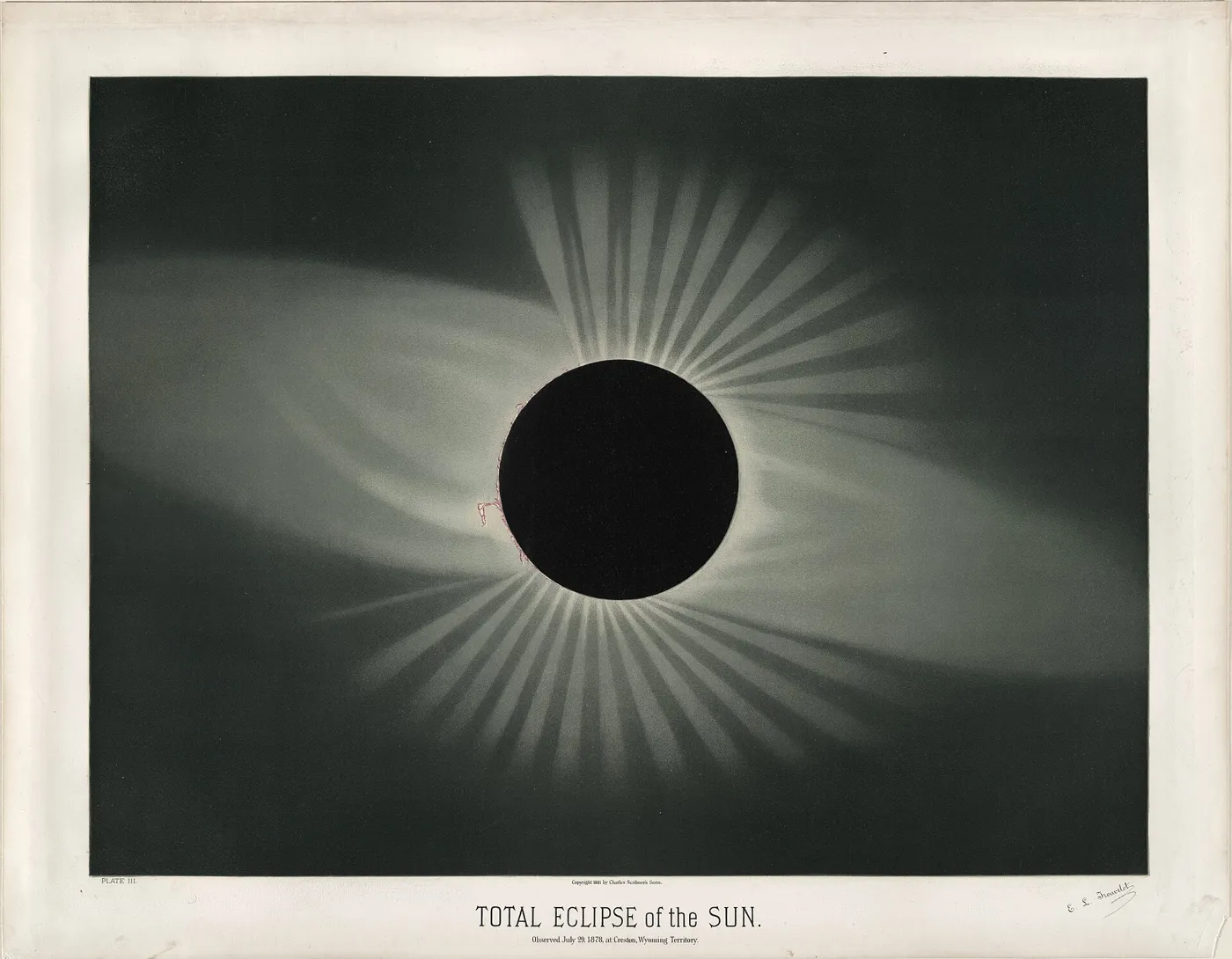
To interpret the effects of this eclipse properly, we must first consider where it takes place. Since it will be visible in totality across the USA, its effects will be particularly noticeable there. As noted earlier, because it occurs in Leo, places traditionally assigned to Leo’s rulership also come under its influence, including Austria, especially Linz; Belgium, especially Ghent; Italy, especially Rome, Sicily, Pula and Ravenna; Bohemia; the Czech Republic, especially Prague; Germany, especially Koblenz; England, especially Bristol; Turkey; and Syria, especially Damascus.
Regarding the nature of its effects, we have already seen that “eclipses in Leo foretell death or misfortune for kings, the nobility and ‘persons of quality’; the ruin and destruction of ancient buildings, palaces and churches; divisions among the clergy, sieges of cities, and a scarcity of horses and grain”. To examine that nature more closely, we need to identify the eclipse ruler. In general terms this would be the Sun, but the luminaries are not traditionally considered as eclipse rulers. This leaves Mars, as ruler of the bounds and decan at the eclipse degree, 29° Leo. We may therefore recall what Mars brings when it rules an eclipse: “Mars as eclipse ruler brings harm through dryness, fire, arson, violence, murder, lawlessness, fevers, war and the sudden death of those in the prime of life. The weather is afflicted by lightning, hurricanes, drought and destructive winds. Sudden storms and violent shipwrecks occur at sea. Fields suffer from excessive heat, damaging winds and fire.”
In accordance with all that has been said, this eclipse will produce the effects described on the mundane level in the regions covered by its symbolism. As noted earlier, the duration of an eclipse’s effects corresponds to the duration of the eclipse itself. Totality will last just under three minutes—2 minutes 44 seconds—so its effects will last just under three years, or, more precisely, two years and nine months. By all indications, the strongest mundane effects are expected in the USA, so it is worth examining the eclipse chart for Washington:
Here we see that Mars has further implications, appearing as the accompanying planet in its heliacal rising phase, and very powerful near its apogee on both epicycle and deferent. The whole question of Mars becomes particularly interesting when compared with President Trump’s natal chart, as the eclipse may affect him especially strongly. First, the eclipse falls on his natal Ascendant at 29° Leo. As already mentioned, eclipses are particularly powerful when they fall within one degree of the Ascendant or a luminary; Mars is also on the Ascendant. A detailed analysis of these implications appears on the Classical Astrology blog, though, in keeping with the descriptions given so far, I would particularly highlight the following:
The previously mentioned malefic Mars stands out: contrary to sect and hayz, conjunct the Ascendant and square the MC, it rules the fourth house of death/the grave and the ninth house of travel/foreign lands and philosophy/religion, and is almuten of the sixth house of illness/injury/enemies. It also rules the greater part of the eighth house of death, which falls in Aries! Its twelfth-part falls on the Sun, ruler of the Ascendant, indicating an uncompromising man of fiery, fixed convictions that provoke resistance and opposition, and hence the emergence of enemies who threaten his life. A markedly choleric temperament—the Ascendant in fiery Leo, its placement on Regulus, and the waxing Moon in its second, choleric quarter in fiery Sagittarius—is accentuated by choleric Mars on the Ascendant. Together with this royal fixed star of the first magnitude, Mars heightens the tendency towards rash reactions and belligerence, especially when he feels challenged or humiliated: that is, when he believes he must demonstrate his power, leadership and resolve. The applying Sun–Mars sextile testifies to the same, carrying the strength of a trine because it extends across the axis of the tropical signs Cancer and Capricorn.
Mars rules the Lot of Victory—Jupiter’s lot, signifying trust, partnership/alliance and success, at 16° Aries—and the Lot of Nemesis—Saturn’s lot, signifying all that is hidden, loss, sorrow, exile and the manner of death, at 5° Aries. It falls exactly on the Lot of Necessity—Mercury’s lot, signifying oppression, quarrels and hatred, at 27° Leo—which John Frawley also describes as an indicator of the necessity of making an unpleasant choice. What brings him success and alliances is also the cause of loss and sorrow, and even death. The necessity of choosing between several options may lead him, in keeping with his markedly choleric temperament, to decide hastily and without reflection, forcing his way through regardless, using threats, coercion or force (Mars), driven by a will to win and to demonstrate strength and authority at any cost. Such indications hardly describe the qualities of a peacemaker or diplomat who, in a crisis, responds calmly and thoughtfully in order to de-escalate tensions. Further testimony comes from the Moon’s applying opposition to the Sun, ruler of the Ascendant, near the nodes, which are especially harmful to the luminaries because their eclipses occur there: a “fated” tendency towards confrontation, or towards provoking hostility and opposition, particularly because the Moon rules the malefic twelfth house of enemies and disposes the ruler of the sixth and seventh houses. Moreover, the Moon separates from retrograde Jupiter, ruler of the eighth sign/house of death, and applies to the ruler of the Ascendant, thus joining these two separating planets. Is this not similar to the previously described translation of light between Mars and Saturn in the ingress chart, which, according to the theory, is fatal to the king?
Indeed, we have witnessed all of this over the past few days, hearing distinctly hostile and warmongering speeches in response to North Korea’s threats to deploy its nuclear arsenal against the USA. President Trump replied that, if it did so, it would face “fire and fury like the world has never seen”. This sounds very much in keeping with his nature, but also with the effects attributed to this eclipse. The eclipse may also be considered dangerous to Trump himself. The first four months or so of 2018 stand out as the beginning of the danger, when the first signs emerge, while the threat intensifies—and is most likely to materialise—in the second, middle eleven-month period after the eclipse: September/October 2018 to October/November 2019. Nevertheless, the danger is present from the moment of the eclipse itself. In any event, many astrologers share the view that this eclipse will prove his undoing, either literally, through assassination, or through his removal from the presidency. At the same time, inhabitants of the US West Coast face a real danger of earthquakes, those in the central and southern regions face widespread outbreaks of livestock disease, while the eastern states will see more intense protests and clashes between people. Larger towns and cities could experience an increase in accidents involving infrastructure, some of which might be caused by terrorist attacks, more likely in cities towards the East Coast.
Given where the eclipse degree falls in the relevant charts, difficulties on the West Coast and towards the central states can be expected to begin within the first four months, and from Nebraska eastwards within eight months of the eclipse.
These are some of the potential implications on the mundane level; we will be able to observe their effects over the coming period.
Finally, it is worth considering the potential natal influence. As mentioned, the last solar eclipse at this degree, 29° Leo, occurred in 1998. It is therefore worth recalling any personal experiences you may have had then, as something similar could recur. It is also worth examining your own natal chart to see whether any of the following configurations are present:
The Sun or Moon at or near 29° Leo, generally within an orb of one degree The Sun or Moon at or near 29° Aquarius (opposition) 29° Leo culminating in the natal chart (conjunct the MC) 29° Leo rising on the eastern horizon in the natal chart (conjunct the Ascendant) The Sun or Moon at or near 29° Taurus or Scorpio (square, though probably with considerably less effect)
If one or more of these factors is present, a detailed analysis of the natal chart is needed to establish what effects the eclipse might have on the native and how far-reaching they may be. Given the nature of the eclipse itself, it is difficult to expect favourable or prosperous effects. Equally, however, negative interpretations cannot be generalised, since the actual effects will be determined by the natal chart and its significations, which differ in every case. The articles circulating these days offering general interpretations by “sign” therefore have little practical value, and we advise you to ignore them.