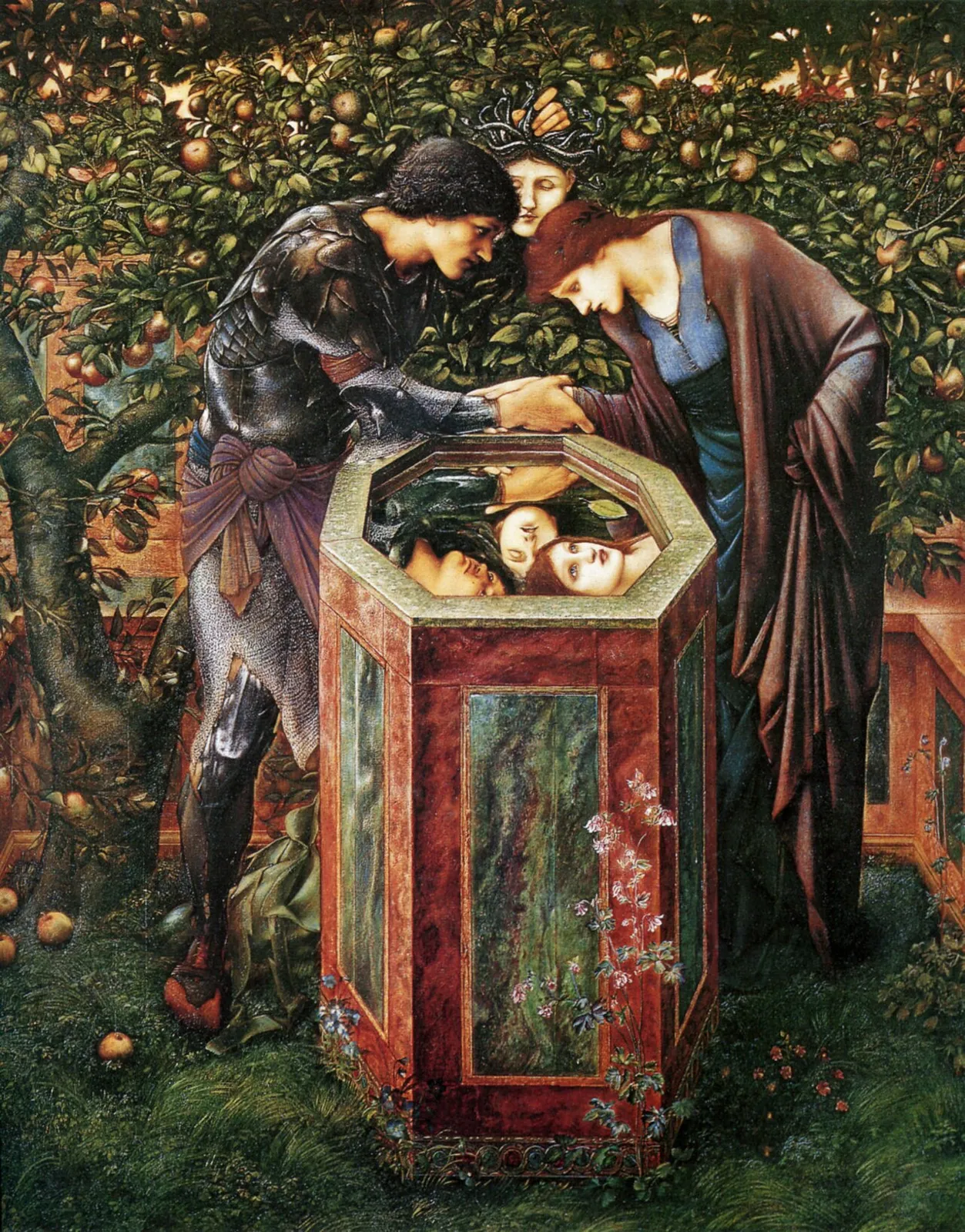
“The name Algol derives from the Arabic Ras-al-Ghul—the leader of demons—or the Hebrew Golem. It thus also represents the fallen angel Lucifer, who establishes a satanic kingdom on Earth. Beautiful and ugly, against God and for humanity, brilliant and dark: the two faces of Medusa, gentle and terrible, the destructive sex of black magic and the liberation of white magic.” (Mile Dupor)
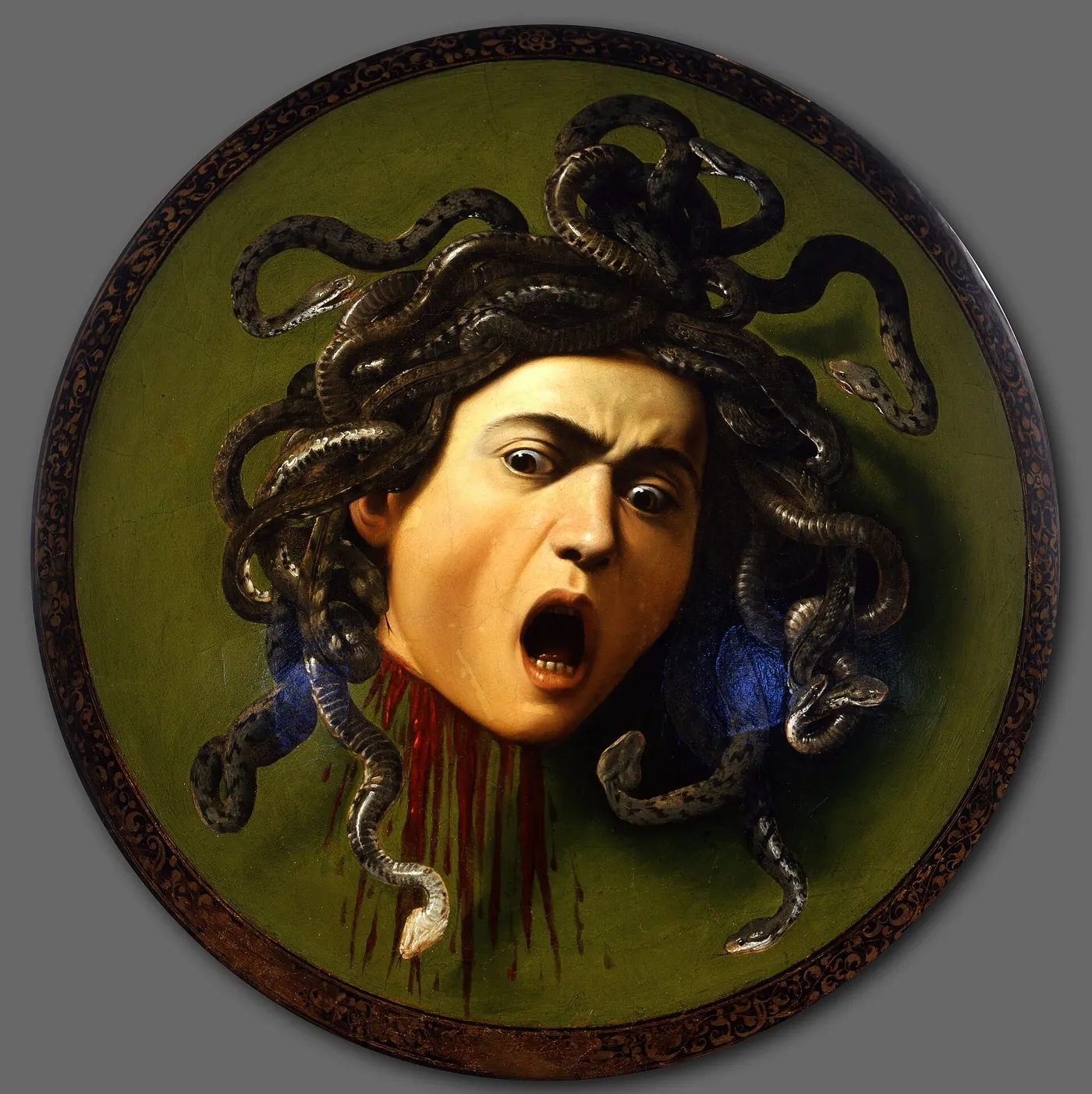
In the constellation Perseus, at twenty-six degrees of Taurus, the binary star Algol glimmers in the “Gorgon’s Head”. Homer’s Iliad alludes to “the Gorgon’s monstrous head, the writhing horror of a dragon”—the baleful head that turns all who look upon it to stone. This evil fate befell only men and a few animals, but no women. Perseus had to take care never to look at the dreadful head. “Medusa reveals the grandeur of death to all who look upon her.”
Medusa was originally worshipped in Libya as a serpent goddess. Her curly hair suggested her African origins. Her name translates as “sovereign female wisdom”, although in another legend, in which she was one of three Gorgons, it means “ruler”, while the other two Gorgons were “wanderer” (Euryale) and “strong woman” (Stheno). “Above all others she was renowned for her beauty … No words could describe the splendour of her hair, the most exquisite part of her allure—so a friend who had seen its lovely radiance told me,” writes the Roman poet Ovid. He relates how the once-beautiful Medusa was assaulted by Neptune in Minerva’s temple—that is, Athena’s—after which the goddess punished her, as though she were to blame, by turning her lovely curls into hissing snakes. (Athena, as the goddess of masculine wisdom and learning, retained only traces of the earlier goddess of wisdom, whose character was priestly.) Medusa had already lost her immortality—of the three Gorgons, she alone was mortal—and then lost her beauty through Athena’s wrath, before finally losing her head, which Perseus cut off while she slept in a cave with the other Gorgons.
Algol in Astronomy:
At a distance estimated at between 79 and 101 light years—93 light years according to the Hipparcos satellite—Algol is one of our nearest eclipsing binary stars, and consequently one of the most extensively studied. Even so, the star remains mysterious, and many questions still await answers. One puzzle is the invisibility of its eclipsing companion, which is completely lost in the glare of the primary star and has never been observed visually. Even spectroscopically, the companion was detected only relatively recently, in 1978, at the McDonald Observatory. Algol A has a surface temperature of 10,100 K and a diameter three times that of our own star. Algol B is slightly larger, but its surface temperature is lower, at 4,900 K. The masses of Algol A and B are estimated at 3.7 and 0.8 solar masses respectively.
Spectroscopic measurements have clearly established the orbit of the bright star, placing it approximately 1.7 million km from the system’s centre of gravity. The fainter, less massive star follows a larger orbit around that centre, and the actual distance between the two stars is most likely around 10 million km. The system’s inclination is approximately 82 degrees, and during the primary eclipse about 79% of the bright star is obscured by its larger companion. Algol has a very small annual proper motion of only 0.01″ and a velocity of 3 km/s.
Further study revealed that its brightness is not constant at maximum, but continues to rise slowly after the primary eclipse, peaking just before the secondary eclipse. This has been explained by the fainter star reflecting light from the primary and displaying phases resembling those of the Moon as it travels along its orbit. The “full moon” phase is most likely visible when the fainter star lies behind the brighter one, with its entire illuminated disc facing Earth. This occurs immediately before and after the secondary eclipse, so it is natural for the combined light of the two stars to reach a maximum then. Studies of this effect have shown that the dark companion is 1.7 times brighter on the side facing the luminous primary. Limb darkening also affects the brightness, owing to the denser atmosphere at the edges of the disc. This makes each star appear brighter at the centre than at the edge. Since the limb is the first part to be occulted during a stellar eclipse, the initial loss of light is gradual, but increases rapidly as the centre of the disc is obscured.
Algol has also been identified as a source of radio emissions. The most likely explanation is a sudden change in the star’s structure, which might be called a “starquake”. A sudden energisation of hot thermal plasma is the most probable cause of these emissions.
It was recognised in 1869 that Algol was not a simple two-star system. For almost a century, small but definite changes had been observed in the period of the eclipsing pair. Modern studies show that the major axis changes its orientation in space over a period of 32 years. Analysis of this effect has established the existence of a third star in the system, with a fourth also possible.
The third star, named Algol C, has been confirmed spectrographically and displays the characteristics of an F-type star. This stable blue-white star is a full magnitude brighter than the Sun—more precisely, ten times as luminous—and 1.8 times as massive. It revolves around the AB system in a period of 1.862, at a distance of more than 60 million km. The existence of a fourth star, Algol D, remains highly uncertain. All that is known is that its orbital period around the system might be 188 years. There is no evidence that a fourth member of the system actually exists.
Algol in Astrology
There is a clear distinction between the characteristics of the stars of Perseus and those in Medusa’s Head, which Ptolemy fails to recognise in his list of planetary natures. Since most astrologers follow Ptolemy, Algol—the principal star in Medusa’s Head—is usually assigned the nature of Jupiter and Saturn. Yet, given its widespread and predominantly sinister reputation, William Lilly was probably more accurate in associating it with Saturn and Mars. It is considered the most unfortunate star in the heavens, and a very dangerous one, reputed to cause violence and unnatural death. Even Ptolemy records that its influence brings “death by beheading or mutilation” when associated with hostile aspects from Mars to the Sun or Moon.
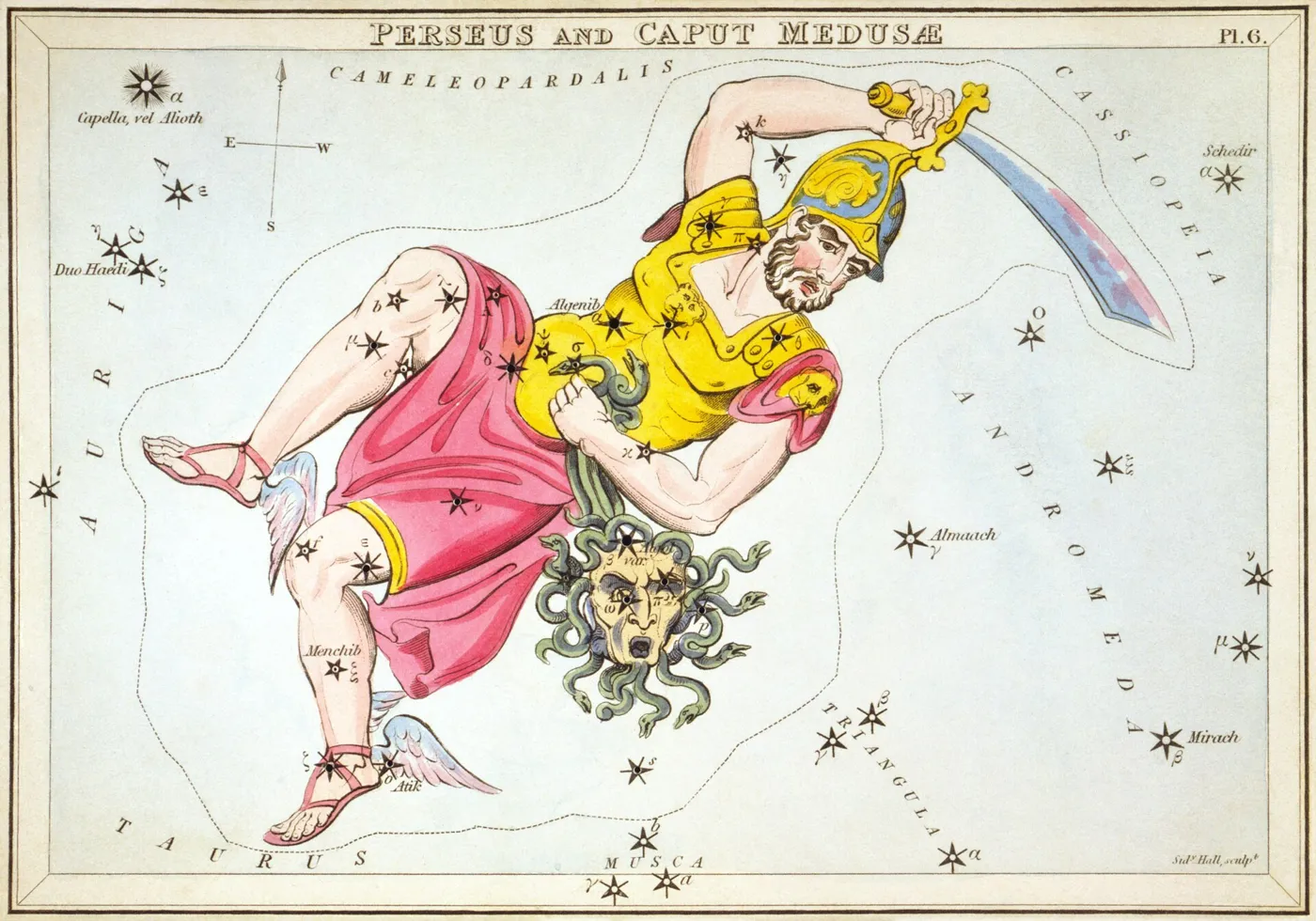
The name Algol derives from the Arabic Al Ghul, “ghoul” or “demon”. It has always been associated with death, tragedy and bloody violence: the Jews call it Rosh ha Satan, “the Head of Satan”, and the Chinese Tseih She, “piled-up corpses”. According to Dr Lomer in Kosmobiologie, Arab commanders took care not to begin any important battle while Algol’s light was dim.
Lilly regarded Algol as one of the most fatal stars, noting that, when afflicted, it signifies beheading, hanging or danger to the head. In his system for assessing planetary strength, any planet within a five-degree orb of Algol receives four points of debility. With the Part of Fortune, it threatens poverty and loss of wealth, while with the “Lord of Manners”: “… it begets in the native a certain obstinacy and violent nature, whereby he either brings a sudden death upon himself, or causes it in others.”
On the direction of the MC to this star, Lilly writes: “It perplexes and casts the native into great dangers on account of murder, bloodshed, or the sudden death of some person, or some other matter wherein the native is either principal or accessory, so that his head is in danger. If the other directions promise good, it gives the native power to sentence others to death. Yet I have ever found this an evil direction, even in the genitures of men of middling station.”
The following are more specific descriptions of how this star behaves when in contact with various elements of the natal chart:
On the Ascendant of the chart: it brings murder, violent death, beheading, murderous tendencies and ruin. If it is also conjunct the Sun, Moon or Jupiter, it brings victory over enemies in war.
With the Sun: Violent death or severe illness. If it is not aspected by any benefic planet in the chart, or if no such planet occupies the eighth house, and the ruling luminary—the Sun in a diurnal birth or the Moon in a nocturnal birth—is square or opposite Mars, the person born under this influence will be beheaded. If the Moon or Sun is at the zenith, it portends mutilation, disfigurement, wounding or dismemberment while still alive; if Mars is also in Gemini or Pisces, the hands or feet will be cut off.
With the Moon: Violent death or severe illness. With Mars, or if Mars is above the Sun or Moon while Algol occupies an angle, the person will be a murderer or meet an untimely end. The outcome is the same if Algol is angular or with the MC. Loss of the mother or wife, and suffering among female members of the household, are more than likely. The Moon on Algol can bring a tragic fate, difficulty finding a partner—despite also bestowing physical beauty—pent-up anger and hysteria. Favourable aspects to the Moon can mitigate this ill fortune to some extent.
With Mercury, it will always signify someone who becomes an object of hatred and whose thoughts are deeply malign. Such people are prone to sexual deviations and disorders. Paedophilia is not uncommon, while in women’s charts this placement frequently signifies prostitutes. These people often undergo a sudden change during adolescence, becoming very troublesome.
In aspect to Venus, it warns of decidedly harsh experiences in love, the possibility of rape and various deviations, miscarriage or inability to bear children; if Venus is afflicted by adverse aspects, violent death is also possible.
With Mars, it indicates collective dangers and wars, but also frequently describes highly aggressive individuals prone to extreme violence. Mars has an affinity with war and murder, and in aspect to Algol it pulls too strongly towards the dark side. In a man’s chart, Mars conjunct Algol makes him brutal and exceedingly violent. Older interpretations state that “the person will be a murderer who will himself meet an untimely end”.
With Mars or Saturn, when the Moon is simultaneously on Sadalmelik, it portends hanging or beheading. If the Moon is on Alphard, death comes through water or poison. With the Hyleg and angular, it brings beheading, or the person under its influence is a murderer who will meet a violent death. With the Part of Fortune or its ruler in the chart, it brings poverty.
According to Dupor, every 68 hours and 49 minutes—or, more precisely, every 1,681 minutes—this star “winks”, or flickers, because it has a smaller companion orbiting it. This “wink” lasts approximately eight hours. It is precisely during those eight hours, when its light is faintest, that its malefic nature comes to the fore, since the influence of its dark side is then strongest. It is known as the most unfortunate, violent and dangerous star in the heavens. Its nature is Saturn–Uranus–Mars: perilous fortune and adventure ending in catastrophe. It brings the danger of death, suicide, hypnosis and loss of health, and destroys the finest structure of matter—the human brain. Traitors and criminals often have it prominently placed: the criminal Haarmann, sentenced in 1926 for 26 murders, had a Mars–Neptune conjunction there, square Saturn. Ivan the Terrible and Rasputin had it on the Ascendant, as did Pavelić. Its influence therefore resembles that of Pluto.
With the Sun in an afflicted chart: extreme illness and sudden death, fatal sex, loss of honour and even life. With the Moon: dangers; in an afflicted chart, a sadist or murderer. With Mars: robbery, suicide. With Mars and Saturn: an unnatural and strange death; with Uranus: sexual suffering, homosexuality. Trine Jupiter: great power over people, a dangerous position. Its influence is very strong, with an orb of five degrees; it also operates through major afflictions, and even through favourable aspects within a two-degree orb. Astrologers should also note that Saturn and Uranus lingered around it in 1941, which led Professor Mužinić to predict that this would be “the most significant year in these thousand years”.
As for conjunctions with house cusps, some examples from practice show that Algol conjunct a man’s seventh-house cusp brought serious marital problems. In conjunction with the fifth-house cusp, it brought difficulties concerning children: every attempt by the wife to conceive ended badly. On the third-house cusp, it brought severe illness to a brother or sister. Conjunct the eleventh-house cusp, it often signifies friends who are thieves, take drugs or may even become murderers. The person generally gravitates towards “bad boys”, and their own life is consequently endangered in some way. If a man has Algol on the eleventh-house cusp—which, by derived houses, is his partner’s fifth house—it predisposes her to at least one abortion.
Vivid Algol Personalities
The great twentieth-century Spanish artist Pablo Picasso had Jupiter conjunct Algol. Cubism was born through his painting “Les Demoiselles d’Avignon”, a group of whores standing before the viewer as though before a client. This new brutality ushered us into the twentieth century, as the female form disintegrated under his tortures. His “Guernica”, filled with despair, is a passionate condemnation of the horrors of war. The existentialist philosopher Jean-Paul Sartre also had Jupiter on Algol. His philosophical conclusions—“Man is a useless passion” and “Hell is other people”—are strongly reminiscent of Algol. In 1940–41, during his Jupiter return on Algol, he became a prisoner of war, and this is said to have been his most productive period.
This star produces vivid, intense people. Joan of Arc, the freedom fighter, had Algol conjunct Saturn and was burnt at the stake. The dancer Isadora Duncan, with Algol conjunct Pluto, died when her scarf became entangled in a car wheel. The ballerina Margot Fonteyn, with Mars conjunct Algol, had a husband who survived a gunshot to the neck but was left paralysed: he had to watch her beautiful movements while remaining immobile himself. John Lennon, with Algol conjunct Uranus, was shot in the back. Stephen King, with Algol conjunct the North Node, the master of horror whose books are repeatedly adapted for the screen, nearly died after being run over by a truck, but recovered. The alluring Johnny Depp, with Algol conjunct Venus, currently boycotted by Hollywood for his political comments, had to battle a headless demon in “Sleepy Hollow”, and uncover the identity of Jack the Ripper in another film, “From Hell”.
“This star seems to contain immense female passion and power,” writes Bernadette Brady. She adds: “Algol represents a strong, intense passion that can utterly destroy you through rage and anger. If a person can restrain the unconscious urge for revenge and channel that passion towards a more productive outcome, Algol will represent one of the most powerful stars in the sky. Whichever planet is influenced by this star in your chart will be filled with strong, intense sexual energy, with the potential to be wonderful or, if suppressed, to lead to rage or violence.” These words also apply to Picasso, though in a rather unpleasant way, since he was in the habit—as it emerged—of giving paintings to the husbands of women he had seduced. Lady Diana, with Algol conjunct Venus, took a vibrator on official trips as both a sexual aid and a lucky mascot.
Diana described life with her husband as “real, real torture”. She met her death beside her true love in a heap of metal. She was the “People’s Princess”, our Queen of Hearts, and her life was a striking expression of the Venus–Algol contact. For her wedding hymn she chose “I Vow to Thee, My Country”, a Jupiterian theme—appropriately accompanied by a Jupiter–Saturn conjunction just rising over the horizon at noon on 29 July 1981, as they approached the altar. The words were fitting: “The love that asks no question, the love that stands the test, that lays upon the altar the dearest and the best.” She also demonstrated a positive way of working with this difficult star, touching people with AIDS, walking through minefields and embracing the homeless.
Her bodyguard, Sergeant Barry Mannakee, grew too close to her and did what a bodyguard should not do; shortly afterwards, on 14 May 1987, he lost his head in a motorcycle accident. Prince Charles told her of the tragedy with brutal nonchalance a day or two later, as he stepped out of a car to pose for photographers—in the days around the Sun’s conjunction with Algol, perhaps even on the very day! Diana was distressed and convinced that Mannakee had been killed by MI5. At that point in her life, mortal fear entered her soul as Saturn transited her Ascendant and the Sun crossed her Venus–Algol conjunction. Her longest love affair was with James Hewitt, and it ended—as he revealed to the BBC—after he received several warnings to break off his relationship with the princess lest he suffer a similar fate. An MI5 agent visited him at his London flat and warned: “If you don’t stop seeing Diana, you’ll meet the same fate as Barry Mannakee and die in a road accident.” He took the advice.
According to Diana K. Rosenberg, Algol in a chart does not necessarily mean that the person will inflict pain on others or fall victim to some horror or misfortune: “You will not be able to ignore suffering and horror, nor brush them aside … Algol’s placement in a chart insists that these difficult aspects of human experience be confronted and assimilated in this lifetime. Yes, some fixed stars are difficult. But they have a purpose. Each defines an area that will be emphasised positively or negatively; the tests are intense and unavoidable. Like other stars, Algol gives us a task which, if understood and accepted, offers great rewards of power and creativity. These stellar challenges are not to be feared, but understood and used positively.”
Sources used in this article:
Fixed Stars and Constellations in Astrology, Vivian E. Robson, 1923 William Lilly: “Christian Astrology” Mile Dupor: *“Do Not Believe—Verify”*Nick Kollerstrom: “The Horrorscope of Algol”