Lately, astrologers have been increasingly preoccupied with the various influences of ever more mysterious celestial objects, always finding ingenious parallels between the discovery of new heavenly bodies and the “stages” of humanity’s (d)evolution. Yet what they consistently overlook is that they always return to the original planets, gradually stripping them of their essential symbolism, whatever level we consider. According to many authors, for example, asteroids such as Ceres, Pallas, Juno and Vesta extend the feminine principle to encompass some of the new roles women have assumed thanks to feminist movements. Yet when we examine the astrological symbolism of these asteroids, we find nothing that was not already encompassed by the symbolism inherent in the Moon and Venus. What is significant, and certainly necessary, is the return of the feminine principle—not the recovery of something from a mystical past, but the creation of a new expression of it, one that is neither a matter of competing with men and “occupying traditionally male positions” nor some fairy-tale vision of enchanted maidens. The point, surely, is that humanity’s progress enriches the symbolism of the original planets in corresponding ways. By “enriches”, I mean that this symbolism is revealed to us: it has always been there, but we did not yet have the eyes to see and recognise it. Other approaches, particularly those that depart from traditional astrological principles, have created considerable confusion among astrologers, with rulerships and other astrological dignities assigned to these new objects in a manner that is, to put it mildly, thoroughly chaotic. That, however, is not the subject of this particular article. My intention here is to remind us of the increasingly neglected Moon and its significance.
With astrology now found on every corner, everyone has been able to pick up a little knowledge. Even those who do not study it, and who approach it for all manner of reasons, know that once Saturn enters their sign, or even a particular house, it will bring problems, hardship and heaviness. Likewise, they know that Jupiter, the greater benefic, will bring happiness, prosperity and success through its transits. Mercury is becoming ever more popular too: everyone now notices its retrograde periods when they forget their keys, lose their identity documents or feel especially distracted, and the press reminds them: “Ah yes, Mercury is retrograde again.” Those who have devoted more time to astrology attach particular importance to the asteroids mentioned at the beginning of this article, and especially to Lilith, shrouded in the same mystique you may glimpse in the eyes of someone who tells you, with a curious pride in their voice, that they were born while the Sun was passing through Scorpio. More recently, we have also acquired Saturn’s Sade Sati, whose origins—and therefore its significance—belong to the different system of Jyotish, but which is now being adapted to the needs of modern astrology. Apparently the Saturn return, or its sensitive two-and-a-half-year transits, are no longer enough, so these “periods of suffering” have now been extended to seven years o.O Naturally, I have no wish to discourage such research, which may certainly have its uses. Yet, unless I am mistaken, the Moon remains the least understood. Somehow it has been left on the sidelines, insufficiently mysterious—except when it is apocalyptically “blood-red”—its phases followed mainly for dieting purposes, while the hypersensitive keep a watchful eye on when it is full or new because they have read somewhere that it affects headaches, good or bad moods, insomnia or whatever else.
“Perhaps it is because the Moon moves fastest of all, making it seem impossible to keep track of which sign it occupies. Yet this very Moon chooses the music you put on your player, chooses your programmes for you, decides what will be on the table today, determines what you will dream on any given night, how much you will sleep today and how many packets of cigarettes you will smoke. It will bring you crowds and good spirits, and it will bring you crowds and frayed nerves. It is the uncertainty of the evening as you set off happily for work in the morning, never dreaming that by nightfall you will be weeping bitterly because a film has reminded you of your own loneliness, or because you have found an injured puppy on your doorstep whose helplessness can, in an instant, send the whole day’s happiness plunging into an abyss and leave this encounter indelibly imprinted on you. It is the Moon that brings happy endings, and the Moon that cuts a conversation short when you least want it to.” (Sanja Perić)
In astrology, the Moon (☽) rules Cancer. It represents our deepest personal needs, our fundamental habits and reactions, and our subconscious. Where the Sun acts, the Moon reacts. How do we instinctively react or respond to problems? What do we feel we need in order to feel secure? The Moon in your natal chart offers answers to all these questions. It is associated with the mother and with feminine energies in general. The Moon is both our inner child and our inner mother. It describes our spontaneous, instinctive reactions, which reflect our true motives and needs. We can also think of the Moon as that which animates us. It governs the rhythmic ebb and flow of activity and energy. The Moon mediates between the inner and outer worlds. While the Sun is rational, the Moon is irrational. The Moon also rules our habits and prejudices. Those prejudices may never be expressed, since our Sun can censor them, but the Moon governs our spontaneous reactions and feelings. As we shall see, for almost all of us, our Moons seem to govern our personalities more than our Suns do. This is especially true when the Moon is in a water sign—Cancer, Scorpio or Pisces—or conjunct one of the angles: close to the Ascendant, Descendant, fourth-house cusp or tenth-house cusp.
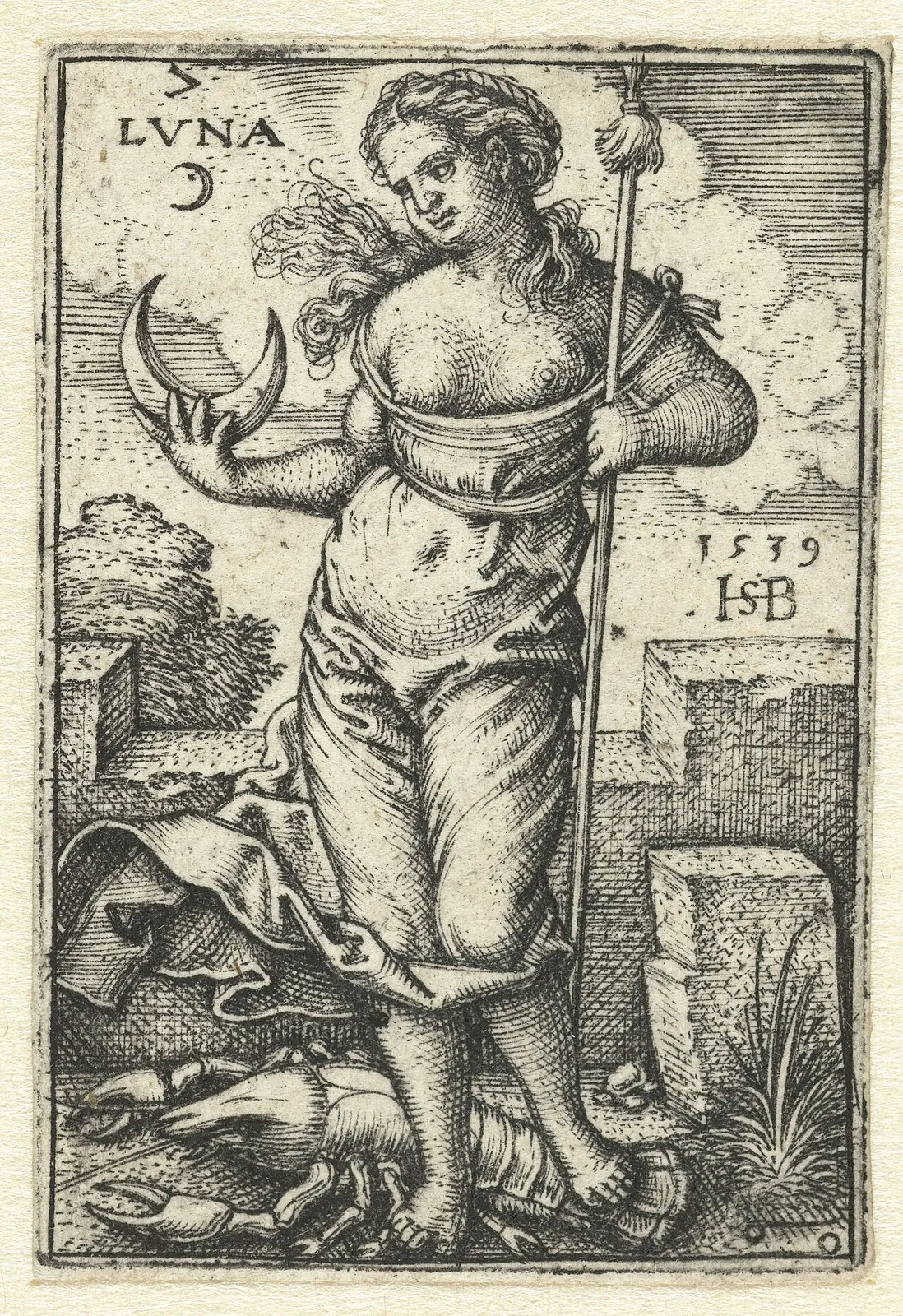
It is no exaggeration to say that the Moon is the most important planet in your horoscope. I base this view above all on the fact that human beings live almost entirely through their Moon. The reason is that people do not truly create anything original—certainly not anything whose source lies in the unadorned Self, also known as the “true self”. Every human action, every act or deed, is essentially a reaction to impressions both received and processed through the Moon. Just as moonlight depends upon the light of the Sun, so every action we take is conditioned by everything that lives within our Moon, stored deep inside, where it exerts an even stronger influence while we remain under the illusion that we are making decisions. This is because every action is driven by subconscious motives, and we merely react to reality accordingly. It is also why we cannot perceive reality and everything around us as it truly is, but instead cast upon it our own projections, rooted in that same subconscious realm. This is why people experience the same thing differently: why something may represent a threat to one person, a challenge to another, or a source of happiness to someone else. In this way, all the things, circumstances and people in our lives are simply mirrors of ourselves. We spend almost our entire lives within these confines, staunchly defending our views—read: reflections—as the only correct ones. The Moon is assigned rulership over the first four years of life, a period during which, according to psychologists, children absorb everything and experience reality far more fully than appearances suggest. We feel things on every level; they are reflected in our psyche, and all those feelings remain deeply rooted in the memory of our whole being. Psychology tells us that traumas, and experiences more generally, arising during this period shape the personality for life. I believe this is true, because everything people do thereafter amounts to developing mechanisms for building a way of life suited to those needs. Of course, I do not believe this is the only period in which we experience things deeply and intensely. In fact, I think we always do so; it is simply that, in the meantime, we have found ways to develop a measure of control, greatly aided by our capacity for reason and rationalisation.
Speaking of projections, the concept of the Anima and Animus seems particularly important to mention in this psychological discussion. Carl Gustav Jung explored masculine and feminine energies through the concepts of the Anima and Animus. He held that men have a feminine side—the Anima—and women a masculine side—the Animus—which many of us have deeply and forcefully repressed. The Anima has an emotional and loving character, while the Animus is assigned a rationalising character. Jung maintained that every man carries within him an eternal image of woman. He described this need as unconscious, directing us once again to the Moon, and as an inherited factor of primordial origin, a trace of his ancestors’ experience of women. Here, of course, we return to the Moon, for it represents not only the most intimate part of our nature but also our entire ancestral heritage, especially that inherited through the mother, grandmother and the whole female line. From this we may conclude that the Moon in a man’s horoscope reveals his eternal image of woman (Moon), an unconscious image (Moon) that is an inherited element of his origins (Moon), as well as his ancestors’ experience of women (Moon). Men therefore project their Anima onto their partners, seeking, in effect, to embody this conditioning in one or more people. This most often creates problems in romantic relationships, since the partner is not seen as she truly is, but as she exists within our Moon. As this becomes increasingly apparent, separation becomes inevitable. For this reason, considering the Moon in questions of intimate relationships, marriage and the like is of immense importance, something no other consideration in the horoscope can override.
When you know what you mean but cannot put it into words, it is your Moon that knows, while your Sun does not know how to express it. All those thoughts that often lie too deep for tears belong to the nature of your Moon. Inexpressible ecstasy, wordless sorrow, the secret dream, the esoteric image of yourself that you cannot communicate to the world, or that the world neither understands nor values—these are products of the Moon in your horoscope. When you are misunderstood, it is your lunar nature, imperfectly expressed through your Sun sign, that you feel has been betrayed. When you know what you ought to do but cannot find the right way to do it, it is your Moon that knows and your Sun that refuses to act accordingly. Likewise, when you find yourself saying, “I don’t know why I said that,” it is either your Moon expressing itself against the will of your Sun—if you are inwardly pleased with the words that slipped out—or your Sun expressing itself against the will of your Moon, if you regret what you blurted out. The things you know without thinking—intuition, premonitions, instincts—are products of the Moon. Forms of expression that you truly feel convey your deepest nature belong to the Moon: art, letters, creative work of any kind; sometimes love; sometimes work. Whatever you feel most deeply to be yourself, whether or not you can give it any expression in the outer world, is a product of your Moon and the sign it occupied at your birth.
In view of all this, I advise everyone to become as familiar as possible with their Moon through its position by sign and house, its disposition and its aspects, for astrology offers no better key to self-knowledge. In traditional astrology, the relationship between the Moon and Mercury is crucial to understanding the native’s state of mind and intellectual capacities. In this respect, it is favourable for these two bodies to “see” one another through any aspect, while the absence of an aspect was considered a limiting factor. For those who do not know where their Moon is, here is a link where you can easily calculate it: http://www.lunarium.co.uk/moonsign/calculator.jsp