
Something I would call narrative-building occurs very often in astrological practice, particularly among beginners. In the nature of things, this is necessary: a natal chart should, after all, be interpreted as a whole. Yet astrologers can become so carried away with constructing their story that they simply lose sight of other possible manifestations of particular astrological factors, going so far as to shoehorn those factors into their narrative. Those with livelier imaginations may go further still, effectively scripting and directing someone’s entire life. The same phenomenon is familiar among detectives who, while investigating a case, develop their own theory about how an act took place and under what circumstances. They believe in it so firmly that they make the evidence fit the story, even accepting unverified facts if these serve their narrative. Naturally, this leads to mistaken conclusions and poor investigations far more often than it leads to genuine discoveries. There is, of course, a chance that they are right, and that such instincts will set them on the right track. And this brings us to that fine line between feeling, intuition or instinct and self-deception. Much the same happens in astrological interpretation. Sometimes a natal chart contains so many compelling factors that our story simply feels so true that it seems to leave almost no room for other manifestations. Astrologers then build on this, carried away by their own convictions about how events will unfold, and support the whole edifice with “indisputable facts”, which quite often include factors whose influence is highly questionable even in theory. This is probably one reason why literally anything and everything has found its way into the astrologer’s toolkit, whether techniques or “newly discovered” astrological influences such as those of asteroids, the trans-Saturnian planets, comets and whatever else one might care to name. Another major contribution to this phenomenon is the astrologer’s need to be rather more dramatic than necessary, making the native’s life seem more exciting. This also satisfies the client’s need for their life suddenly to acquire some deeper meaning, now revealed to them by the astrologer. This informal meeting of desires usually produces deception, or at best a poor prediction. Besides the obvious financial benefit, the astrologer receives confirmation of their great knowledge, while the client acquires a conviction that their life is something grand, which they will believe unquestioningly until that same life brings them down to earth. It then serves up the bitter truth about their own inability to take responsibility for their decisions rather than constantly passing it to others—and with it the blame for every misfortune and injustice. This time the astrologer will be the target, after which the client will generally seek another dose of the placebo effect, perhaps now from a numerologist, a politician, a sports team or whatever else suits their disposition, in an attempt to escape that responsibility.
As ever, the truth is far more down to earth. Let us begin with the astrologer. Lest I be misunderstood, astrological consultations are not inherently a deception designed merely to take your money and offer false hope that there is, after all, something more to your miserable existence. What can make them so is the client’s expectations and the astrologer’s willingness to indulge them. People alone are responsible for the projections they create. Equally, claiming infallibility for predictions is hardly serious and, contrary to what many believe, an astrological consultation is not a contract obliging the astrologer to deliver a certain and infallible forecast. The only obligation is to answer the client’s question by applying astrological techniques, methods and knowledge. What is essentially being paid for is the astrologer’s time, effort and work, just as in many other professions. Nevertheless, astrologers should observe certain rules and principles in their work, seeking answers to the questions put to them within that framework. There is really no need to distort or adapt those rules, still less to invent new ones that will lend our story indisputable authenticity and truth. As someone once remarked somewhere, a natal chart—or any other chart—is essentially simple; the moment it becomes convoluted, you are doing something wrong. Applying those principles, methods and tools correctly will lead you to an answer without any need to introduce unnecessary elements. The essence of it, as it should be, lies in skill. On the other hand, the life of every individual on this planet is hardly fascinating. We need only look around us: most people lead fairly ordinary lives and seem quite content with them. That many feel they could offer and achieve much more, before remarking with a wistful sigh that life is, after all, life, is another matter. Yet this does not stop them expecting a fairy tale from an astrologer: some confirmation of what they have always felt but never found the strength to act upon. Incidentally, people love hearing about themselves. It gives them such mental pleasure that they are willing to pay good money for it. They need not even engage in anything immoral: the thrill is there all the same. Then along comes the astrologer, who uses psychological analysis to snap a magnificent selfie for them, and that is that. This is surely one reason for the growth of psychological astrology, which, I repeat, is not bad in itself. Not to mention the most important element of this kind of analysis: it generally concludes that nothing is the client’s fault, given all the difficult factors they have lived through, consciously or unconsciously, beginning with a troubled childhood and continuing from there. This absolution from responsibility, together with the selfie, seems to be the client’s chief motive. This is precisely how the narrative-building discussed at the beginning comes about. All the factors we have listed contribute to it, so that the rules are abandoned all too often in pursuit of other motives or, indeed, delusions. As we can also observe, this leads to a formulaic approach to astrology, undermining the fundamental premise of natal astrology: the uniqueness of every individual. The irony is that this very sense of uniqueness is often created through stock formulas and phrases! “Modesty becomes the learned,” Dupor used to say. Does an astrologer who genuinely seeks knowledge need the self-validation offered by working in this way? Astrology is an art, but not the art of storytelling, least of all of telling stories that someone wishes to hear, for whatever reason. It is the art of interpreting all those astrological factors to arrive at sound answers within the principles that give astrology its validity—principles rooted in the very structure of life on Earth and of the Universe. To put it romantically, it is the art of interpreting the stars. None of this means rejecting the intuitive element altogether, for it certainly has its place. But astrology is emphatically not a place for intuition to run riot, still less to take over the interpretation. So much subjective influence runs counter to astrology’s objective foundations, and it is precisely this that leads to the “storytelling” we should avoid.
Rather than offer a conclusion, I would like to add a story from John Frawley’s book “The Real Astrology”:
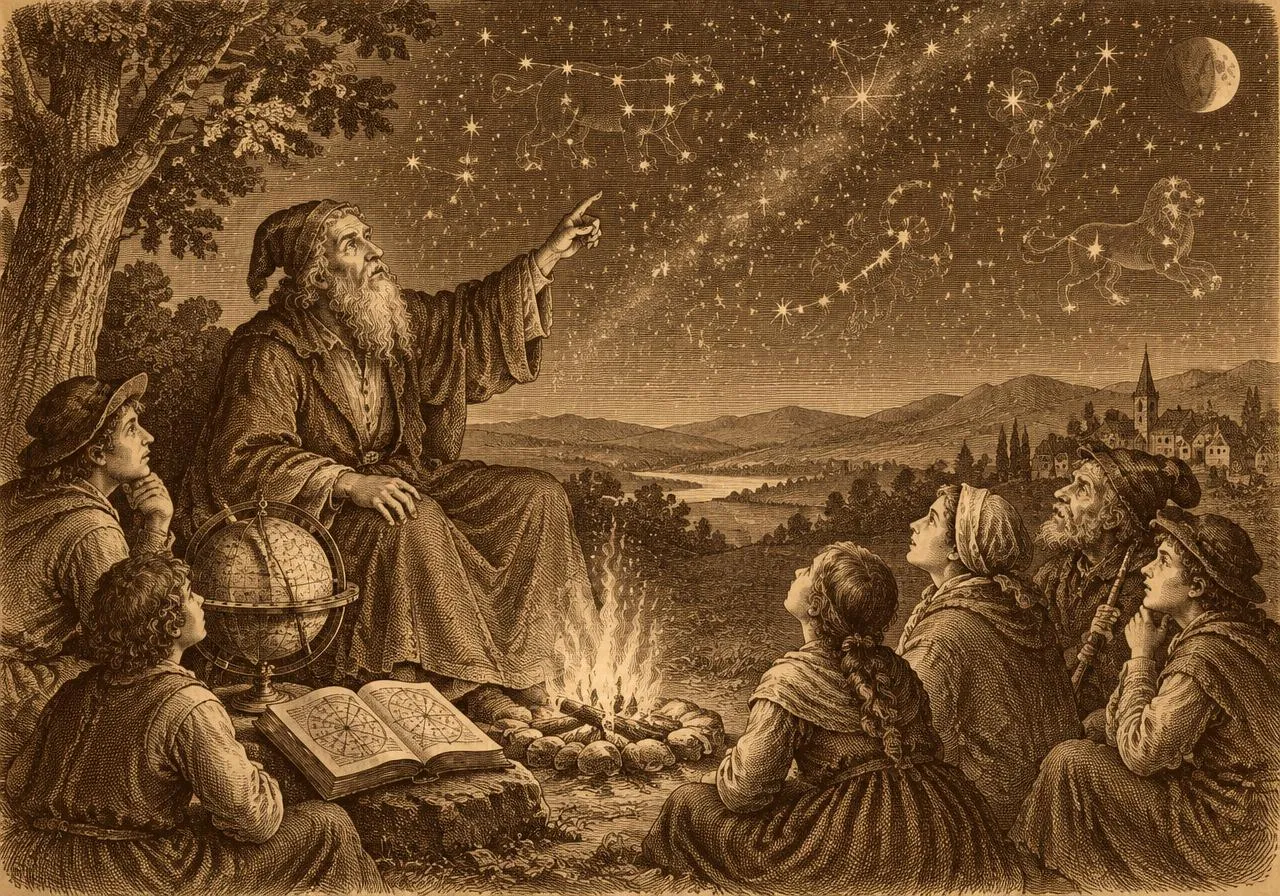
Six hundred years ago, a king summoned the royal astrologer. The messenger hurried out of the throne room, along winding corridors and up a spiral staircase, brushing aside cobwebs and waking the occasional sleeping bat, until he entered the dusty chamber at the top of the Black Tower where the astrologer had his lair. “Come with me,” he said. “The king wishes to consult you.” The astrologer gathered up his astrolabe and a couple of attendant spirits, then hobbled after the messenger as quickly as his age allowed. Reaching the king’s throne, he ran trembling hands over his long, snow-white beard and bowed deeply. “We are considering marrying the Princess of Ruritania,” said the king. “Is this a good idea?” “Well, Your Highness,” replied the astrologer, “you are a Leo and like to be the centre of attention at all times, while she is a Pisces, so she is a dreamer with a vivid imagination. There is not much hope for the two of you. Your lucky number today is six.” “Thank you,” said the king. “You have put my mind at rest. Take this gold ducat for your trouble, and tell your bat that from this day forward he is the Duke of Estragon.” This did not happen.
Six hundred years ago, a king summoned the royal astrologer. The messenger hurried out of the throne room, along winding corridors and up a spiral staircase, stumbling over candle-making equipment and plant pots, until he reached the attic of the Black Tower, where the astrologer was enjoying a rebirthing session. “Come with me,” he said. “The king wishes to consult you.” The astrologer gathered up his astrolabe and hobbled after the messenger as quickly as his fragile archetype allowed. Reaching the king’s throne, he ran trembling hands over his aura and bowed deeply. “We are considering marrying the Princess of Ruritania,” said the king. “Is this a good idea?” “Well, Your Majesty,” replied the astrologer, leaning on the collected works of Carl Jung, “I can see from your chart that you had a difficult childhood and are far more sensitive than other people realise. You have a gift for healing and unfulfilled creative potential.” “Thank you,” said the king. “I now understand the whole situation much better. Take a golden cliché to add to your collection.” This did not happen.
Six hundred years ago, a king summoned the royal astrologer. “I am considering marrying the Princess of Ruritania,” he said. “Is this a good idea?”
“Well, Your Highness,” replied the astrologer, “I can see from your chart that this princess will attract many poets, thinkers and artists from across the continent, making your court a centre of learning. The marriage will forge a lasting bond between the two kingdoms, and her father will be a valuable ally in the coming war against the barbarians. But you will outlive all your children, so that after your death the throne will pass to your wicked brother, who will oppress the people.” “Thank you,” said the king. “That gives me food for thought and some concrete information on which to base a decision. Now return to your studies.” This did not happen either, but it gives a far more accurate picture of what astrology was for most of its history.