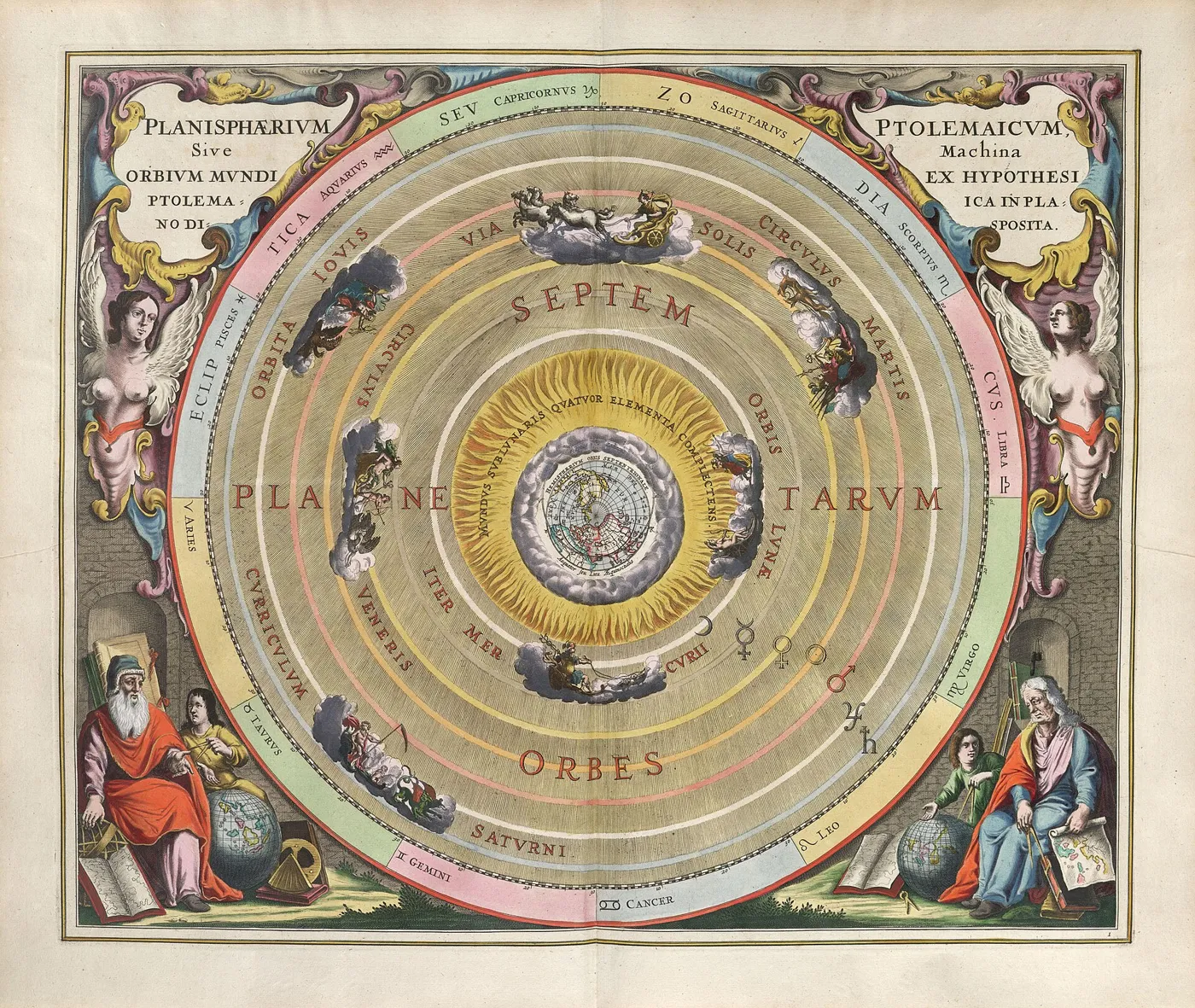
To explain the origins of the first two zodiacal dignities, we must first understand the underlying idea. There are two points of reference: the Chaldean order of the planets and the solar and lunar planetary sectors within it. As its name suggests, the Chaldean order comes from the lands and peoples of ancient Mesopotamia and Babylon. Together with the twelve-sign zodiac, it constitutes astrology’s oldest, so-called revealed foundations. These are not open to question, and so anything derived from them in principle likewise remains unchanged. When these first astrological principles reached Greece between the sixth and fourth centuries BC, they inspired the development of Greek philosophy and its beginnings among the natural philosophers, the so-called physicists, and in pre-Socratic thought. The Greeks never disturbed these foundations; from them they developed much of the astrology we know today. One of the earliest Greek philosophers, Thales of Miletus, was himself an astrologer: he kept astronomical tables and predicted an eclipse in May 585 BC. I mention this to draw attention to the direct connection between early Greek philosophy and astrology, which was only then emerging in Greek Asia Minor.
Let me return to the Chaldean order. It is based on the sequence of planets visible from Earth, according to their passage through the heavens—their apparent revolution around the Earth and their actual revolution around the Sun—and the frequency with which they rise in the same zodiacal signs at the same geographical location. The order is as follows: Saturn–Jupiter–Mars–Sun–Venus–Mercury–Moon. Saturn occupies the most distant planetary sphere and therefore takes the longest to complete a circuit in zodiacal order, approximately twenty-eight years. The Moon, occupying the nearest celestial sphere, at the boundary between the supralunary and sublunary cosmos, takes the least time, approximately twenty-eight days. Here we find the first symbolic correspondence in time between the first and last spheres. The second source of zodiacal dignities lies in the two sectors within the Chaldean order as a whole. With the Sun at the centre, Saturn, Jupiter and Mars form the first, upper, outer, solar or masculine sector, while Venus, Mercury and the Moon form the feminine, inner, lunar sector. Thus there are three planets on either side of the solar centre. The luminaries define these sectors because they are the brightest celestial bodies. This gives them a particular metaphysical significance, expressed through the many symbolic correspondences of the solar and lunar principles: male and female, father and mother, conscious and unconscious, active and passive, through to the highest metaphysical symbolism of divine manifestation at the boundary adjoining the ontological centre of the manifested cosmos—the Earth, beneath the lunar sphere.
The domiciles are derived as follows. As Cancer and Leo are the northernmost signs—northernmost because 0° Cancer marks the summer tropic and the point at which the Sun begins moving towards the celestial north—they are assigned to the luminaries. Leo, a masculine sign, belongs to the masculine Sun, and Cancer, a feminine sign, to the feminine Moon. These two zodiacal positions then establish the solar and lunar semicircles of the zodiac. The solar semicircle extends from Leo to Capricorn, the winter and southern tropic, while the lunar semicircle extends from Aquarius to Cancer. Within each semicircle, one sign can thus be assigned to each of the five planets: one sign aspects the Sun’s sign, and the other the Moon’s domicile, in accordance with the sequence of moving spheres given in the Chaldean order. For this reason, Saturn receives the two signs on either side of the winter tropic, Capricorn and Aquarius. Saturn’s planetary sphere is the most distant from the central Sun and the first sphere, that of the Moon, and these signs are furthest from their domiciles. Jupiter, whose sphere lies beneath Saturn’s in the planetary order, receives the two signs adjoining Saturn’s domiciles, Sagittarius and Pisces. These stand in trine to the houses of the luminaries, one of the sources of Jupiter’s benefic nature. Next comes Mars, after Jupiter, receiving the following houses in the two semicircles, Scorpio and Aries. These stand in square to the luminaries’ domiciles, one of the sources of Mars’s malefic nature. After Mars, immediately beyond the central Sun at the beginning of the lunar sector, comes Venus. She receives the next two signs in sequence, Libra and Taurus, which stand in sextile to the houses of the luminaries, one of the sources of Venus’s benefic nature. Finally, before the boundary with the sublunary world, Mercury remains, receiving the two signs immediately adjacent to the luminaries, Gemini and Virgo. The easiest way to understand this scheme is simply to draw it and add the connecting lines. It really is very straightforward.
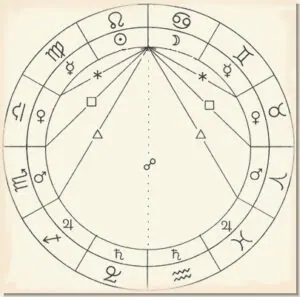
The exaltations are derived as follows. Here too we begin with the luminaries, but whereas the domiciles take the summer tropic as their point of reference, the exaltations begin with the vernal equinox at 0° Aries. This is why Aries is assigned as the Sun’s exaltation: beyond this cosmic point, the days grow longer and the Sun begins its passage towards the masculine, northern and upper semicircle of heaven. In Libra the reverse occurs, so, by analogy with the domicile relationships, Libra becomes the sign of Saturn’s exaltation—recall the opposition between their domiciles—because this planet stands at the opposite end from the Sun. The Moon receives Taurus because, starting from Aries, where the Sun is exalted, the Moon increases in light and apparent fullness and weight in Taurus, following its conjunction with the Sun in the preceding sign. If the New Moon is placed at 0° Aries, Taurus is the middle sign of its first phase. The signs of the luminaries’ exaltations serve as the zodiacal starting points for those of the other planets. Mars, the first planet beyond the Sun in the outer circuit, is exalted in Capricorn, which stands 90° from the Sun’s exaltation. Jupiter, above the sphere of Mars, has its exaltation in Cancer, likewise 90° from the Sun’s exaltation and 180° from that of Mars, its neighbour in the Chaldean order. Saturn, which I have already discussed, stands 90° from both planets of the outer circuit, Mars and Jupiter: Libra in relation to Capricorn and Cancer. You will readily notice that the exaltation signs of the outer planetary sector, from Saturn to the Sun, are the four cardinal signs. They mark the four celestial “cardines” I have mentioned elsewhere, through which the planets’ antiscia and contra-antiscia are established, together with the two equinoxes and two tropics. The exaltations of the two planets in the inner, lunar sector are derived as follows. Venus receives Pisces because it lies 60° from the Moon’s domicile—Venus belongs to the lunar sector—while Mercury, the only planet remaining, receives the sign directly opposite Venus, just as Mars is exalted 180° from its neighbour Jupiter. Venus and Mercury occupy corresponding positions in the order to Mars and Jupiter, which is why Virgo, rather than Gemini, is both Mercury’s domicile and its exaltation. The precise, numbered degrees of these exaltations are believed to have been revealed and are accepted as an unquestioned rule. Unlike the exaltation signs, no material evidence survives to establish an astronomical derivation for these degrees.
These are the principal zodiacal dignities, which the Greeks explained through celestial geometry. Independently of this, Hermeticism places the account of the exaltations within the tradition of a transcendent, timeless astrology reflecting the principles of perfect humanity before Adam’s Fall. This is something I mentioned a long time ago. Here, planetary exaltations can be approached only from the perspective of belief. The ancient sages—astrologers practising long before Ptolemy’s time—said that astrology was an art given to humanity through revelation in ancient Babylon, around 3000 BC. As such, astrology, or at least its fundamental principles, cannot be the product of human experience, but must derive from ontological foundations given to humanity, which humanity cannot alter. Zodiacal exaltations are one of three things, alongside the seven lots of wisdom and the mundane planetary joys, believed to have belonged to so-called angelic astrology: the astrology that existed before the Fall of Man. Indeed, the exaltations are believed to represent the places occupied by the planets before the fall into matter. For this reason, the astrology we have known since the earliest days of civilisation is not entirely identical to its original form. Hence the belief that an exalted planet represents an overstated and somewhat unreal quality, unlike domicile dignity, which fits perfectly into the scheme of the traditional cosmos—but a scheme that has existed only since the moral Fall. The reason is that the qualities symbolised by planets in these positions cannot attain perfect expression in this world. It is therefore difficult to find a governing rule that would ground the exaltations neatly in a logical, comprehensible scheme such as that of domiciles, triplicities or faces, the lowest zodiacal dignities. The apparently arbitrary numbered degrees of exaltation support this view: the twenty-seventh degree of Pisces for Venus, for instance, or the third degree of Taurus for the Moon. No one understands why these particular degrees should have been chosen; according to tradition, however, they are the exact zodiacal positions occupied by the planets before the Fall of Man. Ptolemy, a Greek of the Hellenistic period, found these premises difficult to understand and made fundamental errors by confusing the principles of human, earthly astrology with those of the astrology of the paradisal age. Quite apart from this, he was not himself an astrologer but an encyclopaedist, a sort of broadly educated jack-of-all-trades of his day, so it is hardly surprising that the astrology he promoted was so doctrinally impoverished. Nevertheless, I think the exaltation degrees have some connection with the more important stars of the zodiacal constellations. It is difficult to establish precisely which ones, however, given that this sphere moves by about one degree of arc every seventy-two years. An answer to this question remains to be found.
Triplicities and bounds are subordinate to these points of reference, whose importance I often emphasise through the primacy of the solar tropics. The need for triplicities to accord with domiciles and exaltations is precisely why Ptolemy rejects the third, participating ruler of the elements inherited from the earlier tradition. This is very easy to understand, and very “natural”, as Ptolemy’s astrological reasoning is so often described. The first two triplicity rulers derive from domicile or exaltation rulership—that is, from the tropical and equinoctial starting points. The third is an elemental interloper in the first classification, but “of the same kind” in the second, daily classification, in which a single day is symbolically linked to the year. This brings us to the two sects, day and night. What matters here is that the daily classification is subordinate, not superior, to the annual one. More precisely, domiciles, corresponding to the tropics, and exaltations, corresponding to the equinoxes, take precedence over sect. This is what Ptolemy is discussing. According to him, fire is ruled by the Sun and Jupiter because the Sun both rules a fire sign and is exalted in a fire sign, while Jupiter rules the third fire sign. Saturn is excluded because it has neither of the two major dignities in the fire element. Earth is ruled by Venus and the Moon because these planets share the first two dignities in the first earth sign. Mars is excluded because, despite its exaltation in an earth sign, it is assigned the higher rulership of domicile in a water sign. Air belongs to Saturn and Mercury by the same principle: Saturn rules one sign and is exalted in another, while Mercury rules the first sign of the element. Finally, Mars alone remains, with absolute dominion over water, the remaining element, which belongs to it according to the first point of reference for the distribution, the tropics—that is, the domiciles. Mars is lord of Scorpio and thereby gains authority over its element. Ptolemy’s logic is one of impeccable hierarchy. Although sect has its own internal justification, the subject matter of astrology was classified from the general to the particular, so the general became the supreme point of reference for the particular. Authors before Ptolemy were guided by a principle of “balancing” at every level of the subject. Saturn was thus “shoehorned” into fire, with which it has no primary connection in manifestation, although it does have a tertiary, so-called daily connection. One modern interpreter of ancient astrology observed that the very term “participating” means precisely what Ptolemy had recognised: that threefold rulership over the elements places a derivative level on an equal footing with the primary level of the subject. In this interpreter’s view, this relates to certain rites of the ancient mysteries whose essence revolved around the symbolic union of Heaven and Earth, the so-called restoration to wholeness and destruction of manifestation.
Participation can be understood as an act intended to reconcile opposites. This is precisely what the third ruler of an element represents: the manifest opposite of the element to which it has been assigned, but to which it does not belong in its own right. While this makes perfect sense within a religious framework, it makes none in secular astrology, because manifestation is nothing other than polarisation and differentiation; Saturn in fire is therefore “outside the realm of possibility”. This is what lies behind the ancient tradition Ptolemy “abandoned”. Yet one thing is forgotten in this connection: we have always been dealing with two astrologies, the mystical and the secular. Ptolemy spoke exclusively of the latter, while other authors blended the two in a way that is profoundly obscure to a reader without sufficient knowledge. I suspect that astrology’s esoteric side will receive more attention as forgotten truths are rediscovered in the future. It also follows that modern interpreters of traditional astrology—or, more precisely, some of them—have insufficient knowledge of the Hermetic astrological tradition that predates Ptolemy, preserved in sources concerned with alchemy and magic rather than astrology as such. The word “participating” itself derives from the Latin participatio, originally meaning participation in a solemn ceremony or ritual. Its etymology suggests new lines of enquiry leading towards Hermetic and mystical rites and religion. Here we return to the idea of two astrologies: the secular, openly accessible one, and its mystical, occult sister, which, unlike the first, is not equally accessible to everyone. This mystical sister is more directly connected with the great Hermetic triad it forms alongside alchemy and theurgy. In discussing the zodiac’s threefold division, Ptolemy grounds it in the geometry of the equinoctial and tropical circle, thereby emphasising the primacy of domiciles and exaltations in determining the planets’ places within the elemental division. He calls these divisions trigons and associates them with the cardinal directions, or, more specifically, with air currents. Fire is masculine and rules the north in this division, because north is the masculine, upper principle, and the element begins with the Sun’s springtime, northward turn. Yet Mars is also considered tangentially in connection with this element: Ptolemy says that, besides the north winds, this trigon rules the south-westerly winds under the dominion of Mars, which alone rules water, the element governing the west. In the division of directions, north and east are masculine, west and south feminine. Accordingly, fire and air rule the masculine directions, water and earth the feminine. The second trigon belongs to earth, the Moon and Venus, as already stated. Its direction is south, but because one of Saturn’s domiciles falls within this element, the south-east also participates in it. These divisions show us that Ptolemy does, in fact, recognise participating rulers, but in a different way. Mars participates in fire according to the primary logic of domiciles, and Saturn in earth. Air is masculine, ruled by Saturn and Mercury. Its direction is east, but because of Jupiter’s involvement in the domicile distribution, the north-east also participates. Water is feminine and western, under the dominion of Mars, but with the participation of the Moon and Venus, which is why the south-west also belongs to this element. This is simple and impeccable reasoning derived from domiciles, not daily sects—not because sect lacks justification, but because it is tertiary in the classification of astrological subject matter. The extent to which these implicit third rulers of Ptolemy’s triplicities come into play is determined by sect, but with a qualification. Wherever sect does not fit the domicile-based, tropical point of reference, the argument turns back to domicile. One example is his discussion of Mars in relation to fire: he excludes Mars because it does not belong to the diurnal, solar sector, yet keeps it close to the element itself by assigning the south-west equally to fire and water.
Ptolemy’s triplicities are as follows
FIRE / diurnal: Sun; nocturnal: Jupiter (implicit participant: Mars) EARTH / diurnal: Venus; nocturnal: Moon (implicit participant: Saturn) AIR / diurnal: Saturn; nocturnal: Mercury (implicit participant: Jupiter) WATER / diurnal: Mars; nocturnal: Mars (implicit participants: Venus and the Moon)
Author: Nataša Karalić Koprivica