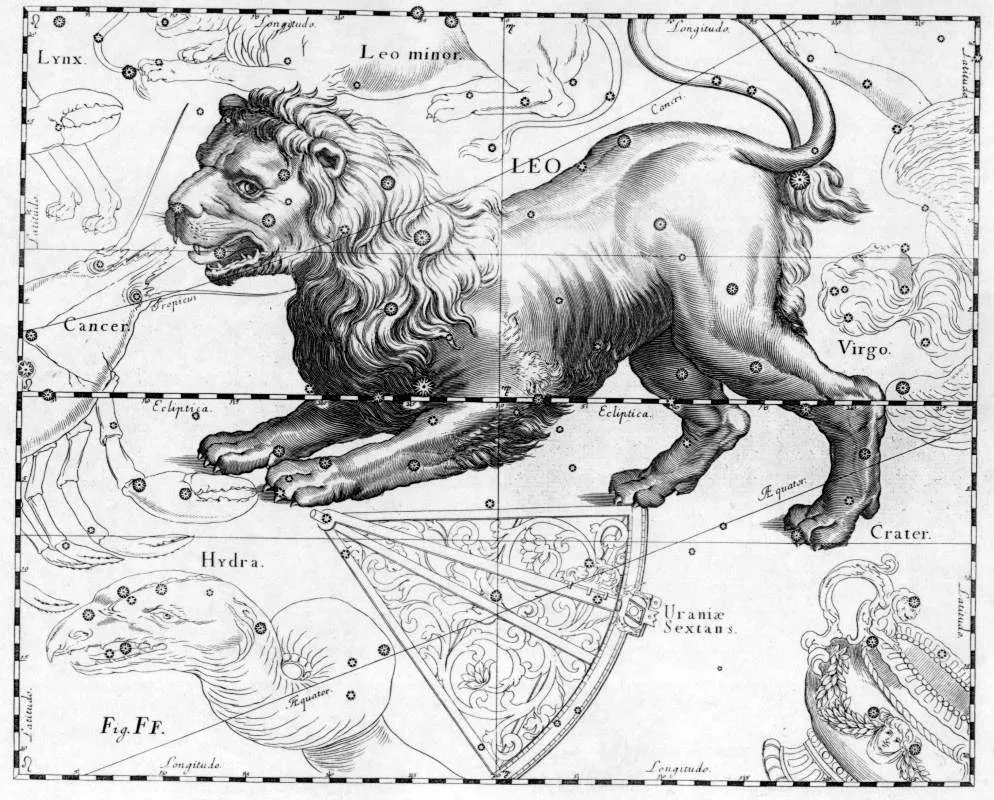
In the constellation Leo, at 21° 38’ Virgo. A blue star in the Lion’s tail. Its name derives from A-Danabul-Asad, meaning “the Lion’s tail”, or, according to Bullinger, “the Judge” or “the Lord who shall come”. It is often shortened to Deneb and appears in this form in most astrological works, although that name properly belongs to another star.
Influence: Ptolemy assigns it the nature of Saturn and Venus; Wilson and Pearce give Saturn, Venus and Mercury; Simmonite, Uranus; and Alvidas, Mercury, Uranus and Mars. Although it can bring generosity, nobility and a rise to fame, this star does not share the more fortunate influence of Regulus, and public advancement is very often followed by disgrace and eventual ruin. It certainly seems to confer swift judgement, despair, regret, public disgrace, misfortune through natural causes, and happiness turning to anger. It makes those born under its influence noble, daring, self-confident, generous and preoccupied with other people’s affairs. According to Ebertin, the “Lion’s Tail” has a Uranian nature and is considered a trigger of major catastrophes in mundane charts. Depending on its position and aspects to other celestial bodies in the individual cosmogram, it brings either elevation or a fall. On the Ascendant, especially in conjunction with Mercury, Denebola is associated with a quarrelsome disposition and a penchant for litigation. It may also be responsible for highly dramatic events. When poorly placed in the chart, with Mercury or Uranus, it indicates mental illness, usually of an incurable kind. Favourable aspects, however, bring further advancement in work concerned with reform and progress. It is a bringer of change, though not always welcome or easy change. In a less favourable configuration, it signifies ruin. Assassination is a possibility. Only when exceptionally well placed does Denebola bring sudden advancement. In combination with the Ascendant and/or a favourably placed Mercury, it indicates a knowledge of several languages.
Denebola seems to take on the symbolism of the Nemean Lion. Just as the Nemean Lion probably symbolises goddess worship still practised in rural areas, this star suggests, to some degree, someone who is “out of step”, outside the mainstream, living on the margins. Denebola was culminating as the Sun rose on the day George Eliot was born. A nineteenth-century British writer, she wrote under a male pseudonym and defied every convention by choosing to live with a married man for many years. Leonardo da Vinci had Mercury rising just as Denebola was setting. Leonardo invented a flying machine four hundred years before the Wright brothers and is remembered in history, with Denebola on the Descendant, as a man whose ideas, represented by Mercury, were far ahead of his time. Another example is Henri de Toulouse-Lautrec, the celebrated nineteenth-century French artist, who had Mars culminating as Denebola rose. In his case, the star’s energy found expression through Mars early in life. As a child, he suffered two separate accidents in which he fractured first one thighbone and then the other. These accidents left him disabled, and he devoted his life to art, becoming known for his observations and portrayals of Parisian society. His childhood injuries condemned him to the role of an outsider, observing the wealthy, flamboyant people of his day. Denebola introduces an element of nonconformity, a different way of seeing the world. This can yield very good results and lead to great success, but that success will generally come on the fringes of the establishment, out of step with the prevailing spirit of the age. Alternatively, its expression can be very negative: an unwillingness to entertain the views of the wider community may foster dictatorial attitudes. More simply, you may find that your opinions differ markedly from those of others, causing frustration. Recognising this and listening to other opinions can be helpful, not necessarily to change your mind, but simply to allow you to understand other points of view.
On the Ascendant: wealth, high office and good fortune, accompanied by many dangers and anxieties arising from one’s own folly; prosperity that seldom lasts, troubles and illness. With the Sun: fame and position, attended by danger, public disgrace and eventual ruin; infections, fevers and acute illnesses; suicide. With the Moon: fame and advancement among the common people, ending in disgrace and downfall; serious disease of a vital organ, blindness and eye injuries, accidents, losses through servants, domestic quarrels and occasional separation from the spouse. If Saturn and Mars are also with Algol, death comes by judicial sentence. With Mercury: many losses through agents, servants or writing; unfavourable for earnings; the loss of a family member through an infectious or malignant disease. With Venus: intense passions, going astray early in life, ruin through love affairs. With Jupiter: pride, hypocrisy, a life of disappointment, troubles abroad or through relatives, secret enemies, danger of arrest or a death sentence. With Saturn: a critical disposition and constant complaining, many enemies, losses through servants or thieves, an unhappy life, sorrow in the home, a despondent wife, and children who are mentally ill or physically deformed. With Uranus: susceptibility to seizures, idiocy, insanity and sometimes violence; impulsiveness and malice; the possibility of committing murder in a fit of madness, confinement in an asylum, often suicide. With Neptune: a quick temper, perceptiveness, intelligence, sarcasm, bitter speech, domestic quarrels, accidents and illnesses in childhood, death in middle age through an accident or prolonged illness.