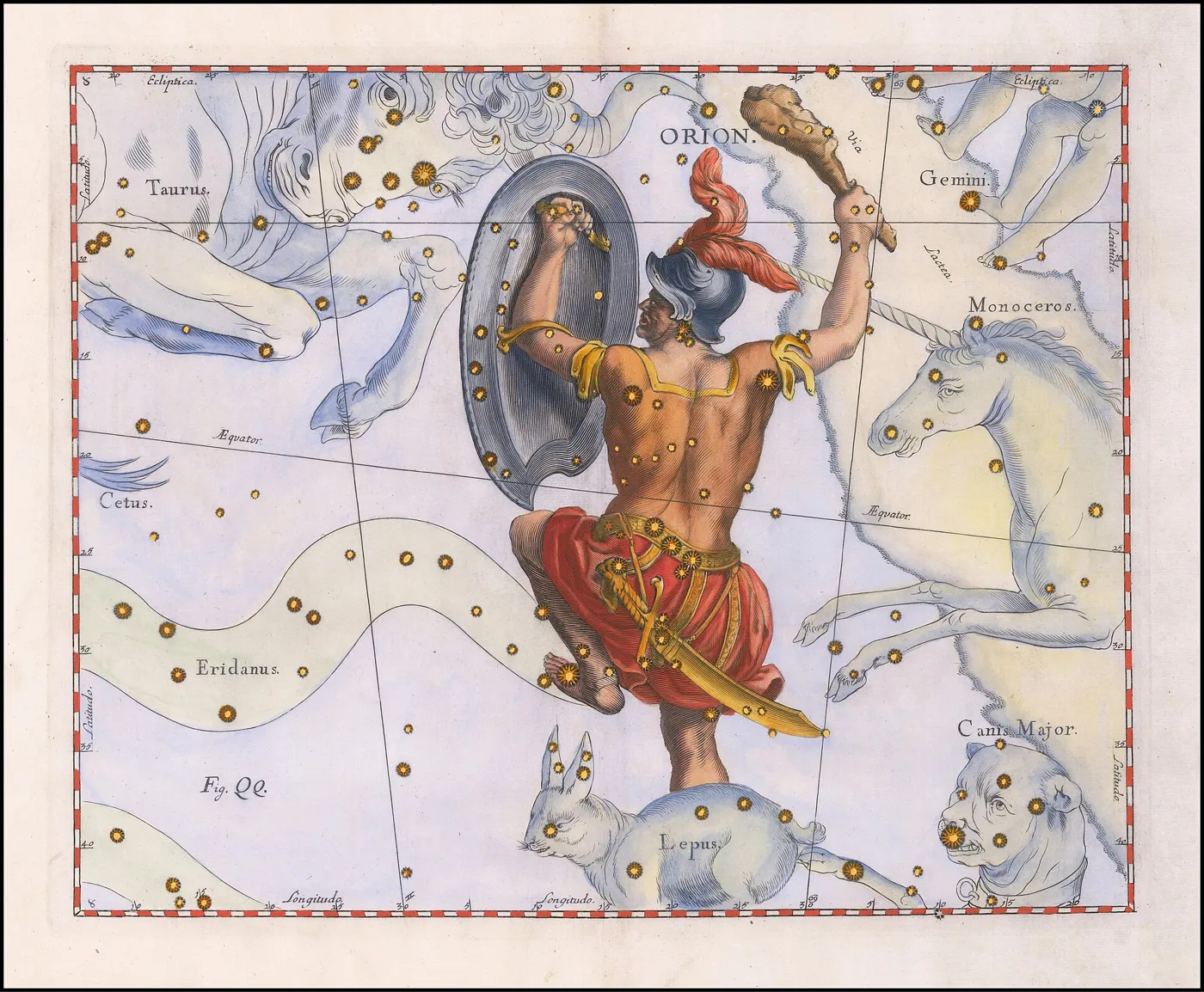
Betelgeuse is the familiar bright red star in Orion’s shoulder. It currently lies at 28° 45’ Gemini. The name Betelgeuse derives from the Arabic “yad al jauza”, meaning “the hand of al-Jauza”. To the ancient Arabs, al-Jauza referred to “the Central One”, a mysterious woman. To us, it marks the right shoulder of Orion, the warrior of ancient Greek mythology. According to the biblical scholar E. W. Bullinger, it means “the coming of the branch/shoot”. [1] Betelgeuse is also known as the fiery star, the royal jewel and the lotus flower of the Cosmos; its name also evokes a magical radiance with deep crimson tones.
Betelgeuse is the second-brightest star in the constellation Orion and the tenth-brightest in the entire sky. It belongs to the supergiant class and is one of the largest known stars. According to the latest measurements, this red supergiant is almost 1,000 times larger and around 100,000 times more luminous than our Sun. Betelgeuse is estimated to be several million years old, and its present characteristics suggest that it will soon “die”, most likely in a supernova explosion. This imminent possibility has made Betelgeuse a major topic of discussion among astronomers for some time. As a supernova, it is said that it could become only slightly less bright than the full Moon, and certainly brighter than Venus, remaining so for about a year. This brilliant, reddish giant, visible in winter from almost every part of the world, could explode as a supernova as early as tomorrow, or at any point in the next 100,000 years—a mere blink of an eye in the immensity of cosmic time. The resulting explosion will be tens of millions of times more luminous than the Sun, which some accounts describe as bringing round-the-clock daylight to Earth, although the star is probably too distant for such a phenomenon. Naturally, the explosion would certainly be an exceptionally fascinating event, especially for astronomers. Two exceptionally bright supernovae have been recorded in the past thousand years: one in 1006 and another in 1054.
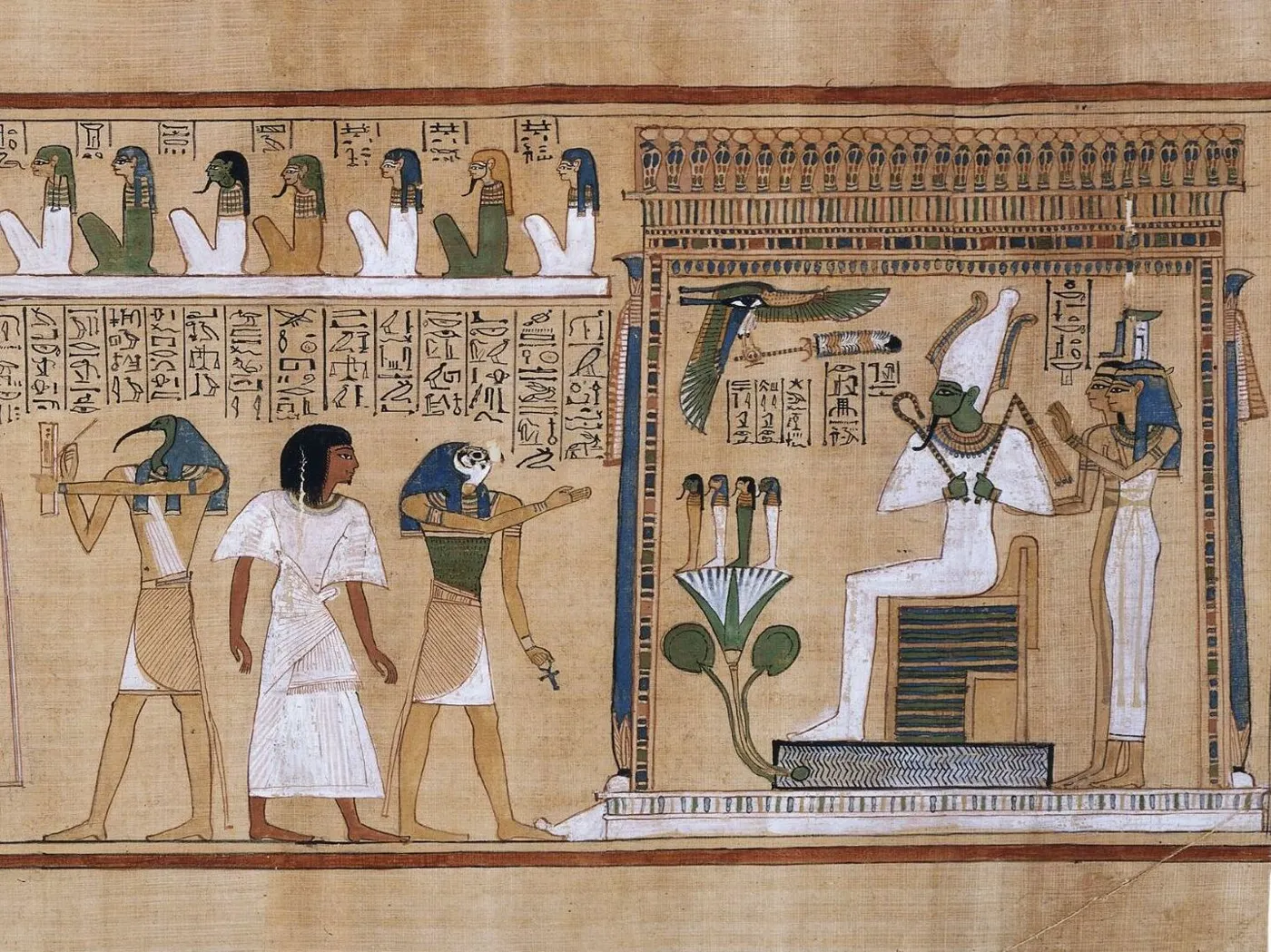
Orion, the constellation to which this star belongs, is probably one of the easiest to recognise in the sky, with the three stars in a row forming Orion’s belt and sapphire-blue Rigel at his foot. This grouping has fascinated skywatchers for millennia. To the Egyptians, Orion was Osiris, the greatest of all gods. The Greeks, however, reduced his status to that of the arrogant companion of his opposite, Artemis. Legend has it that the virgin goddess of the hunt grew increasingly irritated by Orion’s constant boasting that he could hunt down any animal on Earth, and decided to bring him down. She sent a scorpion to sting him in the foot, which blinded him. Betelgeuse appears to have escaped much of the ill fortune that Artemis’s hostility brought upon this constellation, though, as the research will show, this is not always the case. Betelgeuse is a rather unstable star, yet it seems to show us that Orion has the capacity to rise again after a fall.
Astrological influence: Ptolemy states that all the stars in or near Orion’s shoulder are of the nature of Mars and Mercury, and this therefore applies to Betelgeuse, while Alvidas assigns it a favourable aspect between Mercury, Saturn and Jupiter. Robson associates these stars with martial glory and authority, while Ebertin speaks of good fortune, success and lasting fame. Rigor agrees, but adds impetuousness and changeability.
William Lilly remarks that when this star is with the Sun, Moon or Jupiter in the tenth house, it promises “ample fortune and great honour”; of the direction of the MC to Betelgeuse, he says that the native will then be:
Wholly inclined and devoted to military affairs, with such excellent dexterity, judgement and skill in contrivance, that many eminent commanders shall take notice of him. By these means he shall be advanced to high preferment among soldiers and men of understanding, by whom he shall be greatly esteemed. It inclines the native to devise curious engines for war, and likewise for any other purpose.
Betelgeuse is one of the bright stars in the heavens, and its influence generally brings great success without many complications. It lies in the god’s right arm, or shoulder, suggesting something pure and strong. Together with the other stars of this constellation, Betelgeuse is an indicator of fame or success in the natal chart. Whether the recognition is local or worldwide, a person under its influence makes an impact, and is brilliant and successful. Victory and enduring fame. Brilliant, gifted athletes. A herald of wealth. When poorly placed, danger from lightning and the possibility of murder. This star, together with Polaris, represents New York, and it is interesting that on 11 September 2001 the Moon was on Betelgeuse at the moment the first aircraft struck during the terrorist attacks.
Because Betelgeuse is so powerful, it is one of the few stars whose changes in expression can be clearly discerned according to the angle it occupies.
At the Nadir: Any star at the Nadir suggests that its influence will be less immediately apparent, becoming more visible in old age or after death. Abraham Lincoln and Martin Luther King both had Betelgeuse in this position. Lincoln had Jupiter on the Ascendant and Betelgeuse on the IC, so although he enjoyed success during his lifetime, Betelgeuse emphasised his posthumous fame. The same applies to King, who had the Moon on the Ascendant: despite his successful life, it was his death that secured his immortality.
On the Ascendant: In this position, Betelgeuse brings success relatively early in life and can sometimes indicate a “child prodigy”. A good example is James Dean, who had Betelgeuse on the Ascendant together with Jupiter, enabling his rapid rise as an actor.
On the Descendant: In this position, Betelgeuse brings fame somewhat later in life. William Blake also had the Sun here, on Betelgeuse. He was a great artist, yet had to work as an engraver to earn his living. His name came to be held in high esteem only later in life and after his death.
At the Zenith of the chart: Here, Betelgeuse brings fame and success in middle life and defines how we will be remembered. Charles Dickens also had Jupiter here, indicating that he would achieve considerable success during his lifetime and that his work would outlive him. It also brings exceptional military fortune, leadership, inventiveness, insight and assistance in attaining mastery of the arts and sciences. If it is also with the Sun, Moon or Jupiter, it promises immense good fortune and great honours.
This star therefore signifies the possibility of success in life and the creation of a great body of work that may outlive its creator. Naturally, not everyone with a prominent Betelgeuse will attain such fame, since much depends on other conditions, but it will certainly indicate the potential. What has been borne out in practice is that a planet in contact with Betelgeuse by conjunction describes talents or abilities you possess that can bring you joy, success or even fame. This may be something as simple as a loving relationship when Venus or the Moon is involved, in which case Betelgeuse brings great emotional happiness. Whatever this star touches, it yields positive results. The following delineations describe the influence of Betelgeuse when in contact with the planets:
With the Sun: Interest and ability in occult and mystical pursuits, acute illnesses, fevers; fame and high position ultimately end in ruin. With the Moon: An active mind, strong will, turbulence, a rebellious spirit concealed beneath restraint, military success but suffering through disputes with superiors; the possibility of attaining great power, honours and prosperity. With Mercury: Seriousness, studiousness, an inclination towards science and literature; unfavourable for financial gain, fame through writing or engraving on metal, favourable for health but with a susceptibility to accidents. With Venus: Some shyness and reserve, an exceptional gift for making fine jewellery, favourable for financial gain, some sorrow connected with family or marriage. With Mars: Caution, restraint, a good leader and organiser, honour and high rank in military affairs. With Jupiter: A serious and studious mind, involvement in dangerous but profitable ventures, great honours in the Church or in law. With Saturn: Shrewdness, craftiness, cunning dishonesty, betrayal of friends, an eventful life with many ups and downs, eventual wealth but little luxury, unfavourable for family matters. With Uranus: A quick, active and malicious mind, a shrewd criminal, widely known as a swindler and forger but seldom caught, a thoroughly pleasant manner, generosity and a kind heart, hypnotic powers and the ability to read minds. With Neptune: Perceptiveness, mechanical ability, the possibility of inventing a mechanical device, an interest in spiritualism, some physical illness or suffering, mental disorders, unfavourable for financial gain, greatest success through partnership, favourable for marriage and children but discord with siblings, susceptibility to a serious or fatal accident in mature years.
According to Dupor, on the Ascendant it brings wealth through overseas connections or sport; with Jupiter, advancement when connected with the Zenith, and fame; with Mars, a formidable soldier, especially near the Ascendant, but in the eighth house it gives death by fire, firearms or lightning.