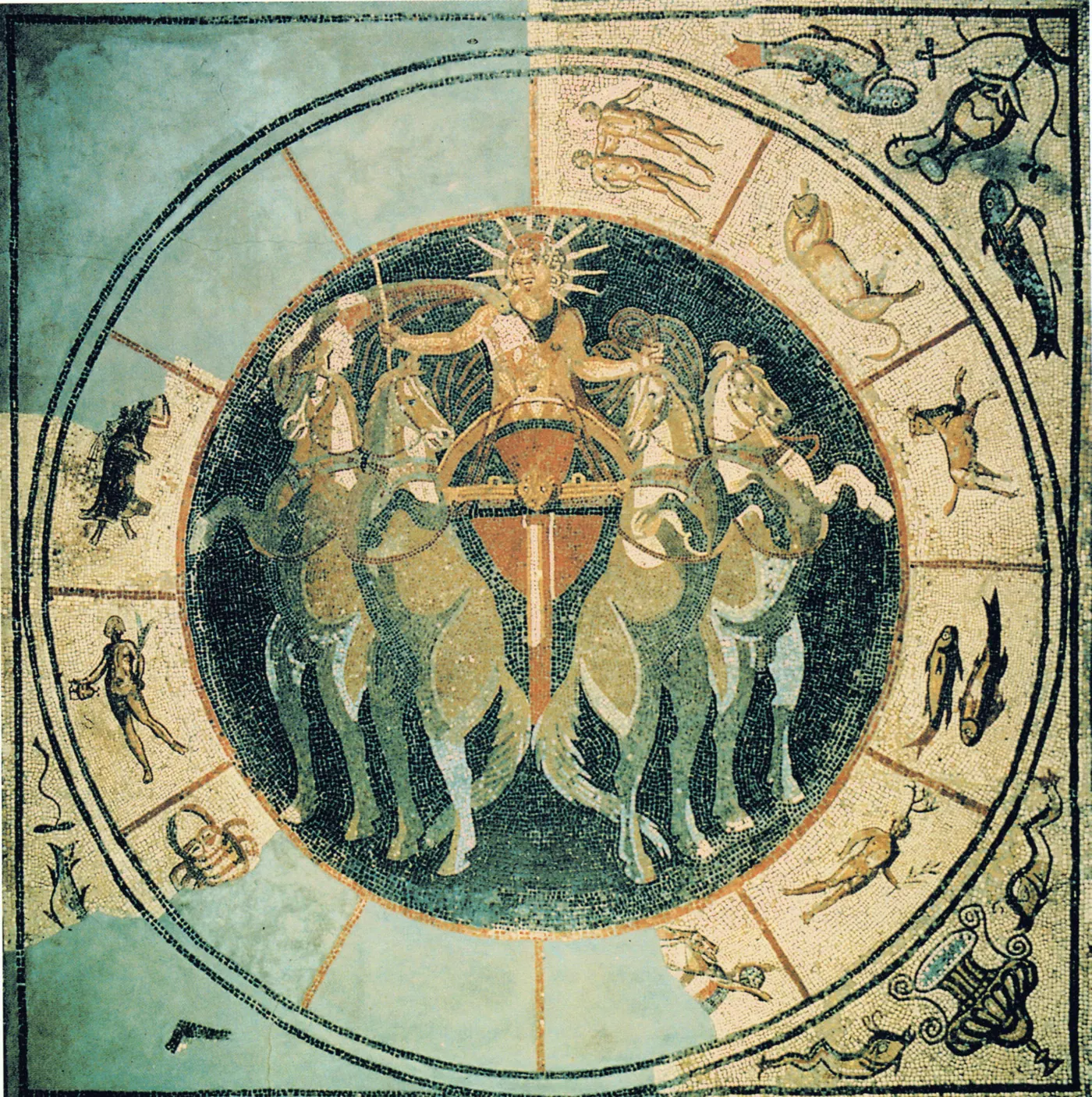
If you come to know that you too are made of light and life, you will return to light and life. (Poimandres, Corpus Hermeticum)
In antiquity, astrology was so closely interwoven with Hellenistic thought and the so-called “Oriental religions” that its symbolism seems to have been, if not the very foundation of contemporary worldviews, then certainly the thread connecting them. The practice of what we now call astrology was itself a product of that time and place—of the Alexandrian sages, as we saw in an earlier article. Yet we shall begin our survey of astrology in the Roman Empire with its “theoretical” dimension: not charts and techniques, astrologers and their clients, but astrological symbols. Notions of planets as deities, and of gods as planets, ideas of celestial influences and fateful stars, were woven into ancient culture and literature, popular beliefs, lofty philosophy and the religious movements of the age.
The ancient Greek philosophers already regarded the planets as divine beings; Pythagoras held that they were moved by an ethereal soul akin to the human soul, while for Plato they were the younger, or visible, gods who exercised the authority of the highest God. Even the rational Aristotle considered their nature divine. Another widely accepted idea was that the human soul shared the nature of the divine and celestial, and originated among the stars. Heraclitus taught that the soul was of the same nature as aether, the soul of the universe, while Plato held that human souls came from the stars and descended to earth through the planetary spheres, leaving the divine behind and taking on the fate allotted to them by the three Fates. Such ideas were not confined to the heights of philosophy; the official epitaph commemorating the Athenians who fell in battle in 432 BC tells us that “aether received the souls of these heroes, as the earth received their bodies.”
The return of the human soul to the stars from which it originated, rather than other widespread visions of the afterlife, such as descent into Hades or reincarnation, was also embraced by the great Cicero in his “Dream of Scipio”. In this visionary journey into the heavens, Scipio the Elder, the conqueror of Carthage, shows the earth from afar to his grandson, Scipio the Younger, pointing out that all earthly “glory” is utterly insignificant from a celestial perspective. He also teaches him that all who faithfully serve their homeland will, after death, receive their rightful place in heaven. Although this “return” to the stars was initially reserved for rulers, and later extended to virtuous people who had earned it, such as statesmen and courageous warriors, by the first century BC the belief had spread that not only heroic souls but also less distinguished ones returned to the stars. (We find a similar development in Egyptian religion, where the Book of the Dead, a collection of magical formulae intended to secure an afterlife, was initially reserved for the highest caste.) One such epitaph reads: “In this tomb lies a young maiden, an anthophoros of Ceres [a bearer of flowers], carried away by the pitiless Fates. Yet by the will of the Immortals her soul dwells among the stars, having taken its place in the company of the blessed.”
The ideas that the human soul originated among the stars and returned home after death by passing through the planetary spheres also found a place in the spiritual traditions of the age: Hermeticism, Gnosticism, Platonism, the Chaldean Oracles and the cult of Mithras. In certain respects, these philosophical and religious currents were closely interwoven. As a path of knowledge rather than faith, Hermeticism is essentially Gnostic in nature, while the cult of Mithras is ritualised Platonism—Platonism put into ritual practice. The Chaldean Oracles, meanwhile, the so-called “Bible of the Platonists”, appear closely connected with at least one strand of Mithraism—and all are steeped in astrological symbolism.
Hermeticism
In Poimandres, the first text of the Corpus Hermeticum, a fifth-century compilation of Hermetic writings, we read*:
The first mind, Nous, being both male and female, life and light, brought forth through the Word a second mind, the creator of the world [the Demiurge]. And this second mind, being of fire and air, fashioned seven rulers whose orbits encompass the sensible world. Their government is called fate (heimarmene).
(On the journey back)
Then the human being ascends through the harmony of the spheres. To the first sphere he surrenders the power of increase and decrease (the Moon); to the second, wicked deceit (Mercury); to the third, lust (Venus); to the fourth, domineering arrogance (the Sun); to the fifth, rashness and impetuosity (Mars); to the sixth, the evil pursuit of riches (Jupiter); and to the seventh sphere, malicious falsehood (Saturn)—all now deprived of their power.
Assigning “sins” to the planetary spheres, or to the planets themselves, was common in the early centuries AD. Such lists varied, however, and there was no consensus as to which sin belonged to which planet. It was generally believed that, during its descent to earth from the highest and most divine planetary sphere, Saturn’s, to the lowest, the Moon’s, the soul acquired particular functions from the planets. On its return, it surrendered these precursors of the “seven deadly sins”. Macrobius, for example, says that the soul receives reason and understanding from Saturn, the capacity for action from Jupiter, boldness of spirit from Mars, sensory perception and imagination from the Sun, passion and desire from Venus, the power of expression from Mercury, and the capacity to shape and grow the body from the Moon. These faculties and functions, the “astral bodies” in which the soul clothes itself during its descent, would be reflected in the natal chart**.**
But let us return to the Hermetic writings. When the Nag Hammadi library was discovered in 1945, among its other “Gnostic” writings was a previously unknown Hermetic text, subsequently entitled **“The Discourse on the Eighth and Ninth [Spheres]”**. Towards the end of the text, after imparting knowledge of the higher spheres to his “son” and leading him on a visionary journey through the realms beyond Saturn, the seventh sphere, Hermes instructs him to record this teaching on turquoise tablets so that it may be preserved. He tells him to inscribe an oath on the tablets as well, lest the teaching fall into the hands of those who would use it for purposes other than its intended one: the struggle against fate (heimarmene).
Hermes says: Set a square milk-white stone as the base for these tablets, and inscribe the name in hieroglyphs upon the azure tablet. My son, do this when I am in Virgo, when the Sun is in the first half of the day and fifteen degrees have passed by me.
Hermes’ teaching on the higher spheres was to be recorded at a time favourable according to Hermetic principles—that is, the principles of electional astrology. And what time could be more favourable than when Mercury (Hermes) occupies the degree of his exaltation, 15° Virgo? In traditional astrology, Mercury is especially strong there, since Virgo is not only the sign of his exaltation but also his domicile.
Alongside religious and philosophical writings such as those collected in the Corpus Hermeticum, magical, alchemical and technical astrological texts were also attributed to Hermes, among them the Liber Hermetis. This is also one of the oldest astrological manuals available to us today. It contains what is sometimes called “pagan astrology”: astrological material not yet influenced by Christian ideas, which entered astrology later.
In the sixteenth tractate of the Corpus Hermeticum, “Asclepius to King Ammon”, we learn that each star was assigned a daemon, and that the daemon “on duty” at the time of a person’s birth would have authority over them:
14- All these daemons have been given authority over the earth, and it is they who bring disorder to countries, to nations and to individual lives. They fashion our souls in the likeness of their own and set them in motion, dwelling within our muscles, marrow, veins and arteries, even our brains, and reaching into our very entrails.
15- The daemons assigned to each star according to the worth [the merits] of each birth take possession of us at the moment we are born and draw breath. They never remain still, but move in circles, changing their positions from moment to moment. When these spirits descend through the body into the two parts of the soul, each disturbs it according to its own activity. Yet the rational part of the soul remains untouched by the dominion of these powers and is free to receive God.
16- When, through the Sun, the rational part of a person’s soul is illuminated by a ray of light—and such people are few—the daemons can no longer act upon it, for neither daemon nor deity can overcome a ray of the supreme God. All others, however, are governed from birth, in both soul and body, by the daemons whose activities they love. It is their thoughts that are deceived, their thoughts that lead them astray, not love. Thus, through our bodies, the daemons govern all things upon the earth, and this dominion Hermes called Fate (heimarmenē).
The belief that the heavens were inhabited by various beings or daemons was widespread at the time; Saint Paul likewise speaks of powers, thrones and dominions. (These angelic or daemonic “choirs” would later become subject to Christ and be incorporated into official Church doctrine.) Daemons were believed to influence human actions, or at least the lower parts of the human soul—the parts they themselves had fashioned. These celestial beings were identified with the planets, stars or zodiac, and were thought either to govern fate or to be the agents through whom it operated. Again, neither the Gnostics, the Hermeticists nor the Platonists agreed on whether the planets, or planetary daemons, were evil, neutral or benevolent beings, or whether “fate” was necessarily a negative phenomenon. For the early Stoics, fate (heimarmene) was a positive concept, virtually indistinguishable from pronoia, divine providence: a benevolent divine force acting upon humanity and guiding it. The Stoic cosmos was founded upon reason and, like the Platonic cosmos, was fundamentally “good”, which gave fate a positive meaning as well. Yet a later Platonic thinker, Numenius, held that the human soul became infected with sin as it descended to earth through the Tropic of Cancer. He associated the evil powers acting upon the soul’s incarnation—upon matter, or the body—with the planetary gods, and this “pessimistic” outlook influenced the ideas of Hermeticism and the Chaldean Oracles.
The so-called Middle Platonists attempted to divide “fate” into two levels: the higher, “positive” pronoia, or divine providence, and the lower fate governed by planetary powers and daemons, the fatalistic force that holds us captive—heimarmene. Thus, one of the principal tasks of Gnostics, Hermeticists and even the precursors of orthodox Christians was to free themselves from the influence of these daemons, archons and planetary powers—from fate. For although the human body and the lower parts of the soul are subject to daemons, planets and fate, which incite a person to sin, there is another part within: a divine spark capable of returning to its divine home.
The Gnostics
In the Secret Book of John, a Gnostic text also known as the Apocryphon of John, the archons were brought forth by Yaldabaoth, the Demiurge, who gave them authority over the seven spheres. The text lists their names, both male and female, and their physical forms, adding: “These are the seven of the week; these archons rule the world.”
(The Romans initially had an eight-day week, while the Hebrews had a seven-day week. The astrological week associated with chronocrators—the rulers of time—which we still use today was introduced in the late Republic and early Empire, and bears witness to astrology’s popularity.)
In the Gnostic text Pistis Sophia, Jesus tells his disciples how he placed souls from the higher spheres into their bodies—“twelve powers from the twelve saviours”—while the archons believed they were placing their own souls within them. In this way, the disciples were born without archontic souls. Jesus goes on to describe how, in a kind of body of light, he ascended to the second sphere, the sphere of heimarmene, or lower fate, where his appearance caused general turmoil. The archons became deeply frightened and disturbed: Jesus had dissolved the dominion of their fate and broken the bonds by which they held souls captive. In the next sphere, that of the “twelve aeons”, his appearance again caused unrest and terrified its rulers. He took away a third of their power and changed their course so that they faced right for six months and left for six months. At this, his disciple Mary asks whether those whom the fallen angels had taught the magic of the archons and the knowledge of fate would still be able to practise their arts. Jesus replies that they will no longer be able to perform evil magic as before, since he has taken away a third of their power, and that their horoscopes will be correct only half the time: “If the sphere of fate is turned to the left, all that they say will come to pass; but if it is turned to the right, they will be entirely mistaken, for I have changed their influences, their squares, their trines and their octagons.” A little later, Jesus says: “In the same way, if they invoke the names of the archons while these are turned to the left, they will answer truthfully whatever is asked of their decans”; but if they invoke them when they are turned to the right, “they will not tell them the truth, but will threaten and bewilder them.”
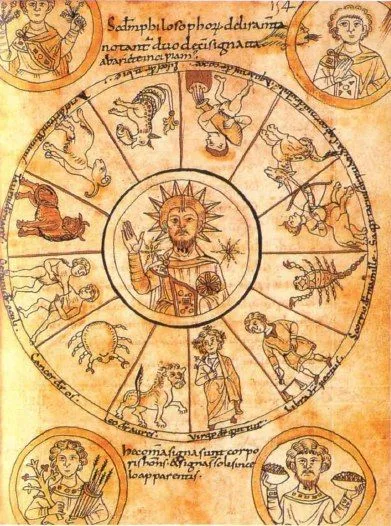
Whereas the Jesus of Pistis Sophia ascends into the heavens ruled by the archons, some other Gnostic texts present the reverse motif: a higher being, a saviour, descends into spheres that are lower than his own. In doing so, this saviour disrupts the rule of the archons, altering the courses of the planets and thus “destroying” fate as a force acting upon humanity. Such texts are more likely to mean the annulment of fate for those to whom they were addressed—a small circle of initiates—than the objective abolition of harmful planetary influences for all humanity, including “heretics” and “unbelievers”. The idea that the supreme deity delivers people from an evil fate also appears in the so-called Oriental religions, the cults of the early centuries AD. Egyptian gods bore the title “lords of fate”, while initiates of Serapis, Isis and Mithras likewise believed that their gods could annul their fate. One Greek magical papyrus, for example, contains a spell or prayer addressed to Serapis: “Preserve me from the influence of the stars”, while another reads: “Save me from my astrological fate.”
Some early Christians believed that the very act of baptism freed the soul from fate and from the dominion of the stars and planets. Thus the Gnostic teacher Theodotus confidently declares that “fate is real before baptism, but afterwards the astrologers are no longer right”. In other words, once a person receives the “Spirit” from above through baptism, their soul is no longer subject to the influence of the evil archons: the Christian acquires a new, pneumatic, or spiritual, body. The term “palingenesis”—rebirth—was used for baptism at the time. Christians of that period, both Gnostics and the “proto-orthodox”, seem to have understood the word literally, seeing baptism as a genuinely new birth, a new “geniture”, a new “nativity”. Among other things, baptism would therefore mark a new beginning, an initiation through which the Christian was no longer under the authority of their horoscope—that is, no longer subject to fate.
The Chaldean Oracles and the Cult of Mithras
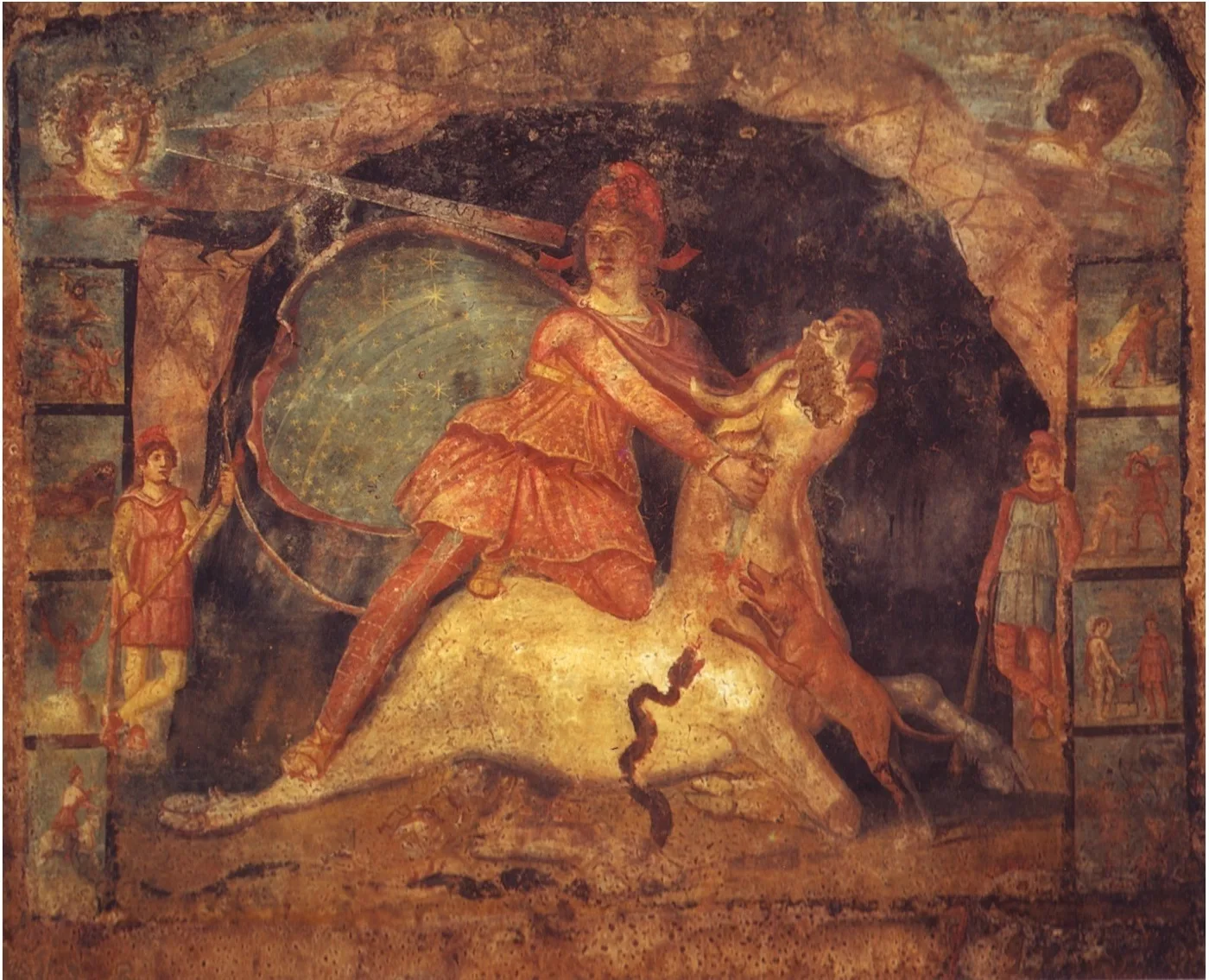
A third current of the early centuries AD steeped in astrological ideas was that of the Chaldean Oracles. These are a collection of verses preserved only in quotations in the works of their Neoplatonic commentators. They have often been called the “Neoplatonic Bible”, since the Neoplatonists of the fourth century AD regarded them as a revelation on a par with Plato’s Timaeus. Later critics called them the “dark underworld of Platonism”, considering them one of the irrational—in the pejorative sense—elements that became entangled with philosophy in late antiquity, for the Chaldean cosmos is populated by numerous daemons. The verses themselves were revealed to Julian the Chaldean and his son, Julian the Theurgist; the designation “Chaldean” was attached to the Oracles only later. From the Oracles we learn that daemons rule the sublunary realm—Nature, or the sphere of Nature—which is the domain of Heimarmene, while the Teletarchs assist the soul in its return to its source. (Unlike Gnostic and Hermetic thought, here the daemons occupy “our territory”, rather than inhabiting the higher, planetary spheres.) The Teletarch of Aether is identified with Helios, the mundane Sun, and the Teletarch of the Empyrean with Aion, the transmundane Sun.
We find similar ideas in Mithraism, specifically in the Mithras Liturgy, a text representing at least one strand of the cult. As in the Chaldean Oracles, in the Mithras Liturgy the soul ascends to heaven along the rays of the Sun, and the magician must inhale pneuma—spirit or breath—from them. According to the Liturgy, on his upward journey the magician encounters beings familiar from the Chaldean Oracles, with the difference that Aion is not the highest being here. In the Oracles, Helios was the mundane Sun and Aion the transcendent, higher Sun; in the Mithras Liturgy, however, the supreme and ultimate deity is Helios Mithras, while the lower solar being encountered by the magician is called Helios Aion.
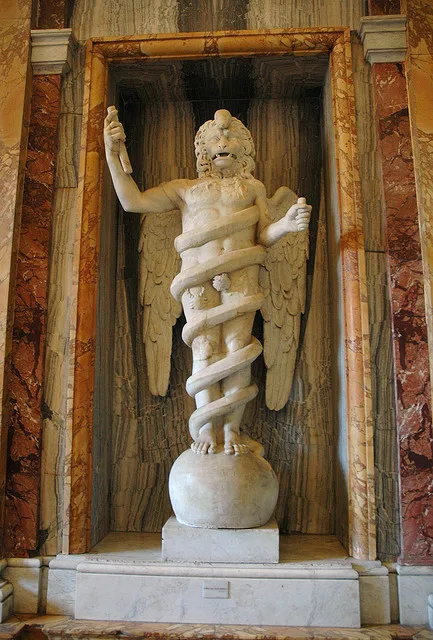
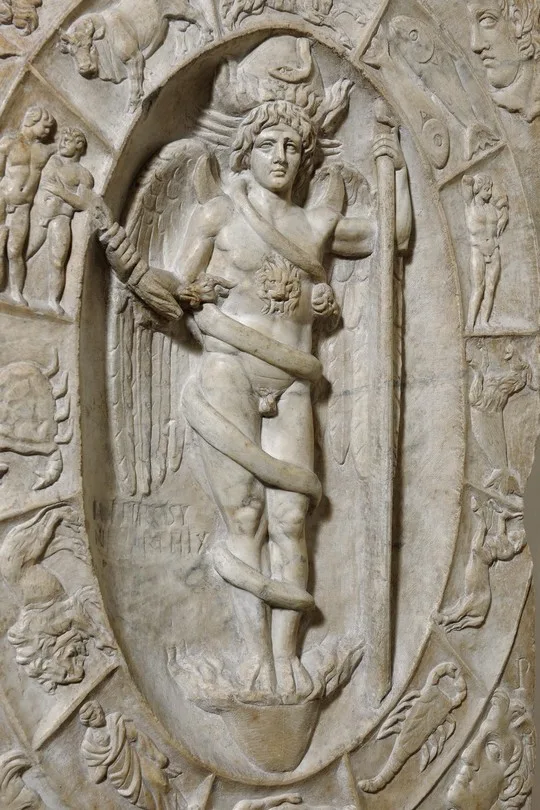
Mithras is an ancient Persian solar deity, but his cult in the Roman Empire contained more Platonic and Hermetic elements than Persian ones. The Roman cult of Mithras was therefore not identical to that of the Persian Mithra, guardian of contracts and oaths. In mithraea, the caves used for the cult’s rituals, we find depictions of other deities with whom Mithras was identified, or who were associated with his cult, or both. One example is the lion-headed Aion, shown on the left, who, like Mithras, was known in Egypt as a god of time. He was also associated with Saturn, who was likewise imagined as a serpent. Mithras was identified with other solar deities, including Apollo, Phaethon and Phanes, shown on the right, the Orphic deity representing boundless light. His relationship with Sol Invictus, the Unconquered Sun, is particularly intriguing—or confusing. Votive and other inscriptions address Mithras as Sol Invictus Mithras, Deus Sol Invictus Mithras, Deus Sol Mithras or Sol Mithras. Yet reliefs and paintings frequently depict the two together: although Mithras is Sol, the Sun, Sol is also his companion.
Beyond Mithras’ connection with the Sun, it is relevant to our subject that mithraea frequently contain depictions of the zodiac or the seven planetary gods. We also know that the cult had seven grades of initiation: Raven (Mercury), Bridegroom (Venus), Soldier (Mars), Lion (Jupiter), Persian (Moon), Sun-Runner (Sun) and Father (Saturn). Although Mithras is a solar deity, the highest grade was associated with Saturn, the nocturnal Sun and outermost sphere, while Ptolemy writes that the Persians worship Saturn under the name Helios Mithras.
Over time, the cult became extremely popular in the imperial army, where it flourished until Theodosius prohibited pagan worship altogether in 392. Sol Invictus, meanwhile, attained the status of an official state cult.
In the next instalment, we shall look at how Caesar and Octavian Augustus used astrological symbolism for political purposes, and how Sol Invictus became the supreme deity of the Empire.
Originally published on the Art of Astrology blog link